Out with the old
Sir — Gmail’s latest update will allow many users to breathe a sigh of relief. People often create their earliest email addresses in their teens. As a result, email ids include dramatic spellings of their names, pop idols, and other such favourites for added flair. Yet, cherished correspondence stop people from discarding those ids, which sit awkwardly on CVs and official forms in adulthood. Gmail is now allowing people to change that without losing emails and data. These quirky emails also hold memories of a time when life felt lighter and inboxes were filled with exciting missives rather than work emails. The only consolation is that a changed email address is as cosmetic as a renamed street — neither can change history.
A.K. Sen,
Nadia
State of unfreedom
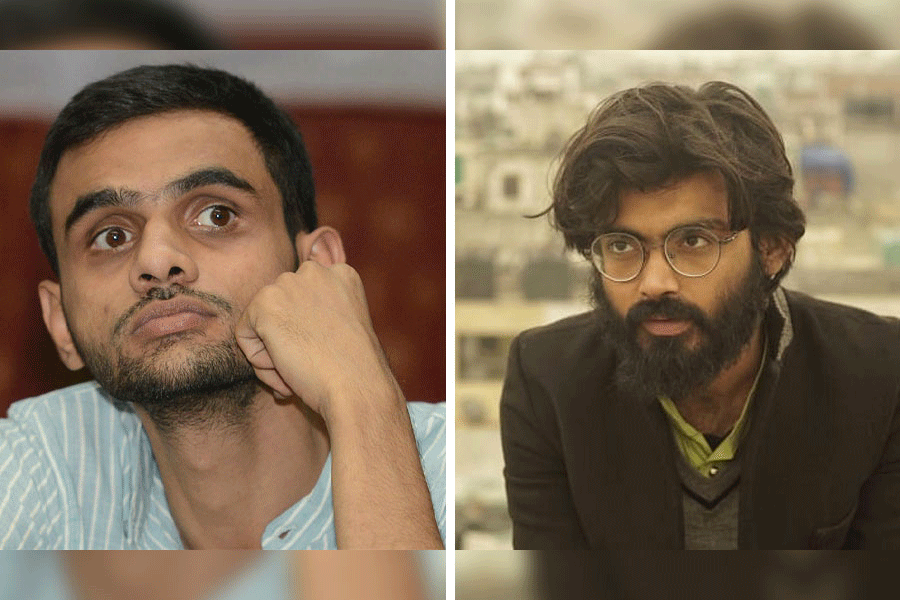
Sir — The Supreme Court’s refusal of bail to Umar Khalid and Sharjeel Imam raises difficult questions about liberty and delay. Five years of incarceration without trial is unusual in any criminal justice system. The court has relied on a prima facie standard under the Unlawful Activities (Prevention) Act. Continued detention on this basis risks turning procedure into punishment. Judicial caution should apply as much to prolonged custody as to allegations.
N. Mahadevan,
Chennai
Sir — A striking feature of the rejection of Umar Khalid’s bail plea is the sharp distinction drawn between accused persons. The court states that Umar Khalid and Sharjeel Imam stand on a qualitatively different footing than those like Gulfisha Fatima and Meeran Haider who were granted bail. That conclusion deserves careful public scrutiny. Bail hearings are not trials, and evidence has not been tested through cross-examination. When liberty depends on prosecutorial material alone, courts must explain with clarity why some remain jailed while others walk free under strict conditions.
Jang Bahadur Singh,
Jamshedpur
Sir — The judgment of the Supreme Court which denied bail to UAPA accused, Umar Khalid and Sharjeel Imam, is a reminder that justice delayed is justice denied.
A delay of more than five years is not routine. It amounts to a structural failure. Courts exist to prevent such failures from destroying individual freedom. Legal doctrine should not become a shield behind which indefinite incarceration is normalised.
Aditya Kamble,
Mumbai
Sir — The Supreme Court has emphasised that its enquiry at the bail stage is accused-specific and limited. That limitation deserves concern. When defence arguments are excluded from meaningful consideration, the balance tilts heavily towards the State. Bail hearings then risk resembling one-sided summaries rather than judicial assessments. A democracy governed by law depends on courts that actively test allegations, even at preliminary stages, especially when the consequence is years of lost liberty.
Sumana Kabiraj,
Calcutta
Sir — The expansive reading of terrorist activity under Section 15 of the UAPA has serious implications. By including disruption of services and threats to the economy, the law moves far beyond conventional violence. Such breadth demands restraint in application. Without restraint, all political protests risk being reframed as terrorism. Courts play a crucial role in drawing limits. Ambiguity in this area should favour liberty, not prolonged detention.
Minisha L. Awomi,
Tuensang, Nagaland
Sir — Parity has emerged as a troubling issue in the Umar Khalid case. Several co-accused, facing similar allegations, have received bail either earlier or now. The court insists that roles differ, yet those differences remain untested in trial. When similar conduct leads to sharply different outcomes, public confidence suffers. Consistency in bail jurisprudence matters because it signals fairness. Uneven application of laws undermines trust in judicial neutrality.
Rai Sengupta,
Calcutta
Sir — The court’s direction to expedite the trial of Umar Khalid and Sharjeel Imam is welcome but insufficient. Such directions have been issued before, with little effect. Speedy trial is not a favour; it is a constitutional guarantee. When courts acknowledge delay yet permit continued detention, the guarantee loses force. Accountability for delay must extend beyond the accused. Investigative and prosecutorial inertia should carry consequences.
Sayantan Basu,
Calcutta
Sir — Senior judges have repeatedly affirmed that bail is the rule and jail the exception. That principle appears increasingly fragile in cases invoking special statutes. While the court cites constitutional limits, it ultimately defers to statutory embargoes. This deference risks hollowing out the presumption of innocence. Laws meant to address exceptional threats should not create a parallel system where liberty becomes secondary.
Sreemoyee Acharya,
New Delhi
Sir — The denial of bail to Umar Khalid and Sharjeel Imam will shape future use of the UAPA. Courts are guardians of both security and freedom. When security concerns dominate without rigorous testing of evidence, the balance shifts. A mature legal system must resist that drift, even in politically charged cases.
Chitra Ghosh,
Calcutta
Taste of home
Sir — The recent strike of gig workers was a reminder of the times when food from outside was an occasional treat. Now it has become the norm and thus lost its appeal. We should try to eat at home as far as possible so that a treat from outside is that much more special.
Sourish Misra,
Calcutta