The Hindu carried on the last but one day of the year that has just ended (December 30, 2025) a small news item. So small that I almost passed it by. And its heading was so technical as to make a lay reader, such as I, leave it alone. It said: “Cutting carbon emissions should not be the top priority: Survey”. But that was only for a moment. Something about it made me return to it. And that something was the word, “not”. Carbon emissions should not be top priority?
Now, I am not a climate-change buff. Far from it. The subject’s finer points, such as carbon credits and debits, the measuring of emissions, the interstices of climate negotiations, the various conferences, conventions and protocols around it with acronyms that go CCC, like IPCC and UNFCCC, and the whirligig of the Conference Of Parties to the United Nations Framework Convention on Climate Change going as COP26, COP27 and on upto COP30, held in dizzying succession in cites like Paris, Glasgow, Berlin, Belém (Brazil), elude me altogether.
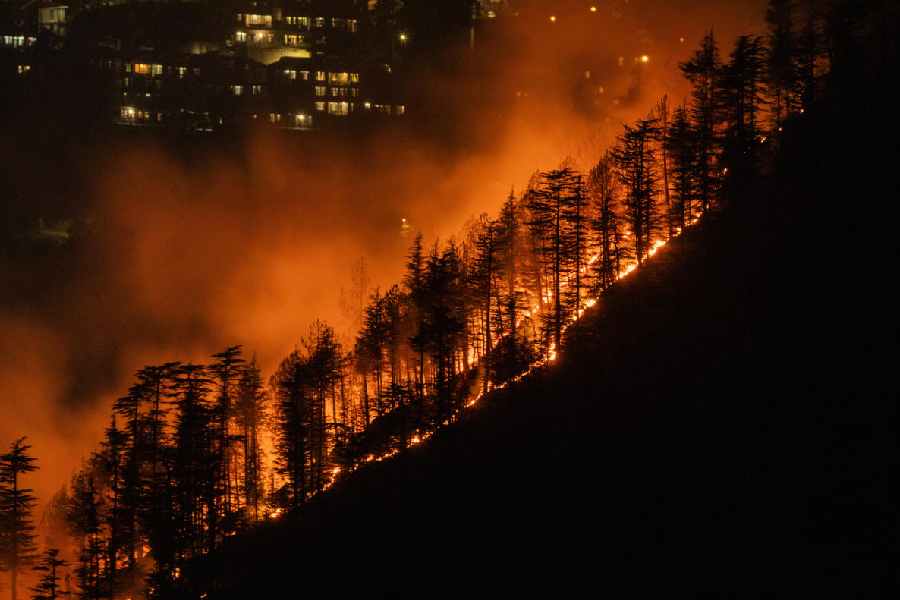
But, like millions of others, don’t I know what is happening around us? Tousled by sudden, unexpected cyclonic winds sending us running for cover, startled by cloudbursts in non-monsoon times, alarmed by parching droughts and scorching heat taking the place of seasonal summer temperature rises, sudden wildfires, and with our teeth chattering in cold waves overtaking winter blues, we know too well what all those CCCs are about. We know that in our bones. We know what is happening to our planet. We know our planet is in deep... No, I won’t use that four-letter word. Our planet is in deep trouble. Very deep trouble.
And so, reading the headline of that small item, my mind elided the ‘not’. But no, the ‘not’ was there, very much there, the story, like all stories in that august newspaper, was totally accurate. It was saying it exactly as ‘the Survey’ said it. As I continued reading it, I realised that the survey was not one carried out at the handsomely remunerative behest of a cartel but was our own, our very own, 2025-2026 Economic Survey.
With my levels of disbelief rising like those of heated seas, and a sense of scientific reasoning peeling my brain off like glacier peaks shedding their ice caps, I read on. “Scarce fiscal resources,” said the Survey, “should not be diverted away from health, agriculture and poverty reduction to accelerate near-term mitigation milestones.” The line of argument was staggering. Basically, it said scarce fiscal resources (read ‘budget allocations’) should be diverted (read ‘moved away’) from mitigating milestones (read ‘pausing the ill winds of climate change’). Re-phrased in honest-to-goodness English, the sentence said that budget allocations are precious and are meant for the health of our poverty-afflicted people whose main occupation is farming and that these allocations cannot, simply cannot, be siphoned off for the dubious cause called ‘fighting climate change’. Put even more bluntly, in good old-style telegraphese which the present generation does not know of, that sentence conveyed the following terse message: ‘Money Scarce Stop Meant For Medicines Stop And for Food Stop For Poor Stop It Cannot Be Squandered On Bogey Of Climate Change Stop Save Planet From Planet Protectors Stop Save Progress From Climate Change Mitigators.’
And then came, like in all good essays, a final flourish to the story. In a crisp, doctrinally brief, almost aphoristic, summary, it said: “Development is, in itself, a form of adaptation.” We love acronyms. So that doctrine could, in short, be called DEFAD, a dual-use abbreviation that could also serve to dub climate-change activists as faddists who need de-fadding.
George Orwell’s Animal Farm has herds of loyal, oh too loyal, quadrupeds being taught to decry their former and deposed human bosses with the slogan-maxim. “Four legs Good, Two-legs Bad, Four-legs Good, Two-legs Bad, Four-legs Good, Two-legs Bad.” And so we may be said to have been given, in this doctrine, a new maxim: ‘Mitigation Is Delusionary, Adaptation Is Visionary’, ‘Mitigation Delusionary, Adaptation Visionary’, ‘Mitigation Delusionary, Adaptation Visionary’.
It may well be that DEFAD will go on and tell us ‘Carbon Not Such An Evil, Not Such An Evil’ (CARBNOVIL), ‘Emission Not So Bad A Thing, Not So Bad A Thing’ (EMNOBING), and then, as a climacteric ‘Carbon, Emission, Plastics, CEP, CEP, Not That Bad, Not That Bad, CEP, CEP Not That Bad, Not That Bad, CEP, CEP’ (CEPNOBAD). But let us leave humour there.
Around the same time as the report on the Survey came a wonderfully refreshing statement from the Thiruvananthapuram MP, Shashi Tharoor. Raising his powerful voice on the massive coastal erosion in Kerala, he described it as “chunks of land falling into the sea”. He knows, for his constituency alone has lost over 64 square kilometres of land to the sea. Speaking like only he can, Tharoor said this loss of “Bharat Mata’s Bhoomi” is ignored while minor border disputes receive national attention. This was a loss not just of idle or dispensable land, but of the stakes to livelihood of coastal populations.
Climate change hurts people, their health, livelihood, their very survival. Climate-change mitigation helps, does not hinder public health, agriculture being the first beneficiary of mitigation. Sneha Mahale has written (The New Sunday Express Magazine, February 1, 2026) tellingly: “Climate disasters have shifted from isolated shocks to overlapping transformations that are sneakily redrawing the country’s physical map. Coastal regions just metres above sea level face tides pressing
inland… deltas risk being redrawn and mountain settlements built on overstrained slopes are collapsing under cloudbursts… [E]co-vulnerability now cuts across coastlines, mountains, deltas, forests, and megacities alike.”
In a remarkably accessible scientific paper in the latest issue of the Journal of the Indian Society of Remote Sensing, Dr Shailesh Nayak, the eminent earth scientist and current head of the National Institute of Advanced Studies, Bengaluru, has written about the Himalaya: “The temperature in the Himalaya is projected to rise substantially during this century, and snowfall is likely to decline…”; “… there is an increasing threat of Glacial Lake Outburst Flood (GLOF)…”; “The accelerated warming and glacial melt in the Hindukush Himalaya along with declining monsoon rainfall, an increase in warm days and nights and hot and day extremes in the Northeastern Himalaya have impacted the agriculture…” He has also drawn special attention to the seismic hazards that experts tell us the Himalaya face.
Has climate change activism said an absolute no-no to adaptation, not to speak of development or progress? It has, as far as I know, only spoken of a responsive and responsible via media between mitigation and adaptation, between climate change sensitivity and the demands of progress. Climate change activism is about, not against, ‘people’.
The 2025-2026 Survey has been drafted by patriot-specialists in development strategies. They are impatient about India reaching and maintaining a steadily rising GDP, investment and savings rates. That cannot be faulted. Their report may yet serve a ‘development plus climate change mitigation’ purpose if it leads to a serious debate on the subject, helping governments at the Centre and in our states and Union territories to see that climate-imperiled as we are , we can still blunt the blow (mitigation). If only, if only, we do not get diverted by new denials of reality.