Friday, 12 June 2026
Friday, 12 June 2026
Friday, 12 June 2026
Hair today, gone tomorrow
A haircut at Delhi’s ITC Maurya has finally stopped making legal waves — after the Supreme Court of India decided that while a bad haircut may hurt, it doesn’t cost Rs 2 crore.
In a judgment delivered on February 6, a bench of Justices Rajesh Bindal and Manmohan reduced the compensation awarded to management professional and model Aashna Roy from Rs 2 crore to Rs 25 lakh.
The court agreed there was “deficiency in service” — but ruled that damages must be backed by solid proof, not emotional volume.
"The damages cannot be awarded merely on presumptions or whims and fancies of the complainant. To make out a case for award of damages, especially when the claim is to the tune of crores of rupees, some trustworthy and reliable evidence has to be led," Justice Bindal said.
The dispute dates back to April 2018, when Roy alleged that her hair was cut much shorter than instructed, causing mental trauma and loss of modelling assignments.
The National Consumer Disputes Redressal Commission (NCDRC) awarded her Rs 2 crore. Even after the Supreme Court sent the matter back for reassessment, the Commission stuck to the same figure.
But the apex court was unimpressed with the paperwork.
"Even if the Code of Civil Procedure may not be strictly applicable, the Commission has not assessed as to how the respondent suffered loss to the tune of Rs 2,00,00,000/-. General discussion in the impugned judgment may not justify the same," it said.
The court pointed out that reliance on photocopies — and the argument that trauma prevented preservation of originals — could not justify such a hefty payout.
In the end, the legal saga that began with a salon appointment ended with a judicial trim: compensation reduced to Rs 25 lakh — a far cry from the original crores claimed.
Mumbai’s roads can sing now
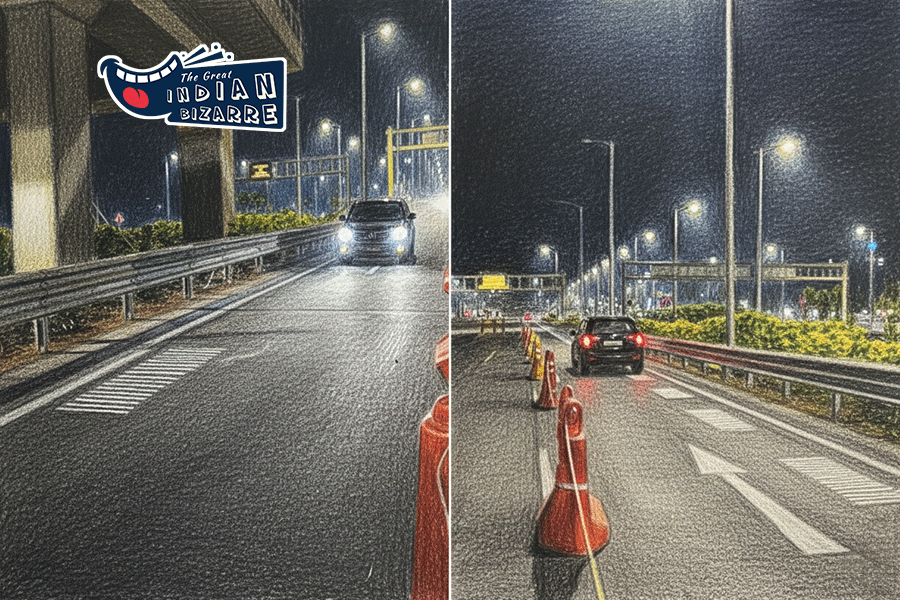
Mumbai just got a new roadside talent: it sings. Yes, you read that right. On 11 February 2026, the Brihanmumbai Municipal Corporation (BMC) introduced India’s first musical road, a 500-metre stretch on the Chhatrapati Sambhaji Maharaj Coastal Road.
Maharashtra chief minister Devendra Fadnavis and deputy chief minister Eknath Shinde even went for a spin to hear the road belt out some tunes.
Here’s the deal: as you drive over it at the 'perfect' speed, roughly 70–80 km/h, the grooves in the road make your car cabin play the globally-famous Jai Ho.
The magic happens between Nariman Point and Worli. Your tyres rub against grooves just right, vibrations turn into sound waves, and suddenly your car has better taste in music than your playlist.
Why Jai Ho? Because nothing says “drive carefully” like an Oscar-winning tune about triumph and glory. Jai Ho was composed by Academy Award-winning artist A.R. Rahman for Slumdog Millionaire.
And yes, Rahman himself took the car for a spin and posted a video on X: "India's First Musical road ⚠️ Mumbai's got a new 'musical road' grooves carved in just right to play #JaiHo song when cars zip over at the perfect speed."
So now, Mumbai drivers can stress over traffic, potholes, and honking… but at least they’ll get a soundtrack while doing it.
Temple garden plants not meant for worship
Horticulture, it turns out, is a broad discipline.
In Telangana’s Sangareddy district, a temple priest was arrested after police discovered that the temple’s flower garden was growing more than just marigolds. Hidden carefully among the bright orange blooms were cannabis plants, 685 of them.
Officials said the accused, Avuti Nagaiah, 48, served as a priest at a temple in Panchagam village and was locally known as a spiritual guide.
On January 31, a raid by the DTF Sangareddy team uncovered what investigators described as a large-scale illegal cultivation setup operating discreetly inside the temple grounds.
According to the police, the marigold plants served a dual purpose: visual cover and olfactory distraction.
The cannabis crop, investigators said, was disguised among the flowers in a way that made it appear like routine temple gardening, allowing the activity to go unnoticed for an extended period.
During the raid carried out under the supervision of the Deputy Commissioner of Medak and the District Prohibition and Excise Officer of Sangareddy, officials seized items valued at around Rs 70 lakh. This included 685 cannabis plants, 17.741 kilograms of dry ganja, 0.897 kilograms of ganja seeds, Rs 30,000 in cash, a digital weighing machine, and a mobile phone.
Police said the accused was allegedly packaging and selling marijuana while continuing his duties as a priest.
One social media user commented: “How smart is he that this man used marigold flowers to hide the smell and appearance of the drugs and fooled everyone.”
When data meets dating
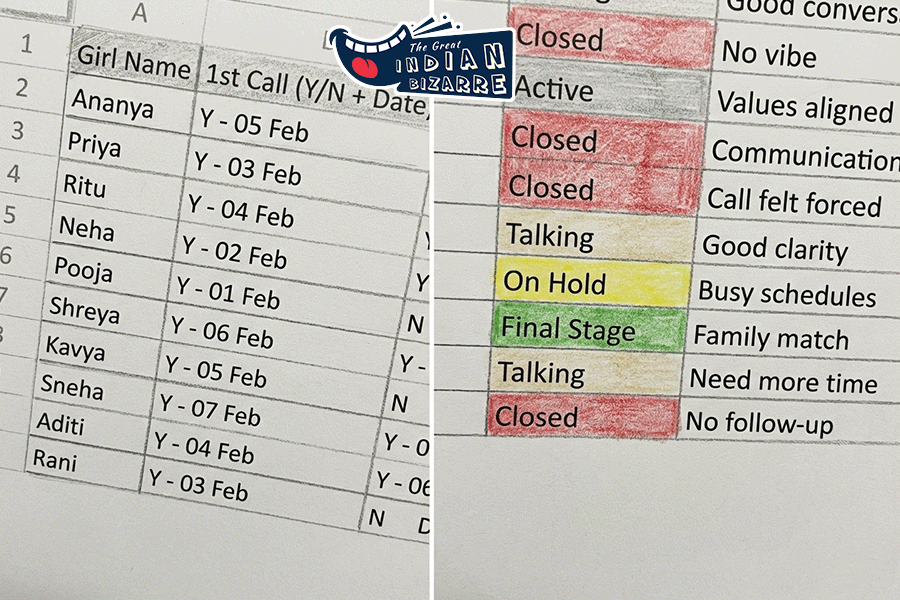
The internet is buzzing after a video showed a software professional meticulously tracking arranged marriage prospects using a Microsoft Excel sheet.
This wasn’t just a list. It was a full-blown database with columns for attributes, ratings and notes. Think of it as Match.com meets Office 365.
Unlike traditional matches discussed over chai, auntie intervention, or WhatsApp messages from your cousin in Dubai, this techie ctrl-F’d his way through prospective life partners. If relationships were projects, he had the Gantt chart and pivot table to prove it.
Social media users applauded the efficiency, wondering if formulas could also calculate in-law compatibility.
Others joked that if love was an Excel problem, macro functions might become mandatory wedding vows.
Tech support by day, troubleshooting locks by night
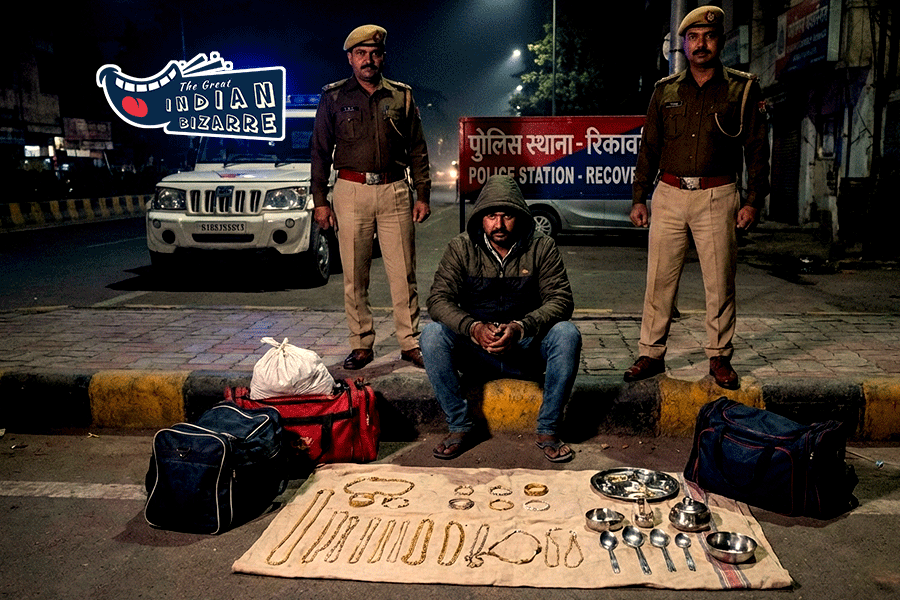
Visakhapatnam’s crime files added an unusual entry this week when a Hyderabad techie swapped keyboards for crowbars and allegedly spent his nights raiding homes.
Police in Vizag arrested the software professional after recovering nearly 700 grams of gold and 3.8 kilograms of silver from a series of burglaries.
By daylight, he was an average coder debugging apps. By night, he apparently rerouted his talents to troubleshooting locks.
According to investigators, the man allegedly carried out a string of break-ins across the city, lifting valuables worth lakhs while residents slept.
Police followed clues, conducted raids, and ultimately found the stash — turning what seemed like a routine burglary case into tech-infused mystery.
Social media reactions ran from shock to memes about night mode activation. One comment asked if he was just trying to increase his ‘cache’ — monetary and computing.
Reverse migration
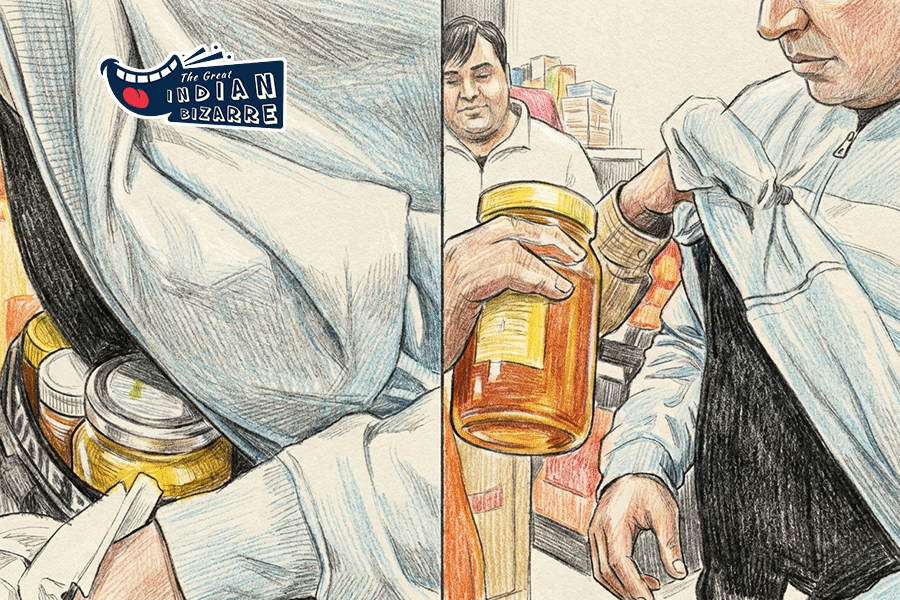
From Haryana's Karnal, a video has come to light in which an Australia-returnee was seen stealing ghee, honey, ketchup, and many other items from a grocery shop.
The man has been identified as Ashwini, also known as Ashu Bhatia, from Karnal.
Reports suggested that the man had recently returned from Australia to India on a tourist visa. The employees at the store became suspicious of his behaviour after his previous visits.
This time, when he entered to pay for a packet of Maggi, the staff kept a close watch on him. This led to the identification of him stealing grocery items like ghee and honey and putting them inside his clothing.
Just when he made attempts to leave the store, the employees surrounded and stopped him, recovering whatever was stolen.
In an era where grocery inflation is discussed in policy terms, this appeared to be a more hands-on approach to procurement, one that ultimately did not clear checkout.
Elopement goes Naagin-style
Just when you thought elopement stories couldn’t get any spicier, Kanpur delivered one with a supernatural twist.
A young couple on the run decided that love is brave, destiny is calling, and apparently, snakes make excellent witnesses.
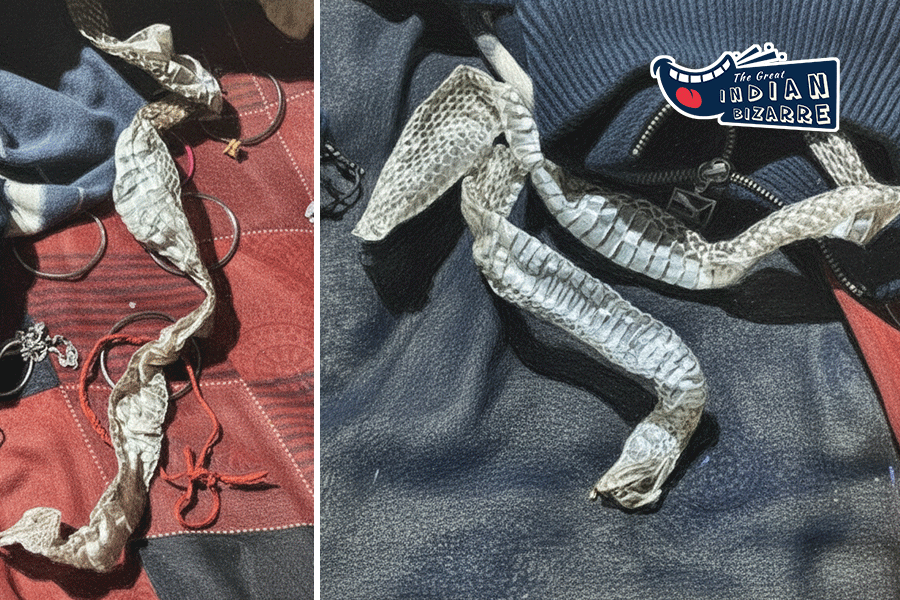
After slipping away from home amid family opposition, the duo found themselves cornered — not by relatives, police, or dramatic Bollywood parents — but by a cobras-and-serpents cameo straight out of a fantasy series.
The video shows them sitting together in what can only be described as Naagin mode: a live snake coiled nearby as if it were officiating the whole affair.
The serpent did not hiss objections. It did not strike dramatic poses like in TV shows.
It just sat there, earning more screen time in the couple’s escape saga than the actual bridegroom’s relatives.
Social media dubbed it the Naagin elopement, with curious internet sleuths debating whether the snake was symbolic, spiritual, or simply looking for snacks.
Online reactions ranged from laughter to astonishment: one user suggested the couple should have asked the snake for blessings, while another wondered if they intended to start a joint venture — love bites and snake bites included.
Meanwhile, authorities reported the couple was eventually persuaded to return to their families, though the snake’s role in the negotiations remains unconfirmed.