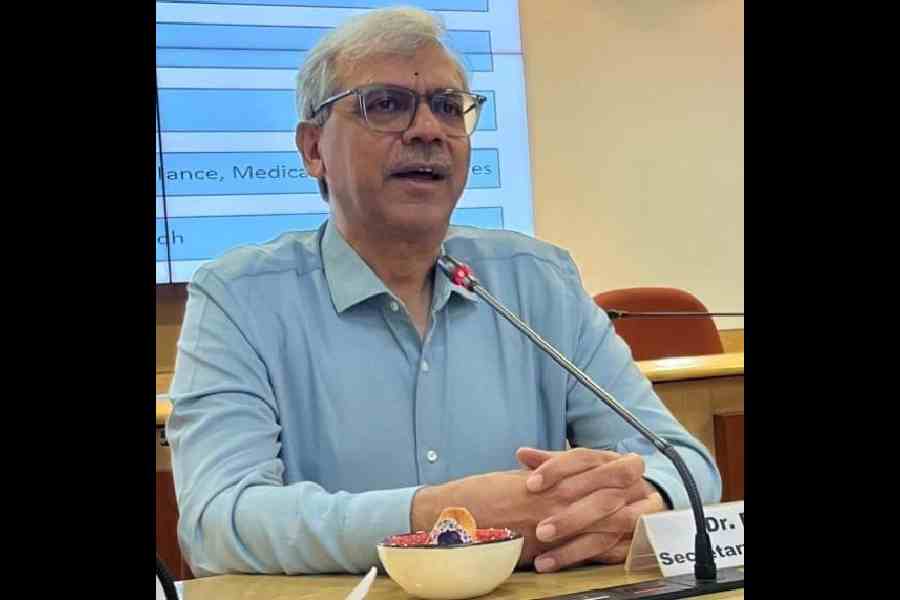
The resistance of the human body to antibiotics is “already a pandemic,” and research conducted in various hospitals throughout India indicates that this resistance is on the rise, said the director-general of the Indian Council of Medical Research (ICMR), the leading organisation for biomedical research in India, in Calcutta on Saturday.
Rajiv Bahl expressed concern that people will be rendered “helpless” against bacterial infections unless the misuse and overuse of antibiotics is stopped.
The ICMR is in the process of releasing guidelines on how doctors should use antibiotics in the pre-laboratory confirmation stage. Misuse and overuse of drugs have to pause for them to remain effective, he said.
“Antimicrobial resistance is already a pandemic. ICMR has been following antimicrobial resistance across India in multiple hospitals. What we have found is that there is increasing resistance to antibiotics,” said Bahl, also the secretary of the Centre’s department of health research.
“Bacteria are now becoming resistant largely because of the overuse and misuse of antibiotics. If we use antibiotics rationally, they will last for several hundred years. If we do not, after a while, we will be helpless against bacterial infections,” Bahl said.
The ICMR director-general was in the city to inaugurate a bust of the pioneer of oral rehydration solution (ORS), Dilip Mahalanabis, on the Beleghata campus of the National Institute for Research in Bacterial Infections (formerly NICED).
Antimicrobials are agents, including antibiotics, antivirals, antifungals, and antiparasitics, that kill or inhibit the growth of microorganisms such as bacteria, viruses, fungi, and parasites. Doctors stated that the unnecessary use of all antimicrobials was a concern.
A doctor said some surgeons tend to overuse antifungals on patients who do not have an infection that warrants their use.
Bahl also stressed judicious use of antibiotics during the pre-laboratory confirmation stage.
“We are in the process of releasing guidelines for empirical use of antibiotics. Empirical means when a doctor has to decide on whether and what antibiotics to prescribe before culture results arrive. This is based on clinical signs. Empirical means before laboratory confirmation,” said Bahl.
It is the doctor’s training and understanding of where a bacterial infection is suspected and where it is important to treat immediately, he said.
There are multiple factors why doctors continue to overuse antibiotics despite discussions around antibiotic resistance for years.
“Many doctors are worried the patient’s condition might deteriorate. They feel it is better to prescribe an antibiotic. Doctors are often worried that they might be missing a sign of possible infection and play safe by prescribing antibiotics,” said Chandramouli Bhattacharya, an infectious disease specialist with Peerless Hospital.
Bhattacharya was not at the National Institute for Research in Bacterial Infections. He spoke to Metro separately.
He said antibiotic resistance should be listed among the top five threats to human beings now.
“It is tough to explain to patients that unnecessary use of antibiotics can have negative consequences. This conversation takes five minutes or more. Many doctors do not have the time or the inclination to explain, which is why they write down antibiotics even if there is no need,” Bhattacharya added.
Besides over-prescription, the easy availability of antibiotics over the counter also contributes to the problem.
The injection of antibiotics in poultry and broilers compounds the problem. “Antibiotics are used as growth promoters in broilers. The owners feel pushing antibiotics, even if there is no infection, will keep the birds healthy. It also increases their weight,” Bhattacharya added.
Doctors said most instances of cough and cold were viral. They are self-limiting. People recover within a few days, irrespective of whether they are given antibiotics or not. However, many consume antibiotics for these symptoms.