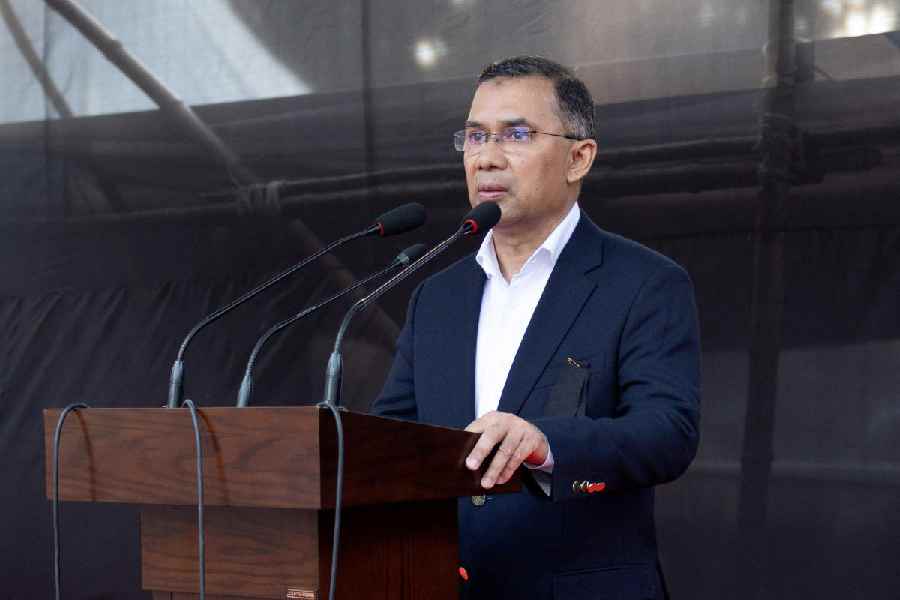
Tarique Rahman, Prime Minister-designate of Bangladesh, on Saturday said the new government’s foreign policy would be pivoted on “Bangladesh’s interest and the interests of its people” rather than following any country-specific policy.
His comments at his maiden news conference as the designated leader of the nation indicated that his administration would adopt a balanced approach while dealing with neighbours such as India, Pakistan and China.
“We have cleared ourselves regarding the foreign policy, which is in the interest of Bangladesh, and the interest of the Bangladesh people comes first,” Rahman said to a question on the future of India-Bangladesh relations.
“Protecting the interests of Bangladesh and the Bangladesh people — is our foreign policy.”
Journalists from Bangladesh and abroad crowded the news conference, held a day after Rahman’s Bangladesh Nationalist Party secured a two-thirds majority in the national elections.
The BNP has won 212 of the 297 seats, with the Islamist Jamaat-e-Islami and its allies securing 77. Sheikh Hasina’s Awami League was barred from the polls.
Rahman, expected to be sworn in within three or four days, was asked specific questions about ties with New Delhi and Prime Minister Narendra Modi’s congratulatory call. But he refrained from naming India or any other country while answering queries on international relations.
A source said Rahman’s “Bangladesh First” policy was a response to the challenge of balancing diplomatic relations, including the one with India, at a time when he faces the uphill task of repairing a “fragile” economy, buffeted by steep inflation under the Mohammad Yunus regime.
“He (Rahman) knows that he needs India’s support, besides that of China and, to some extent, Pakistan. He also wants good ties with the US to negotiate tariffs,” the source said.
“To repair the so-called fragile economy, he needs a steady flow of essential commodities, many of which come from India. So, he avoided commenting adversely on India directly.”
Asked about the challenges he faces, Rahman first spoke about reviving the economy.
“We have very serious challenges to tackle the economy of the country. We have the challenge to ensure the law and order situation of the country, along with good governance,” the son of former Prime Minister Khaleda Zia said.
China has strong investments in Bangladesh, and Pakistan’s activities increased in the country under the interim government.
Rahman’s stance on India became clearer when a foreign journalist asked him about Sheikh Hasina.
“That (the Hasina-related issue) depends on the legal process,” Rahman said without naming Hasina or referring to her presence in India.
Many in Bangladesh, however, believe that his efforts at balancing ties, particularly in relation to India, will not be easy given the rise of Right-wing forces like the Jamaat.
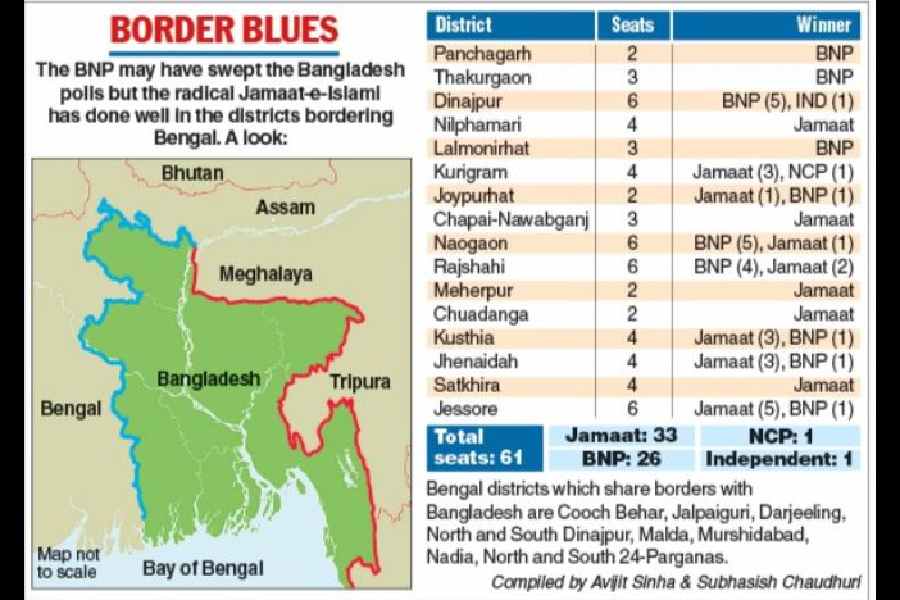
Although Jamaat finished far behind the BNP in the polls, its influence is expected to remain strong in areas along Bangladesh’s border with India, where it won almost half its individual tally of 68 seats.
If Jamaat intensifies its anti-India campaign and activities from Bangladeshi soil, it may prove difficult for the new Prime Minister to maintain stable ties with India.
Perhaps anticipating the growing influence of such forces, Rahman also called for unity and the upholding of the rule of law.
“We must remain united and uphold the will of the people. At any cost, peace and discipline must be maintained,” he said.
“We will not tolerate any kind of injustice or illegal activities. Regardless of religion, caste or differing opinions, we will not accept any attack by the strong on the weak under any excuse. The rule of law is equal for all.”
A source said that, as a symbolic affirmation of his commitment to balance in foreign policy, Rahman might invite Modi and Pakistan Prime Minister Shehbaz Sharif to his swearing-in.
Sabyasachi Basu Ray Chaudhury, a foreign policy expert, said that adopting a balanced approach was necessary for Rahman, who has limited political experience and has returned to his homeland after 17 years in self-imposed exile.
“Although he played a key role in the BNP’s landslide victory, he lacks extensive experience in governance and diplomacy because of his long exile,” the veteran academic said.
“So, he appears to be adopting a balancing policy similar to Narendra Modi’s ‘India First’ and Donald Trump’s ‘USA First’ policies.”
Rahman’s news conference suggested that he intended to maintain balance within the country, too. He faced the national and international media alongside senior party leaders, sending a message of cooperation and urging all political parties to assist in rebuilding the country.
“To ensure that no evil force can re-establish autocracy in the country, we must remain united and uphold the will of the people,” he said.