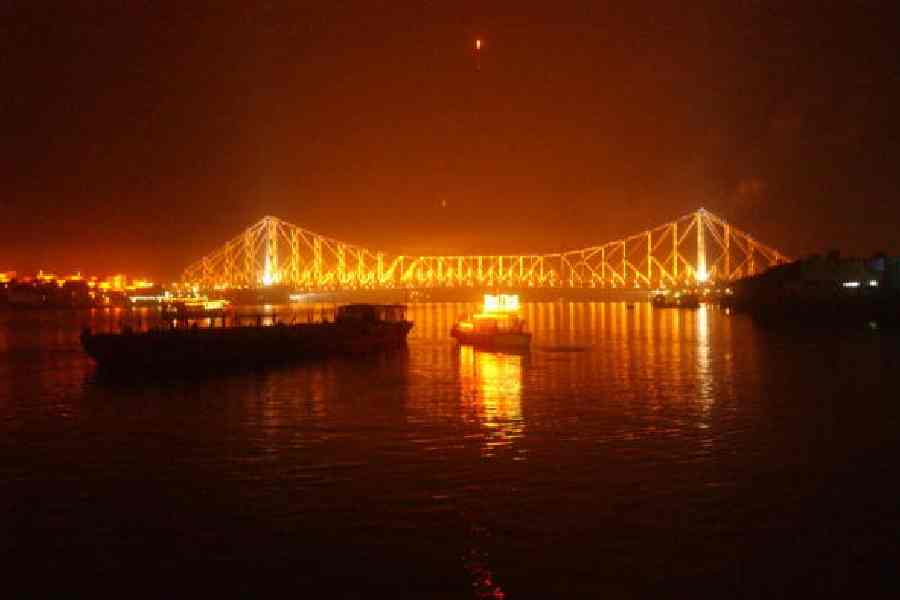
Ritwik Ghatak's Bari Theke Paliye frames the Howrah Bridge as a threshold: a place where innocence meets the city’s uncompromising, even 'strange', reality. If steel trusses can bind two restless banks of a tidal river, Ghatak seems to ask, why cannot human faith manage a similar act of connection?
Cities are often understood through images long before they are understood through facts. For Calcutta, one such image has endured across generations: the vast steel lattice of the Howrah Bridge rising over the Hooghly. Cinema grasped this instinctively. The Hindi thriller, Howrah Bridge, turned the span into a stage for urban suspense. Decades later, a quieter image entered collective memory: an ageing Amitabh Bachchan cycling beneath its ribs — an image that captures Calcutta's insistence on dignity, nostalgia, and survival. The bridge, in other words, is not merely infrastructure. It is character. It is witness.
Yet this bridge has lived two distinct lives — one provisional and adaptive, the other monumental and enduring. Before steel claimed the Hooghly, Calcutta relied on a floating, retractable crossing that rose and fell with the river’s tides. When the city outgrew improvisation, the answer had to be permanence.
That permanence arrived in 1943 — not merely as an upgrade, but as a declaration. Called the 'New Howrah Bridge', it opened in the dead of a Second World War night, when Japanese air sorties threatened the city. Few bridges of comparable scale were built and made operational under such conditions, and fewer still remained uninterrupted through Partition, refugee influxes, wars, industrial unrest, and political upheavals. That unbroken service lends Howrah Bridge a historical gravitas rarely associated with urban infrastructure.
Designed as a balanced cantilever truss, it was built almost entirely without nuts or bolts, relying instead on riveted high-tensile steel. The Hooghly’s unstable bed ruled out mid-stream piers; massive caissons were sunk deep into shifting silt. With war-torn Europe short of steel, the Tata enterprise developed an indigenous alloy—Tiscrom—among the earliest instances of true 'Made in India' ingenuity: nearly 26,500 tonnes went into the bridge.
In this spirit, Howrah Bridge stands comfortably beside bridges recognised by UNESCO: the Pont du Gard for engineering audacity, the Vizcaya Bridge for metal innovation, and the Stari Most for cultural symbolism and reconciliation.
The financing of this ambition tells a less familiar story. While the floating bridge revenue contributed significantly, the bulk of the funding came from Howrah Bridge Loan Bonds guaranteed by the Bengal government. Legally and financially, the bridge was a provincial government project. The Howrah Bridge Act of 1926 is explicit: the Commissioners for the Port of Calcutta were appointed not as owners, but as statutory trustees.
This legal architecture explains the paradox that followed. Despite popular belief, the bridge does not belong to the Port. Yet, for decades, its maintenance has been carried out almost entirely by the Port at great expense and with exemplary care. Few heritage structures are maintained so meticulously by an entity that neither owns nor earns from the asset.
The Howrah Bridge does not ask to be saved. It asks to be acknowledged. It is time for the West Bengal government, its true owner, to assume stewardship and place this living icon before the world — not as a relic but as proof of how societies build, endure, and remain connected.