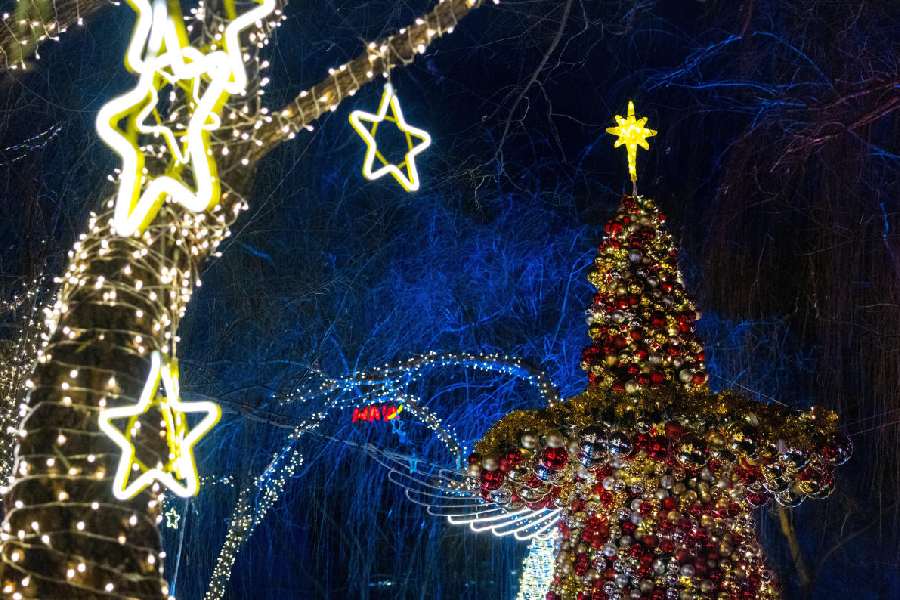
Christians comprise 1-2% of China’s population, but you wouldn’t think so, looking at the Christmas sights in China’s big cities. A Christmas tree made of colourful yarn; another of bread loaves kneaded from nearly-expired flour which attracted both viewers and sparrows; winter wonderlands conjured up in malls; special Christmas versions of popular toys such as Labubu; the uniquely Chinese saxophone-playing Santa; an old church compound ablaze with lights...
The idea of fanatics vandalising these displays, as they have in India, seems absurd. Christmas is a festival of enjoyment; brightly decorated pedestrian plazas are crowded with people buying cute gifts for their kids. It was in China that this diarist first saw a child wearing the now ubiquitous red Santa hat, way back in 2003. The next year, children were waving little rings of coloured lights. No wonder, for China houses the 'Christmas capital of the world', Yiwu — the city famous for manufacturing Christmas accessories. Indeed, more than three-fourths of the world’s Christmas decorations are manufactured in China.
Christmas is not a holiday in mainland China, as it is in Hong Kong and Macau. However, that doesn’t dampen the festive spirit. Unlike India, where the Bharatiya Janata Party-led government at the Centre declared December 25 as 'Good Governance Day', depriving both adults and children of the biggest Christian holiday, in China, December 25 brings with it a double celebration: seen as an unofficial Valentine’s Day, couples buy each other gifts and throng skating rinks. There are even Chinese versions of the three popular Christmas songs: "We wish you a merry Christmas", "Jingle bells" and the carol, "Silent night".
Pre-Liberation, thanks to China's colonial history, Christmas was always celebrated in the country. There was even a Christmas-themed film made in China as far back as 1935; one of the actresses went on to become Mao’s fourth wife.
After 1949, Christmas was celebrated on a limited scale, largely in big cities by the Young Men's Christian Associations there. In the '80s, when China 'opened up' to the West, the scale increased, although gradually. In 1992, the Shanghai Peace Hotel, a stunning Art Deco building built in the early 1900s, held a Christmas dinner and fashion show, with tickets priced as much as 888 yuan — two month’s salary of a middle class person then.
Ultra-nationalists opposed to Christmas exist in China too, but they aren’t allowed to run amok. They can spoil the festival only for those over whom they wield control. Thus, in 2014, a Xian college banned Christmas celebrations on its campus and made it mandatory for students to watch propaganda films for three hours on Christmas day. No guesses on how nationalistic the students felt after that! Off and on, city administrations and even a few private companies have banned Christmas displays.
Behind these measures lies the old insecurity that Western culture is taking Chinese youth away from their roots — an irrational fear. During Chinese festivals, the entire country is like one big carnival. The world’s most powerful Communist Party makes sure that commerce reigns, be it on Chinese New Year or Christmas.
There’s another difference between Christmas in China and in India: cleaner air. China ranked 13th in the AQI rankings of 2025; India ranked third. India’s capital was the world’s most polluted city in December. There was a time when Beijing occupied this slot. In December 2025, China’s capital ranked among the 10 most polluted cities. A Westerner inquiring on a China travel website about how safe was it, in terms of pollution, to travel in China during Christmas, got a go-ahead from other Western expats living in Beijing and Shanghai, including those who identified as asthma sufferers.