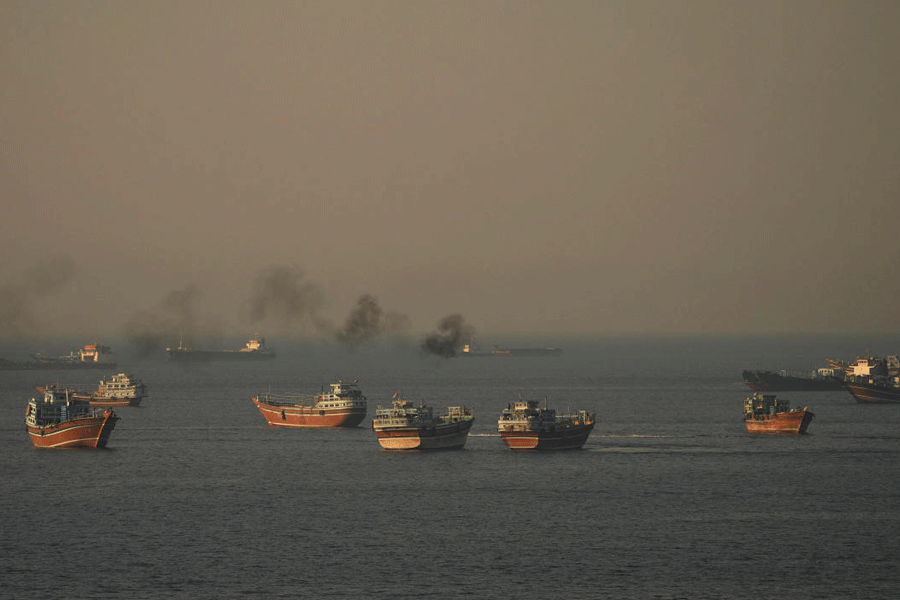
The US-Israel war on Iran is now rippling through India’s trade, manufacturing and agriculture sectors, with rising freight costs, insurance premiums and shipping disruptions threatening key imports and exports.
The conflict may disrupt India's imports of edible sunflower oil and key fertiliser inputs, industry bodies have warned, adding that exports of agricultural commodities to the Middle East and Europe could also be affected.
Shipping companies have begun imposing emergency conflict surcharges on cargo moving through the region. French container giant CMA CGM is levying between $2,000 and $4,000 per container, raising costs for importers.
“The export to Middle East is on hold now,” Soluble Fertiliser Industry Association (SFIA) President Rajib Chakraborty told PTI. “As the conflict continues, risks will rise, and shipping companies may impose insurance surcharges, making imports costlier,” he added.
Chakraborty flagged concerns over supplies of sulphur and sulphuric acid — critical inputs for producing DAP and SSP fertilisers — ahead of India’s kharif sowing season beginning in June.
Qatar, the UAE and Oman together account for 76 per cent of India’s sulphur imports.
“The closure of several ports will lead to congestion and container shortages,” he said.
India imports around 16 million tonnes of edible oil annually, of which sunflower oil accounts for roughly 20 per cent, sourced mainly from Russia, Ukraine and Argentina. Shipments could face delays if vessels reroute away from the Red Sea.
Manufacturers in the petrochemical, rubber, cement and steel sectors are also likely to face higher input costs, as these industries are linked to crude derivatives and vulnerable to transport bottlenecks.
India’s export sector is exposed to longer supply chains and thinner margins.
Rice and onion shipments to the Middle East have been disrupted, with over 2,000 containers of food items, including rice and perishable onions, stranded at Indian ports.
The broader economy is expected to face oil price volatility and macroeconomic spillovers from the escalating crisis, analysts said, though India’s oil supply chain does not yet face structural insecurity.
Rising tensions around the Strait of Hormuz — a key route for India’s crude oil and LNG imports — have pushed Brent crude prices to a seven-month high of about $73 per barrel, adding pressure to global energy markets. But an actual disruption to supplies remains unlikely for now.
Market analytic firm Kpler's vessel-tracking data showed that 2.5–2.7 million barrels per day, or about 50 per cent of India’s crude imports, transit the Strait of Hormuz, largely sourced from Iraq, Saudi Arabia, the UAE and Kuwait.
“Over the past two to three months, India’s dependence on Middle Eastern barrels has increased as refiners pivoted away from a portion of Russian volumes. As a result, the share of Gulf-origin crude in India’s import basket has risen, increasing short-term sensitivity to any disruption in Hormuz transit,” said Sumit Ritolia, lead research analyst of Kpler.
Sustained crude price gains could feed into higher retail fuel prices, raising transport costs and adding fresh pressure on headline inflation.
A wider oil import bill will also further strain an already-depreciating rupee.
Equity investors lost Rs 6.59 lakh crore on Monday as markets tumbled amid rising tensions in West Asia. The market capitalisation of BSE-listed companies fell by Rs 6,59,978.08 crore to Rs 4,56,90,693.19 crore ($5 trillion).
Gold and silver prices also climbed as investors rushed to safe-haven assets amid rising geopolitical uncertainty. Analysts said continued volatility in West Asia could keep bullion prices elevated, especially if crude prices remain high and risk sentiment weakens further.