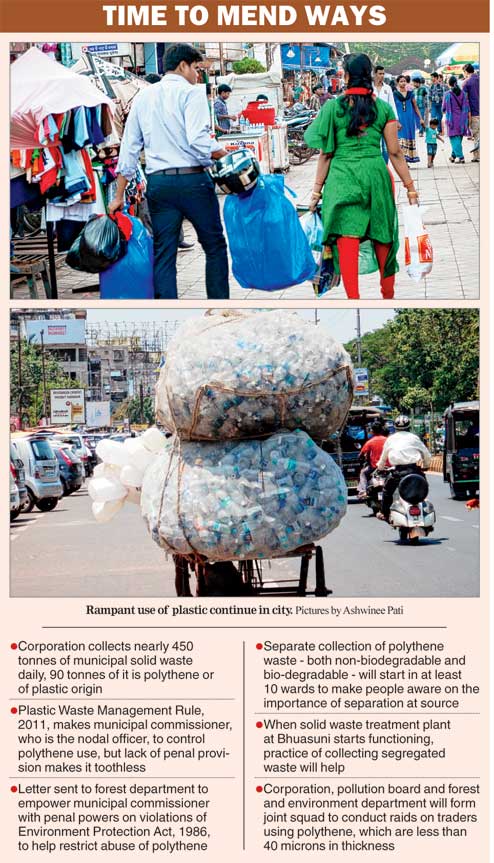

Bhubaneswar, March 19: The corporation is all set to implement segregation of polythene at source by sensitising citizens to have two types of dustbins at home.
While the city churns out nearly 450 tonnes of solid waste in a day, nearly 20 per cent constitute polythene and similar materials. The pilot wards to be taken up in the initial phase will be selected on the basis of their literacy and overall awareness level.
Additional municipal commissioner D. Brundha said: "The Swachha Bhubaneswar Abhijan (SBA) cell at the Bubhaneswar Municipal Corporation (BMC) will draft a plan within a week to include at least 10 wards, so that residents will be told to have two types of dustbins in their houses. It will help the solid waste collectors and transporters to have different strategies and collection mechanism. In the long run, the solid waste treatment plant at Bhuasuni will take care of the waste."
Joint squads from the BMC, State Pollution Control Board (SPCB) and forests and environment department will organise regular raids at shops and other establishments to minimise the use of polythene with less than 40-micron thickness.
"While consent and declaration forms for the micro small and medium enterprises (MSME) units will be mandatory before giving them permission to open their units, restriction on the entry of polythene to the city at different vantage points will be done by the anti-polythene squads," Brundha said.
The menace of polythene is all over Bhubaneswar. They lead to choked drains. Secondary and tertiary drains are also affected. They also take a toll on the soil quality and endanger the health of animals in many parts of the city.
The civic authorities today held a meeting with other line departments of the state government to take stock of the situation.
Ambarish K, team leader at the SBA cell, said: "The segregation model of solid waste collection at source has already been implemented in several municipal corporations in Maharashtra and Andhra Pradesh. While a household needs to give the biodegradable waste every day to the collector, they may handover the bin of polythene once in two to three days."
He also added polythene below 40 microns was dangerous because they block the rainwater to percolate down to the underground water table.
"Thinner polythene materials add toxic chemicals such as dioxins, which may result in causing reproductive and development problems in human beings, affect the immune system, interfere with hormonal balance and may have carcinogenic effects according to literature circulated by the World Health Organisation. Thin polythene also produces toxins which pollutes the underground water," said Ambarish.
Pitambar Parida, a resident of Pokhariput said: "Hospitals and nursing homes already have a proven system of segregating waste at source. Households must adopt it for a better environment."
SBA cell officials have plans to extensively use the collected polythene in modern road-laying technology and also in cement manufacturing.
The penal provisions under Section 19 of the Environment Protection (EP) Act, 1986, want the municipal commissioners to enforce the polythene ban, a senior BMC official told The Telegraph. "Already, the state level advisory committee on plastic management has recommended penal provisions to be bestowed on collectors and sub-collectors. If that power is assigned to the municipal commissioner, the enforcement will be definitely better."
Penalties such as imposing fines and sealing units that violate the 40-micron guideline are there in the EP Act, but no civic body has the power to impose the fines.
"BMC is planning to launch a mass awareness drive involving schoolchildren and homemakers. Polythene ban can be a reality soon through social interventions," said Gopal Panigrahi, the additional public relations officer at the corporation.
Residents will be asked to have two types of dustbins in their houses. It will help the solid waste collectors to have different strategies and collection mechanism-D Brundha additional municipal commissioner