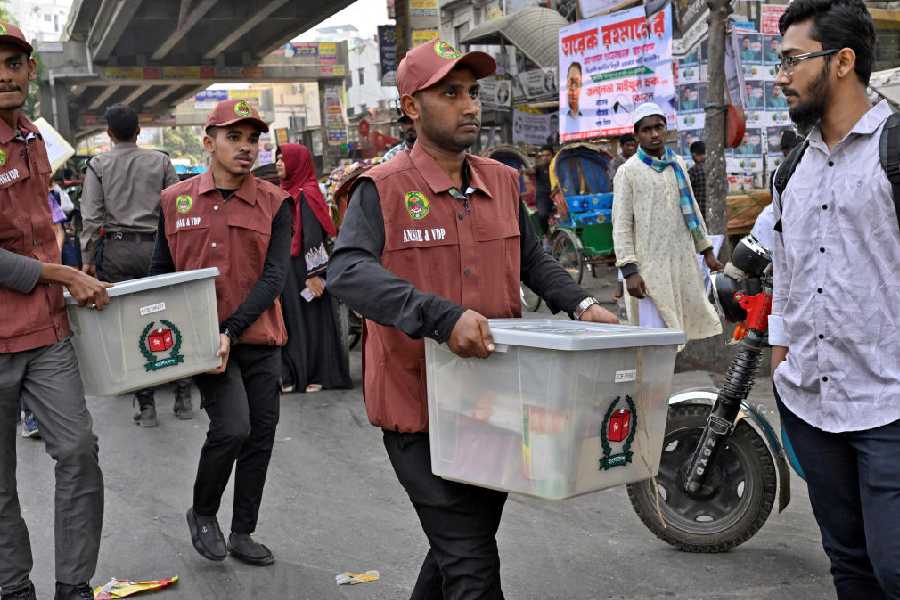
Bangladesh will vote on Thursday, nearly 19 months after a student-led uprising forced former prime minister Sheikh Hasina to flee Dhaka. The bulk of those who had participated in the uprising are Gen-Z – in the 15 to the 29 age group – who constitute around 28 per cent of the country’s population that will queue outside the booths.
The interim government headed by chief advisor Muhammad Yunus has promised fair voting for all, but Bangladesh does not have a stellar reputation in democracy. Since 2009, when Hasina came to power, opposition parties have claimed multiple times that the elections are neither free nor fair.
This time, the world is watching. The Wall Street Journal declared in a headline: “Getting a Job Is Harder Than Toppling a Government for Bangladesh’s Gen Z.”
Like their compatriots in many developing countries, young people in Bangladesh are also worried about shrinking job opportunities in the country.
"I expect the new government to understand young job seekers like me," said first-time voter Monika Akter, 24, from Bogura district. "We need a fair and transparent recruitment and exam process. Especially National University graduates, we suffer the most."
Mohammad Muniruzzaman, 21, echoed her.
“About 86 per cent of National University students are unemployed. That’s really painful. We don’t want to finish our studies and remain jobless. We need IT-based education so we can compete globally,” Muniruzzaman said.
The country’s precarious economic situation is a cause of worry for the voters in rural Bangladesh too.
"We spend a lot on seeds and fertiliser, but when we sell vegetables, we don’t get a fair rate," said Farhana Akhter, 21, from a farming family in Bogura. "We don’t expect miracles in one day, but we hope things improve step by step."
Since the fall of Hasina and the end of the Awami League’s stranglehold over Bangladesh, the country has been in turmoil with attacks on those in the Hasina government, or Awami sympathisers as well as the minorities.
Most young Bangladeshis still call the Hasina government Fascist.
“We couldn’t speak freely during the Fascist period,” said journalist Mohammad Samimum Jahan. “Whoever comes to power, we need freedom of speech; even to criticise the government.”
The main contest is between the centre-right Bangladesh Nationalist Party (BNP) and the Islamist Jamaat-e-Islami, longtime allies now facing off in the absence of the disbanded Awami League.
The interim government had banned the Awami League and its frontal organisations.
After the death of BNP chief and former prime minister Khaleda Zia, her son Tariq Rahman has returned after spending years in London in exile. He is leading the BNP’s poll campaign.
“Uncertainties remain over what kind of election it will be,” said economist and political analyst Debapriya Bhattacharya, who led a key anti-corruption committee under the interim administration.
“Will everyone be able to vote freely? If they do, will their votes be properly counted? So, we cannot judge until the entire process is over.”
Referring to Yunus’s promise of a “new settlement for a new Bangladesh by pushing a reset button,” Bhattacharya said: “A gap is visible in candidate selection, voter participation doubts and the return of old practices involving money and muscle.”
While the interim government recognised how authoritarian power concentration and “family-based politics” weakened the state, it did not address these structural problems, he argued.
Zillur Rahman, executive director of the Centre for Governance Studies, said many expected the vote to mark the end of the interim government, which he said failed to deliver promised reforms.
“My fear centres around what would be the scenario of the election day and post election period,” he said.
Rahman said Jamaat, despite its stigma since 1971 for opposing Bangladesh’s independence, created space “visibly with interim government's backing and western support for geopolitical reasons, using its regimented party structure.”
“If the voter turnout is high BNP could win but if it is low, Jamaat could benefit,” he said.
Sabir Mostafa, political affairs writer and former chief of the BBC’s Voice of Bangla services, said, “[Yet], I think the people of Bangladesh have not turned so crazy as to vote for a party [Jamaat] which was opposed to the very foundation of the country.”
He warned that “election manipulation” remained a real fear.
Jon Danilowicz, former deputy head of the US mission in Dhaka, called the vote a “real test.”
“The real test of Bangladesh’s political class will take place on February 13,” he wrote on X. “Will they be able to accept the verdict of Bangladesh’s voters and play their respective roles in helping to build a new Bangladesh? If not, then the odds of history repeating itself will rise.”