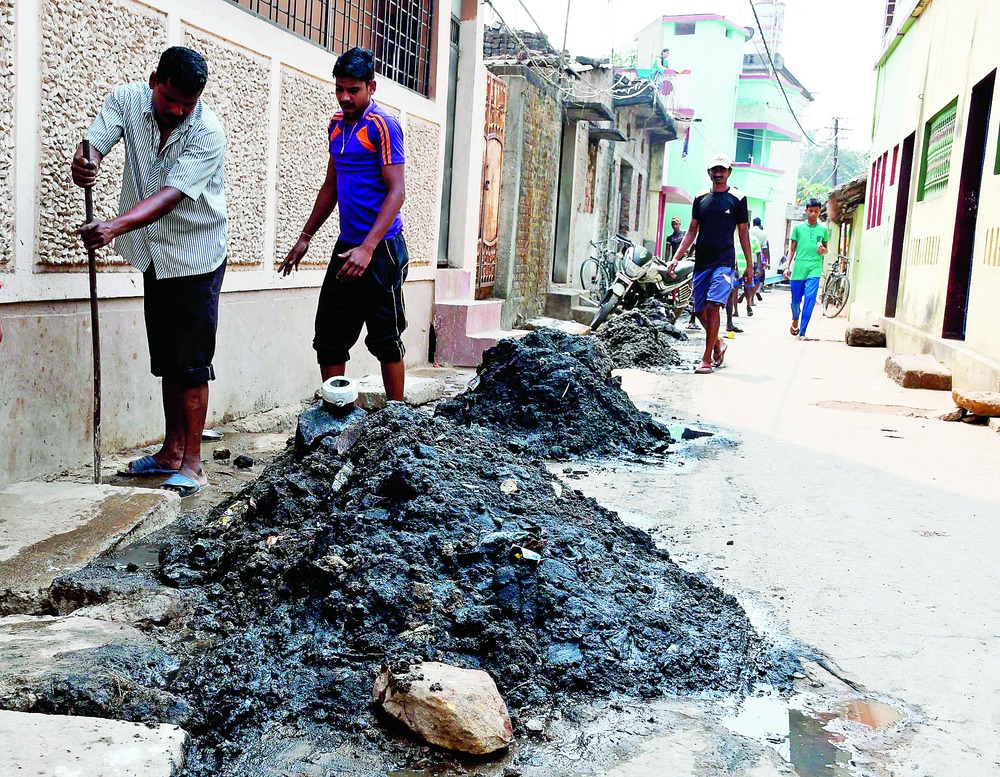

Cuttack, March 6: Special squads deployed to align drinking water pipelines passing through drains here are finding the job difficult because of sludge deposited in the channels. The work is part of the civic body's effort to fight the outbreak of jaundice.
There has been no let up in jaundice cases in Cuttack in the past two months with around 180 cases reported from Matha Sahi in ward No. 8 and its adjoining localities in three other wards. At least 10 to 20 cases were daily detected on average in the past week with the possible cause of the disease's outbreak being mixing of drain water with piped water.
Executive engineer (public health division-1, Cuttack) Sushant Ghadei today said: "Already, 40 to 45 special squads are being deployed daily for over a week to detect leakage in pipelines and align pipelines passing through drains in ward Nos. 8, 9 and 16. But unless the mud is cleared from the drains, it will not be possible to do the job in the vulnerable areas."
Reacting to Ghadei, municipal commissioner Gyana Das told The Telegraph: "Clearing sludge from drains to facilitate detection and aligning of drinking water pipelines passing through them has been initiated on priority basis in the highly vulnerable areas."
As the number of patients rose and the disease spread to wards in Tulsipur, a team of officers were assigned the task to assess the situation in the "highly vulnerable" areas, which the civic body had identified in April last year. Most of the areas, from where jaundice cases had been detected in the past two months were not among the zones identified as vulnerable to the disease.
Besides, the Cuttack Municipal Corporation today extended door-to-door survey to detect jaundice patients at highly vulnerable localities in 15 wards.
The civic body officials conceded that these localities, mostly having slum pockets, were highly susceptible to the spread of jaundice as drinking water is supplied under unhygienic conditions. These areas also lack toilets and septic tanks, while open air defecation is rampant.
"Six officers are monitoring the survey to detect jaundice patients and alignment of drinking water pipes passing through drains. These pipelines supply drinking water in the highly vulnerable areas in 15 wards," Das said.
Nearly 250 anganwadi workers, accredited social health activists and health workers have been engaged on survey work. During the survey, halogen tablets are being distributed to spread awareness. "We have a target to cover all the highly vulnerable areas in the 15 wards by end of this week," Das said.
"Unauthorised household connections detected in the process are being disconnected and they are being forced to take regular connections," Ghadei said.