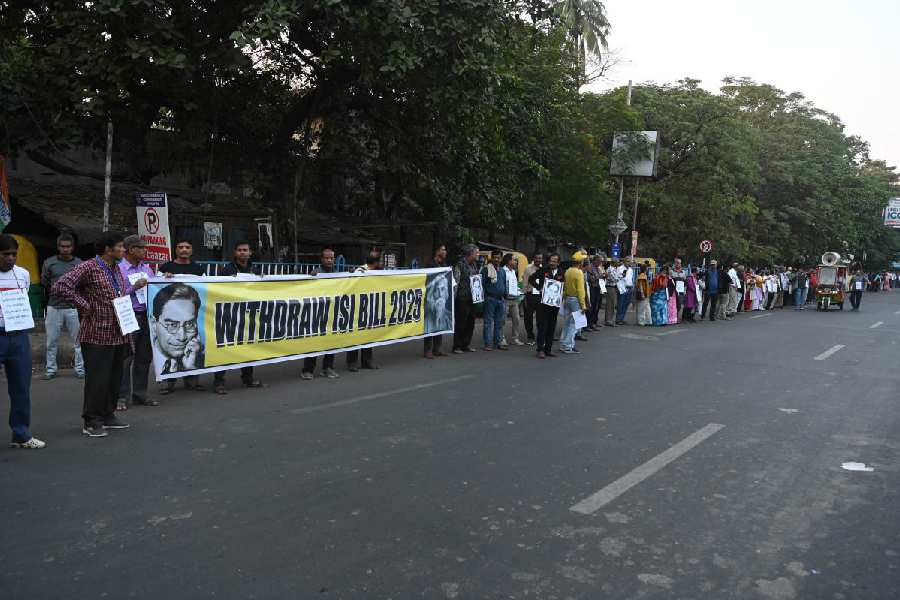
The Centre’s plans to change the governance structure at the Indian Statistical Institute, Calcutta, are an assault on its autonomy, intended to inject “pseudoscience” into its curriculum and research and control its data analysis initiatives to obtain palatable outcomes.
So believe many past and present teachers and researchers at the premier institution, several of them unafraid to speak out on record.
Multiple senior teachers alleged that academic rigour at the ISI was being diluted to make room for programmes based on the so-called Indian Knowledge System (IKS), in line with the Narendra Modi government’s focus on what most scientists identify as pseudoscience.
This effort to control research stems from a “bent of mind that leads to manipulation and interpretation of data”, said Partha P. Majumder, retired ISI professor who served as National Science Chair till July last year.
“Once the academic council is diluted, it will pave the way for the introduction of pseudoscience in the garb of research,” Majumder said.
Economist Abhirup Sarkar, also a retired ISI professor, said the institute works on data and “establishing control over that data is at the heart of this bid to take over the institute through a structural overhaul”.
Among other things, the institute researches the Indian economy, which can be a touchy subject for the government.
A teacher at the ISI’s machine intelligence unit said the institute’s statisticians “can find the loopholes in fudged figures through empirical research”.
“Perhaps that is the reason the Union government is so eager to take control,” he said.
Structure & Bill
The 94-year-old institute has historically been governed by its own society, constituted under a state law, and has a 33-member council to decide on administrative matters. This council has teachers as well as representatives of non-teaching staff and the Centre.
The institute also has an academic council, made up solely of teachers, that takes academic decisions.
However, the draft Revised Indian Statistical Institute Bill, 2025, proposes an overarching board of governors packed with members nominated by the Union government.
The council and academic council will be subservient to the board, which will decide everything from the courses offered to the director’s appointment.
Autonomy fear
The checks and balances provided by the society-and-two-councils governance structure had helped the ISI, founded by Prasanta Chandra Mahalanobis in December 1931, preserve its autonomous functioning at a time others have capitulated before the government and the market.
“Such capitulation could be prevented (at the ISI) because of our autonomous governance structure. The (Union) ministry of statistics and programme implementation is a mere member of the ISI council. The Union government is eager to break this governance structure,” ISI associate professor Kuntal Ghosh said.
Eye on economy
An arm of the ISI, the Sampling and Official Statistics Unit, researches the Indian economy. “They (the government) are seeking to control that research,” economist Sarkar alleged.
Formed in 2012, the unit focuses on research, training and policy support in official statistics, working on areas such as national data systems, development statistics in India (especially the Northeast), and methodology development for government bodies.
“When the sampling and official statistics unit is captured, we all know how easy it becomes for them (the Centre) to influence (the results thrown up by the research),” Sarkar said.
He said the institute collects data for socio-economic application as well as computer science applications.
“Using the data, we try to arrive at an independent conclusion. Maybe the authorities (the Centre) do not like that,” he said.
‘Indian’ carrot
Programmes linked to IKS are allegedly dangled as carrots before funds-starved academic institutions.
“As long as you fit the IKS in, there won’t be any dearth of funding,” said Anupam Basu, former professor of computer science and engineering IIT Kharagpur and one-time NIT Durgapur director, who is among those opposed to the draft ISI bill.
“The stick is, you have to compromise on scientific rigour and embrace pseudoscience.”
ISI teachers, past and present, flagged some of the projects introduced in institutes like the IITs over the past few years:
- IIT Kharagpur is poised to roll out a master’s programme (MS) in IKS in June. Its centre of excellence in IKS had launched a calendar in 2022 focusing on the “reinterpretation of the Indus Valley Civilisation”, prompting alumni to write to the Union education minister expressing “strong dismay” at a project devoid of “scientific evidence”.
- IIT Mandi has introduced topics such as reincarnations and out-of-body experiences as part of its foray into IKS.
- Jadavpur University, reeling under a funds crunch as support from the state and central governments declines, inaugurated a “centre for the evaluation of traditional medicine” on January 3. It is funded with ₹9.66 crore from the Union ministry of Ayush (ayurveda, yoga and naturopathy, unani, siddha and homoeopathy).
The Left-dominated Jadavpur University Teachers’ Association did not raise a murmur of protest at the quiet entry of IKS.
Many ISI professors said their institute was “being primed as the next centre to popularise and legitimise pseudoscience”.
“We work in the field of computational mathematics; maybe we will be told to focus on ‘prachin Bharater anka’ (ancient Indian mathematics),” ISI professor Ghosh said.
“Since the bill seeks to make the academic council subservient to the board, we won’t be able to resist the entry of IKS.”
Research aversion
Economist Sarkar said the attempt to dilute academic rigour at the ISI also reflected “this (central) government’s general apathy to pure theoretical research, where the ISI excels”.
“Pure mathematical theory, pure economic theory, pure computer theory -- these areas will definitely suffer because of the apathy. The government does not want to spend its resources on these fundamental areas of research,” Sarkar said.
He suggested that this reflected short-sightedness more than ideology.
“Those in Delhi think it’s a waste of money. Their (attitude) is, ‘How does it matter whether a mathematics theorem is proven?’” he said.
“What they don’t realise is that pure and fundamental theoretical research is applied later, after 50 years or maybe after 100 years. If the theoretical research is shelved, application will cease to exist.”
The ‘threat’
The consensus across the ISI’s Baranagar campus is that administrative arrogance is not the sole motivation behind the government’s desire to exercise a stranglehold on the institute.
On the face of it, ISI Calcutta never posed a threat to the saffron camp on the scale of a Jawaharlal Nehru University, because its interest areas are specific, almost niche.
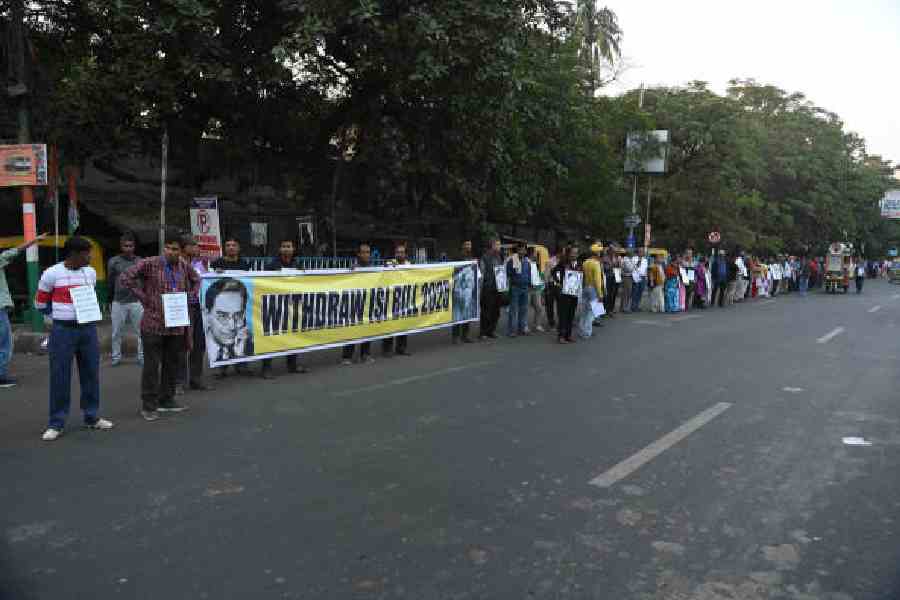
ISI teachers never opposed the Modi government as strongly as, say, Delhi University teachers did on issues ranging from academic freedom to funding. They had in their own way protested against the new citizenship matrix. And, they are up in arms against the ISI bill.
“The ISI poses a bigger threat than many others because it is independent,” a young researcher said, requesting anonymity.
Ministry response
The additional secretary assigned the responsibility of the ISI, Puja Singh Mandal, declined comment when The Telegraph contacted her.
Another official, who did not wish to be named, dismissed the allegations.
“We want to give the institute more autonomy through the bill. Only, we want to come up with a lean governance structure to fast-track decision-making,” the official said.
“We don’t wish to control academic programmes or research. The council will continue to exist in the form of the board.”
On December 26, the ministry uploaded a list of frequently asked questions (FAQs) defending the draft bill.
It argued that the “excessive internal representation” and the large number of elected members in the ISI council hindered decision-making “as even a small group of dissenters can effectively block important decisions”.
An email to ISI council chairperson Koppillil Radhakrishnan, seeking his reactions to the teachers’ concerns, remains unanswered.
The current officiating director of the ISI, Ayanendranath Basu, said he needed permission from the council secretary to respond.