Wednesday, 24 June 2026
Wednesday, 24 June 2026
Wednesday, 24 June 2026
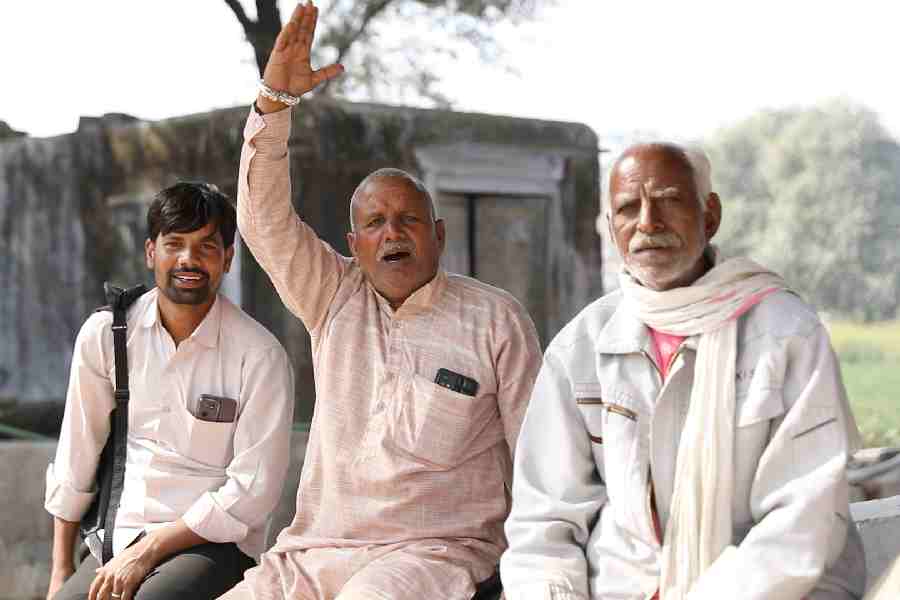
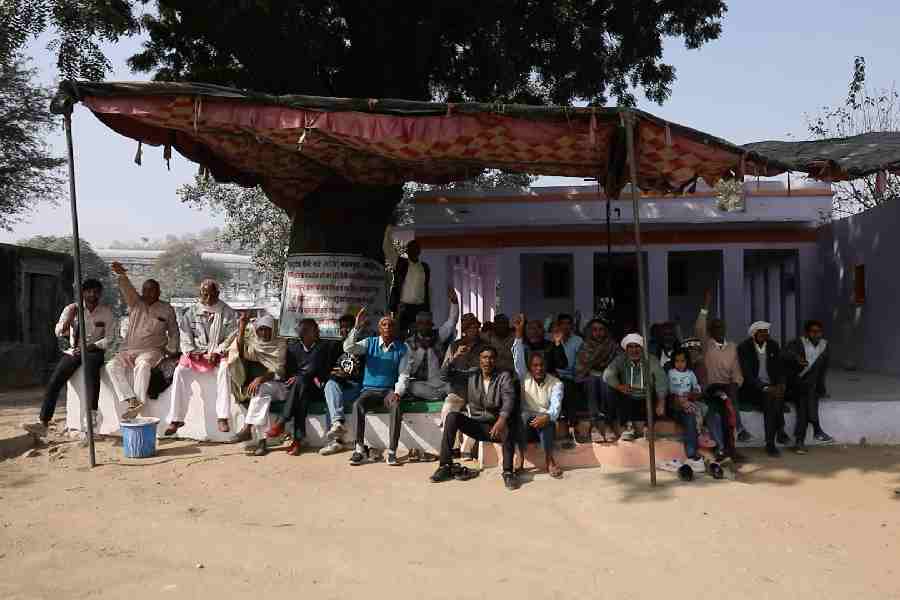
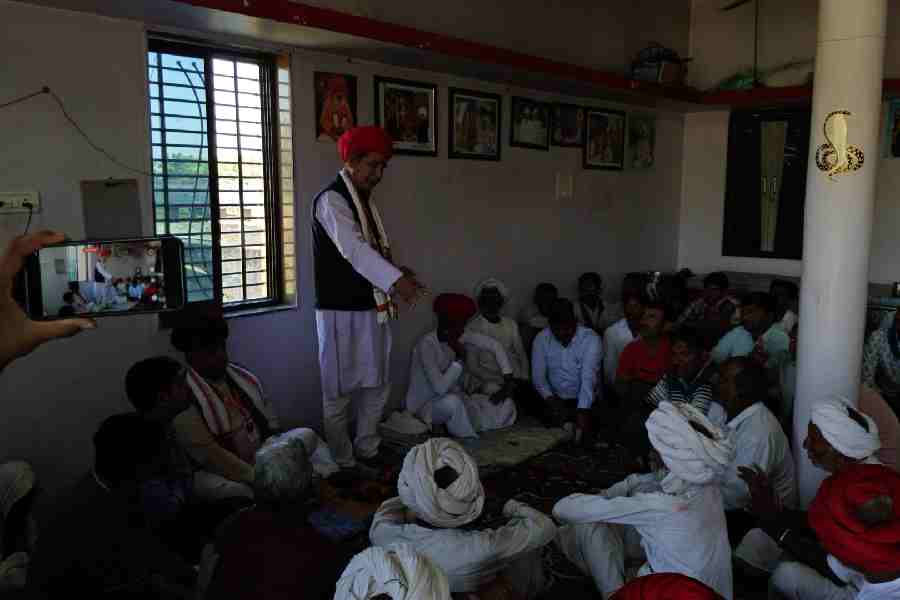
Every day for over three years now, residents of Jodhpura village in northeast Rajasthan’s Kotputli-Behror district, around 50 km from Jaipur, gather at a small field from around 9am to 5pm.
It would be easy to mistake it for a daily village hangout session if it weren’t for the poster that hangs behind them.
“UltraTech Cement Plant (KCW) Mohanpura-Jodhpura Gate. An indefinite sit-in protest has been staged here for over three years, demanding the closure of the plant or rehabilitation of Mohanpura-Jodhpura village.”
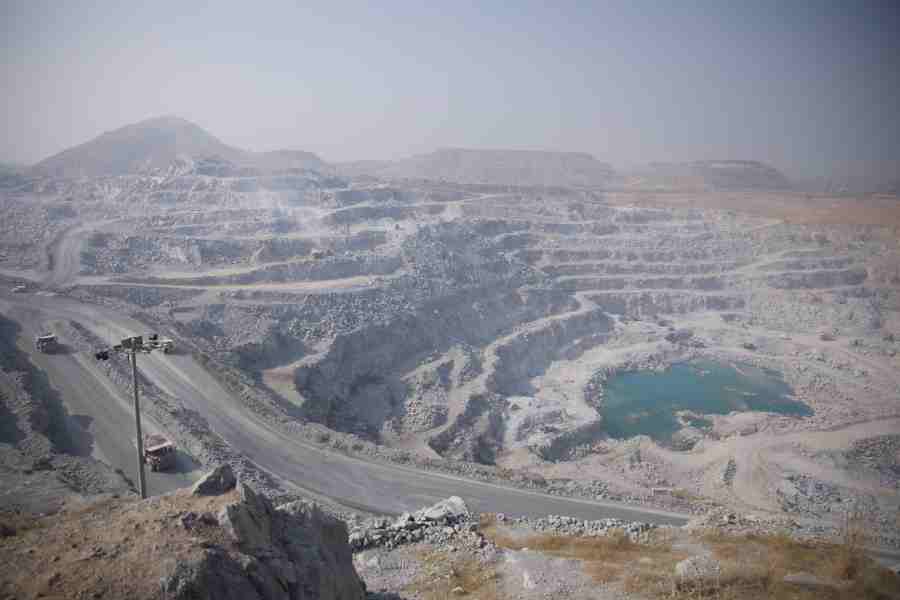
The villages of Mohanpura and Jodhpura are located less than 500 m from the UltraTech Cement Plant. The villagers say the mining has made their lives a living hell.
Protests and widespread backlash raged across north India after the Supreme Court on November 20 last year redefined the Aravallis as any landform rising to 100 m above the local terrain or clustered within 500 m. It was seen as potentially exposing large portions of the Aravallis to mining and development. On December 29, the apex court stayed the order, and the stay was extended on January 21.
As time passed, the big protests died and the Aravallis slipped from headlines and national attention.
But for the people who live in the districts lining the hill range in Rajasthan, the fight started long before the Supreme Court ruling, and it continues even after the media spotlight has dimmed.
On some days, the attendance at the Jodhpura protest site is in the 50s, on other days it is in the single digits, but villagers make it a point to be there from morning to evening – some skipping work, some joining right after they are done with work or chores.
Most of their day is spent in gathering documents, signing petitions, drinking copious amounts of tea and catching up with each other in between. Sometimes to keep their spirits up, they shout slogans in unison. Whenever there is an announcement or some news, one person announces it on the microphone. Villagers come out of their homes and gather at the field almost instantly.
On weekends, the protest site also becomes a playground for the children
“Our biggest problem is that the blasting happening so close to our homes has caused our walls to crack; they can collapse any time,” says Kailash Yadav, an activist and a resident of the village.
“The second plant opened very close to our village in 2023, and its stone crushers are situated at a distance of 82 m from the residential area. The dust from the stone crushing has caused serious breathing problems and other health hazards among residents.
“Worst of all, they have mined so deep that groundwater has depleted and the village has lost access to groundwater. "We have to pay Rs 500 to buy water from tankers, as there is a severe shortage of drinking water," he added.
The villagers started first by appealing to the authorities, which later evolved into a sit-in agitation after they saw no action taken.
In November 2025, the Central Zone Bench of the National Green Tribunal (NGT) ordered the Rajasthan government to set up a committee to rehabilitate the entire village and also compensate the villagers for health (Rs 20,000 per person) and property damage (Rs 50,000 per family).
The NGT also held UltraTech Cement Ltd responsible for environmental damage and health hazards in the area.
The villagers claim not much has changed. They continue to live in the same conditions as before. They continue to sit in protest.
On days when they feel hopeless, they look towards that same mining site. In the distance, atop the hill, stands a small temple where the villagers pray.
The Telegraph Online had accompanied the villagers when they went to meet the sub-divisional magistrate (SDM) of Kotputli district.
The SDM, in a closed-door meeting with the representatives of Jodhpura, Kasli-Shuklawas and Sikar, is understood to have asked for a month’s time to implement the compensation and take care of the grievances of the other villages.
The SDM refused to speak to The Telegraph Online as it was a “matter of the villagers and media isn’t needed.”
Truckloads of danger
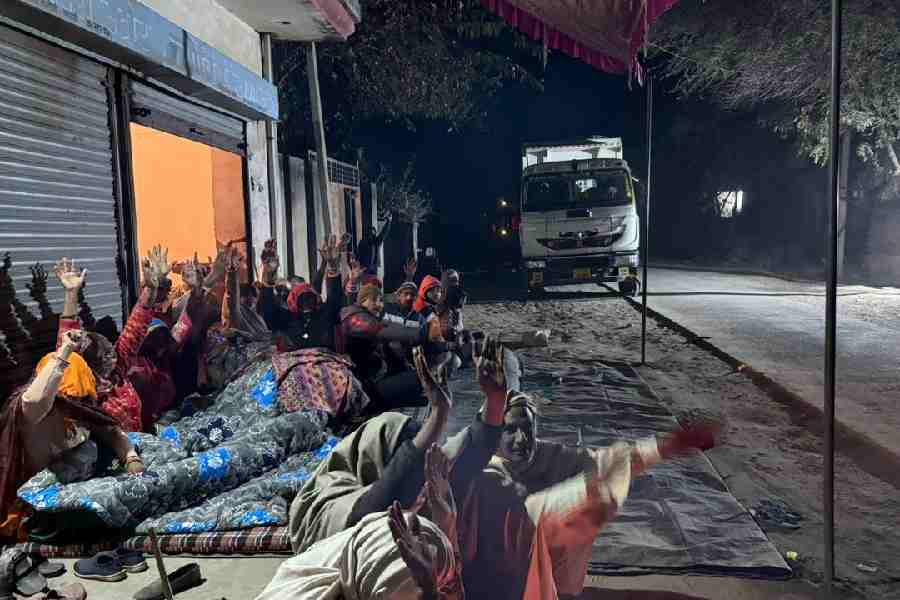
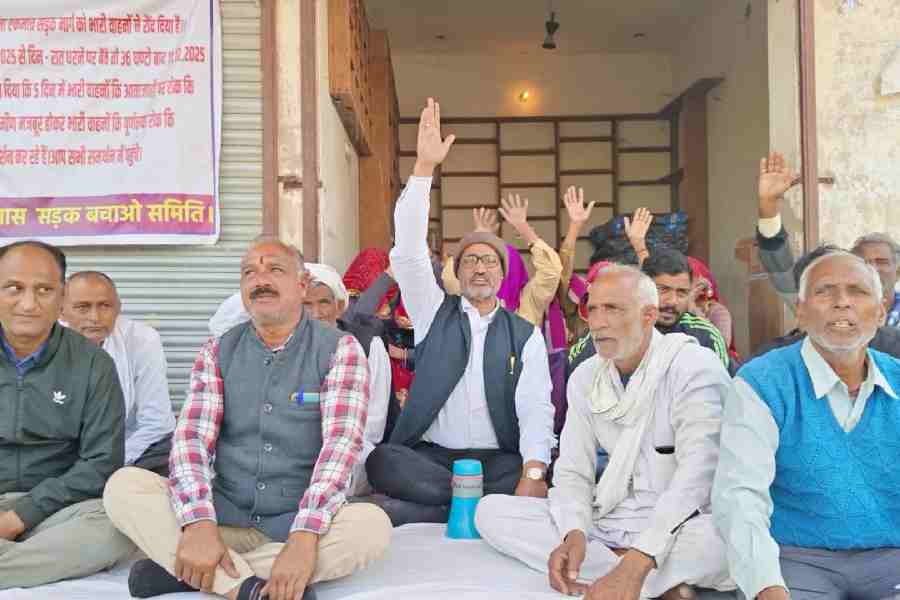
A little over a kilometre from Jodhpura, on a narrow stretch of road connecting the villages of Kasli and Shuklawas, villagers sit on chairs and mattresses, soaking in the winter sun. Even at night, even in the harsh Rajasthan cold, they remain.
An old man lights up a traditional hookah, while another lights a fire. Those lounging on mattresses or on plastic chairs gravitate towards the two. Calls for chai from one of the nearby houses excite all of them. One can almost forget that it's a protest – it almost seems like a sleepover.
They have been protesting for over a month against the plying of overloaded dumper trucks on that narrow stretch of road. These trucks carry stones for Ultra Prime Industries Pvt. Ltd.
The villagers keep coming and going from the protest site. At night, they set up mattresses in an empty shop where the protesters take turns to sleep while the others keep guard. On some days, everyone eats together at the protest site, on others they go back home to eat before coming back.
They say that the overloaded trucks pose a safety hazard for the residents of the village, as big boulders may fall off and endanger pedestrians, especially children who go to school through the road.
The trucks also damage the road, creating large potholes, which are gradually making the road unusable for tractors and other vehicles, the villagers say.
Whenever an overloaded truck enters this narrow patch of road, one of the protestors, usually the younger ones, walks up to the middle of the road, stands in front of the truck and asks it to turn around.
After several appeals and protests, the public works department installed a signboard at the mouths of the road barring heavy trucks from entering the road. Some enter regardless, and the villagers stand guard round the clock to make sure the trucks don’t pass.
The authorities have requested the villagers for a month to find a solution or alternative route for the trucks, but the villagers, especially environmentalist and activist Radheyshyam Shuklawas, aren’t convinced.
“If we don’t stand guard, they will simply go back to using the road like always, and nothing will ever change. So we will stay here until a proper solution is found,” Shuklawas says.
The SDM is learnt to have requested the residents to allow trucks to ply for a month until an alternative route is found. The owner of UltraPrime Industries Pvt Ltd also said as much to The Telegraph Online.
A river still survives, because of people
Just about 20 km from Kotputli cutting across the Aravallis is Neem ka Thana – a setting almost similar to Kotputli, except the houses are scarcer and more spread out.
Several protests have been going on for years here, with the most recent one having started on January 26, 2026.
Residents of Bhagwanpura started their protest against M/S Ojaswi Marbles & Granites Pvt. Ltd, which started fencing work and was documented bringing in heavy machinery from January 16.
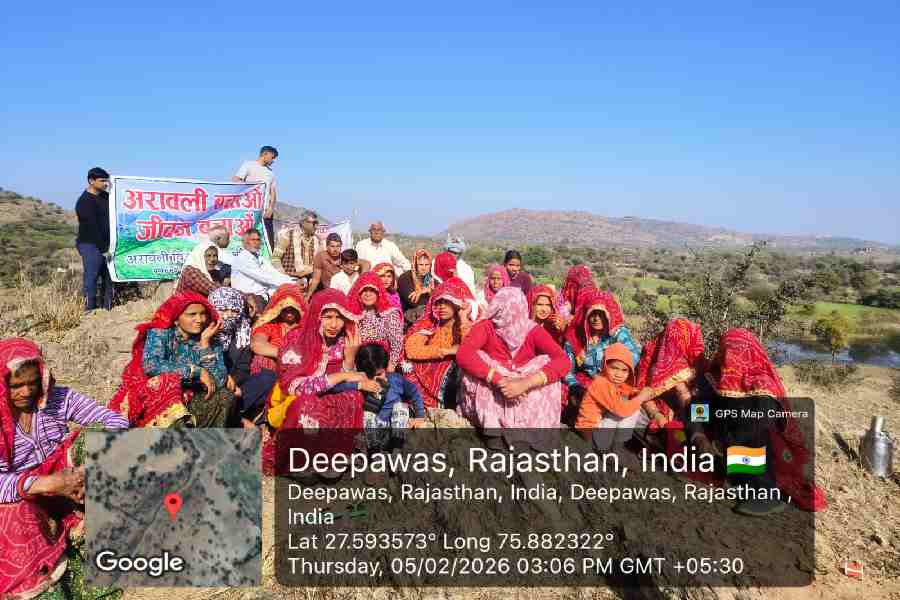
The villagers usually gather atop a small hill that overlooks the Girjan River and the hills where mining work has started. Previously, this was where groups would gather in the evening to have a quiet time or chitchat and have their evening tea. Now it has become a protest site.
According to a writ petition filed in the Supreme Court, the agricultural fields and houses of some villagers fall within the area leased out for mining.
The villagers fear that if the mining starts, it will have health implications for residents and will also dry up the Girjan river which originates from the Aravallis – one of the last surviving ones of its kind. At least five such rivers have diminished or are virtually dead.
The whole tehsil depends on the Girjan river. The water from the river is used for agriculture. It also recharges the groundwater in the area, which the villagers use for drinking and other purposes. Without the water from the river, their lives will come to a standstill.
“The people who profit from these mining companies don’t live around the land they mine on, because they know how mining poisons the land,” says Mamraj Meena, whose house is right next to a hill being cleared of vegetation.
“Our families have been living here for generations. I have seen young and old suffer the health consequences of mining. I have seen hard-working families pushed into poverty and starvation. We are against the hunger for wealth that makes people blind to the consequences of their actions upon others.”
A year or so ago, when officials from the mining company started to visit the site, the villagers protested. The villagers said after that there was no fresh activity in the area for almost a year until it started again on January 16.
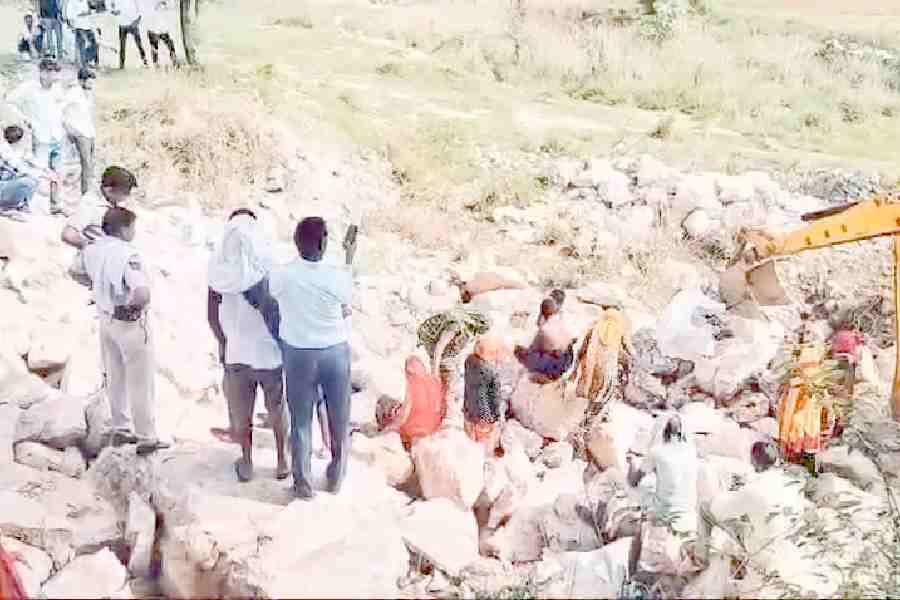
A few kilometres away, women, clad in sarees and ghungat covering their faces, stand guard to protect the Girjan river. In 2023, they fought to stop a mining company from digging near the riverbed. They protested by standing in front of the heavy machinery.
Now, these women who are involved in agriculture communicate through WhatsApp groups to keep each other informed of any potential threat.
A petition has been filed in the Supreme Court against the mining company alleging violations.
“We are trying to develop the village, not destroy it,” said a representative from the mining company who spoke to The Telegraph Online.
82,000 families in peril
Several hundred kilometres – and numerous dhabas, motels and “child beer” shops – away from Jaipur, residents of 12 villages in Sirohi’s Pindwara have been protesting against the proposed mining project of Kamlesh Metacast Private Ltd.
Unlike their counterparts, this protest is more on paper than on the streets. Most of the protesters are from the Adivasi communities, who don’t have access to proper roads or electricity. Some of them travel 10 km on foot just to join these protests to save their home.
According to a petition filed by them, the proposed mining lease includes several houses and agricultural lands from the 12 villages.
The villagers say that if mining work starts they will lose their homes and their only source of livelihood, agriculture and animal husbandry. The residents whose houses don’t fall under the mining lease area are scared that their houses and their health will bear the same consequences as their counterparts in Jodhpura once mining activity starts.
Several residents of these villages are descendants of freedom fighters, and other warrior clans, who are proud of their legacy in the state.
Public outrage has spread in the Pindwara subdivision of Sirohi district after the administration issued notices under Sections 126 and 135(3) of the Indian Civil Services Code, 2023 (BNSS), to protesting villagers.
The Telegraph Online learnt that Section 163 was also imposed in the areas to prevent the residents from organising a larger agitation, which was initially planned for January 28 but had to be postponed indefinitely.
Administration sources told The Telegraph Online that the residents have been told that a high-level committee will be formed to investigate their grievances and that no mining activity will happen in the area until the committee submits a report.
The villagers say these are false promises being made as the panchayat elections are near. Advocate Tushar Purohit, who is fighting the case on behalf of the residents and is a resident of Pindwara himself, said, “The protest will happen, whether it’s tomorrow or the day after. We are not going to stop.”
Long march along the Aravallis
On January 24, several environmentalists, ecologists, lawyers, researchers, social activists, and rural-urban communities, mainly hailing from the rural communities in the Aravallis, set off on a 700 km march on foot across the length of the Aravallis, from Gujarat till Haryana.
Their objective is to safeguard the Aravallis and raise awareness to a wider audience by visiting all the districts adjoining the mountain range and documenting the impact of mining activities.