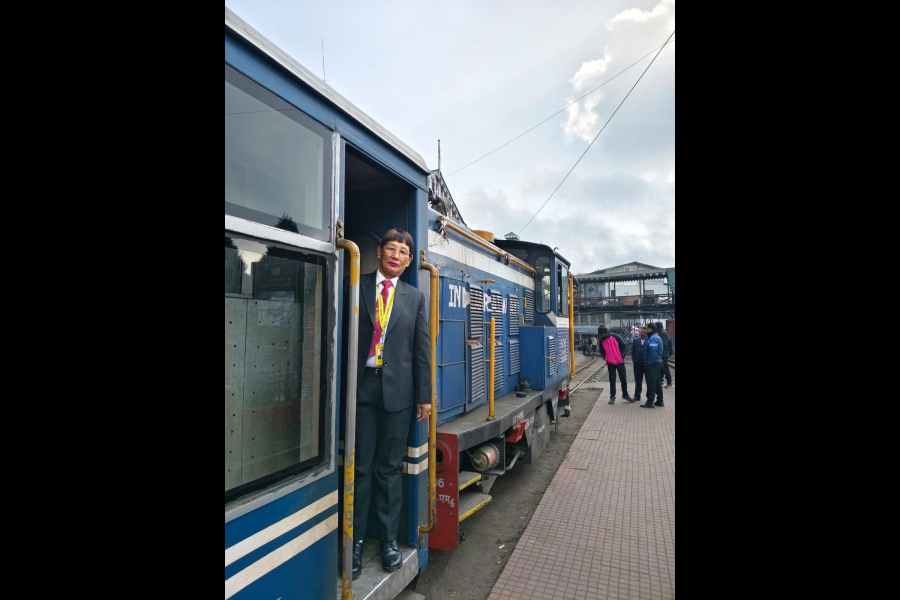
Much like the Z-reverse system that helps the Toy Train navigate a steep climb by moving forward, backing up and switching tracks, a quiet shift is helping women take up roles traditionally reserved for men since the Darjeeling Himalayan Railway’s inception 145 years ago.
When 55-year-old Sarita Yolmo assumed charge as the first woman travelling ticket examiner (TTE) for the DHR on February 5, she had Madhu Lama to thank for being the trailblazer.
Madhu, 68, became the first woman ticket collector (TC) for the DHR in 1990 and worked till her retirement in 2017.
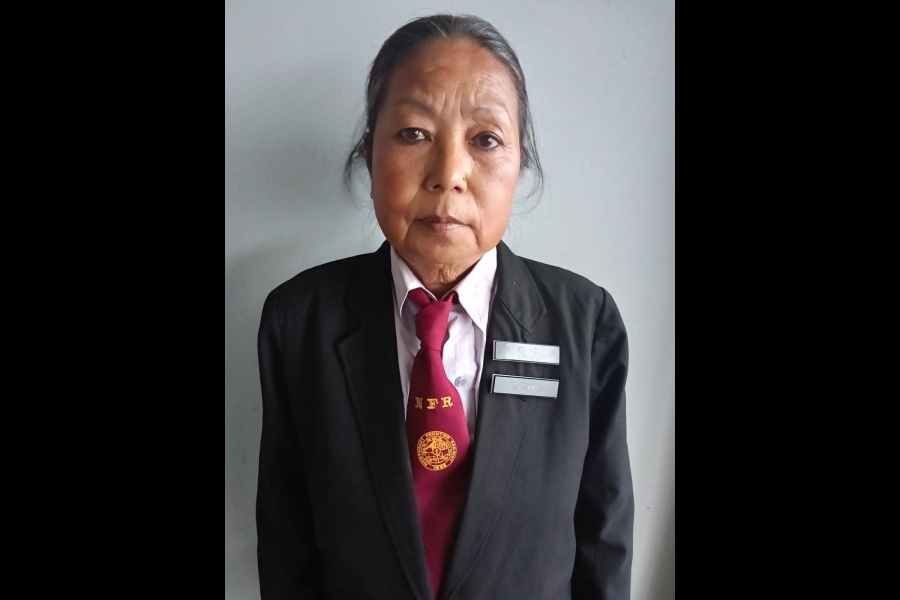
Madhu Lama first lady ticket collector (TC) of DHR telegraph picture
Technically, a TC is tasked with examining tickets on the platform and making announcements. A TTE inspects tickets on a running train.
However, Madhu often had to verify tickets on joyrides on the Darjeeling-Ghoom and Darjeeling-Kurseong routes.
“I have both good and bitter memories,” she told The Telegraph.
Madhu enjoys how people unexpectedly turn up years later and show her the photographs they took with her during the train rides.
“I also faced harassment over refunds when rides had to be aborted due to derailments. Sometimes, we could not assure passengers of refunds without permission from seniors or within three hours of the incident. It was quite a challenge to handle passengers in such situations,” Madhu recalled.
She had joined the DHR as a Group-D staff in the catering wing in 1984 before passing an internal TC exam in 1990.
Sarita, who joined a railway printing press in Kurseong, was posted to New Jalpaiguri in 2019 when it shut down.
She soon cleared an internal exam for the post of TC and did a short refresher course to become a TTE.
“I had been working as a TTE for the past three-four years, but on February 5 my seniors told me to travel on the Toy Train from NJP to Darjeeling,” Sarita said.
She was again given the responsibility on February 8 and took the return train the next day.
“I was excited as I could visit my relatives in my hometown Sonada, but I was also a bit nervous,” she said.
Her husband Dawa Yolmo, a retired section engineer of the DHR, encouraged her to take up the assignment.
Many steam-engine aficionados highlighted the inspirational role of women in the DHR.
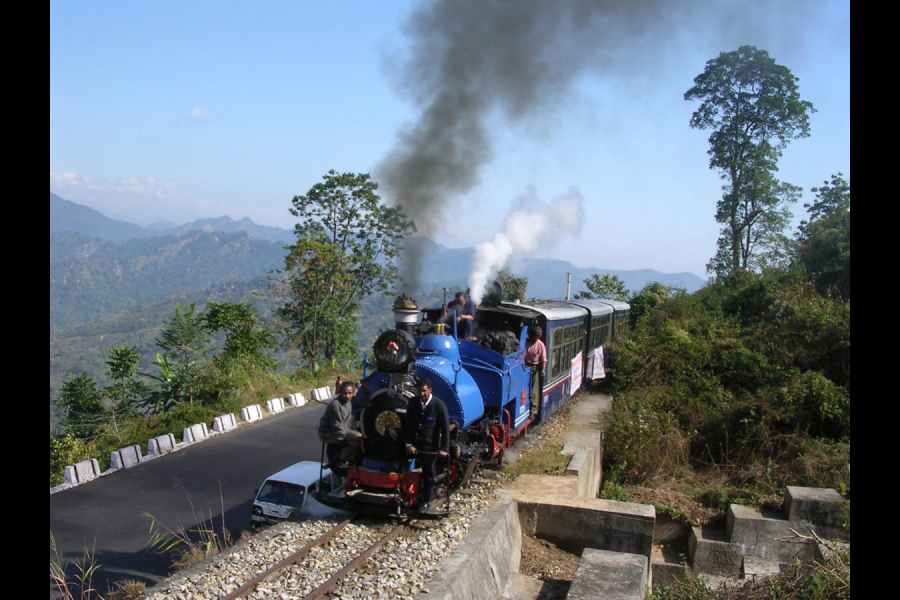
A toy train of the DHR.
A document of Unesco, which listed the DHR as a World Heritage Site in 1999, states that Franklin Prestage — the then agent of the Eastern Bengal Railway Company — proposed a steam tramway from Siliguri to Darjeeling in 1878. The project was completed in 1881.
According to a famous lore in the annals of the mountain rail’s history, Prestage had written to his wife about the difficulty in constructing a railway line on a steep stretch near Gayabari.
His wife had asked him to “return” (home) if he could not move forward.
It acted as a lightbulb moment for the engineering team, which came up with the idea of a zig-zag reverse mode of construction, called the Z-reverse or Z-loop, to negotiate the steep climb.
It is a switchback system in which the train moves forward along one leg of the Z, halts and shifts to a reversing track, goes back up the mountain, and switches tracks again to move ahead after gaining sufficient altitude.
“This is a famous DHR lore and has been mentioned by several writers in the past,” said Sonam B. Wangyal, an author and doctor from Darjeeling.
“There are six reverses…. (along the 88km route from Siliguri to Darjeeling),” the Unesco document states.
The other method to gain height is through a loop.
“There are three loops along the DHR stretch, the famous being the Batasia loop. I even came across Z-loops in Peru which were built after the DHR,” Wangyal said.