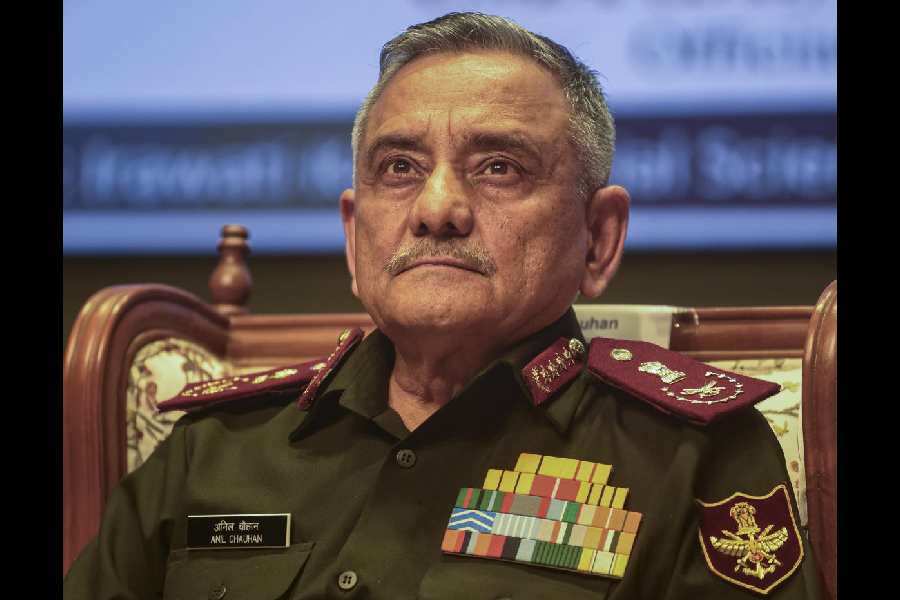
Chief of Defence Staff General Anil Chauhan on Friday claimed that Jawaharlal Nehru recognised Tibet as part of China because he wanted good relations with Beijing, assuming the Panchsheel pact signed in 1954 effectively settled the northern border row, but China had different views.
His comments came amid the ongoing border tension with China along the Line of Actual Control in Ladakh and the latest controversy over Manoj Naravane’s unpublished memoir, Four Stars of Destiny, which purportedly claims the top political leadership in Delhi failed to give clear directions to the former army chief while Chinese tanks were advancing towards Indian territory in August 2020.
“On independence, the British left, and it was for India actually to decide
where a front is. Nehru probably knew that we had something, as the McMahon Line was in the east, and we had some kind of a claim in the Ladakh area, but it was not here. So that’s why he wanted to go in for a Panchsheel Agreement, probably,” Chauhan said.
The 890km McMahon Line is the de facto boundary between India and China in
the Northeast. The international boundary in the Northeast was drawn at the tripartite Simla Convention of 1913-1914 by British India, Tibet and China.
Independent India, the CDS said, was keen to build a good relationship with China and Beijing also wanted stability in the area after its “so-called” liberation of Tibet.
“For the Chinese also, because they had kind of liberated, so-called liberated Tibet, they had moved into Lhasa, they had moved into Xinjiang — this particular area was extreme from both ends, so they wanted stability, probably in this particular region.
“In 1954, India recognised Tibet as part of China; both countries signed the Panchsheel Agreement. With this, India assumed that it had settled its border, the northern border, the only area which we assumed was not settled, through a formal kind of a treaty…. But the Chinese stand was that this agreement was negotiated only for trade, and it in no way reflected the Chinese stand on the border,” Chauhan said.
According to him, after China occupied Tibet and India supported China’s permanent membership of the United Nations, the “Himalayan buffer” between India and Tibet “evaporated” and converted into a border.
According to India’s foreign ministry website, the Panchsheel, or the Five Principles of Peaceful Co-existence, was first formally enunciated in the agreement on trade and dealings between the Tibet region of China and India on April 29, 1954. According to the pact, the two governments “have resolved to enter into the present agreement based on mutual respect for each other’s territorial integrity and sovereignty, mutual non-aggression, mutual non-interference, equality and mutual benefit, and peaceful co-existence”.
Last year, during Prime Minister Narendra Modi’s visit to Beijing after seven years, Chinese President Xi Jinping had underscored that the Panchsheel pact must be cherished and promoted by the two countries. While Xi highlighted the agreement as a guiding framework for India-China ties, Modi underlined the importance of mutual respect, mutual interest and mutual sensitivity as the basis for stability and long-term cooperation between the two countries.