For much of the past decade and a half, Bangladesh has been described abroad as a paradox. A nation posting steady, even impressive, economic growth while its democratic space steadily narrowed under Sheikh Hasina’s iron-fisted rule.
This week’s parliamentary election — the 13th since independence— was therefore more than a routine transfer of power. It followed a revolutionary-scale uprising that brought an abrupt end to Hasina’s 16-year autocratic tenure and posed a far larger question about the country’s political future.
It was thus a test of whether the country’s politics could reset after years of one-party dominance and whether Islamist resurgence would redefine the state’s trajectory.
The answer, delivered at the ballot box, was decisive. And it was not revolutionary.
The Bangladesh Nationalist Party (BNP) reclaimed power with a commanding majority, securing more than two-thirds of the 300 seats in the Jatiya Sangsad (National Parliament).
Its chairman, Tarique Rahman, stepped back into the heart of national politics after years abroad and secured decisive victories in two constituencies and now stands on the threshold of the Prime Minister’s office.
After 17 years of rule by Hasina and the Awami League, the country’s longtime main Opposition swept the field in an election from which the Awami League was legally barred.
Yet the scale of the victory obscures the nature of it. This was not a tidal wave of a new ideological fervour sweeping aside the old order. It was a reckoning shaped by voter frustration and organisational muscle. And that was aided by the unforgiving arithmetic of Bangladesh’s first-past-the-post electoral system.
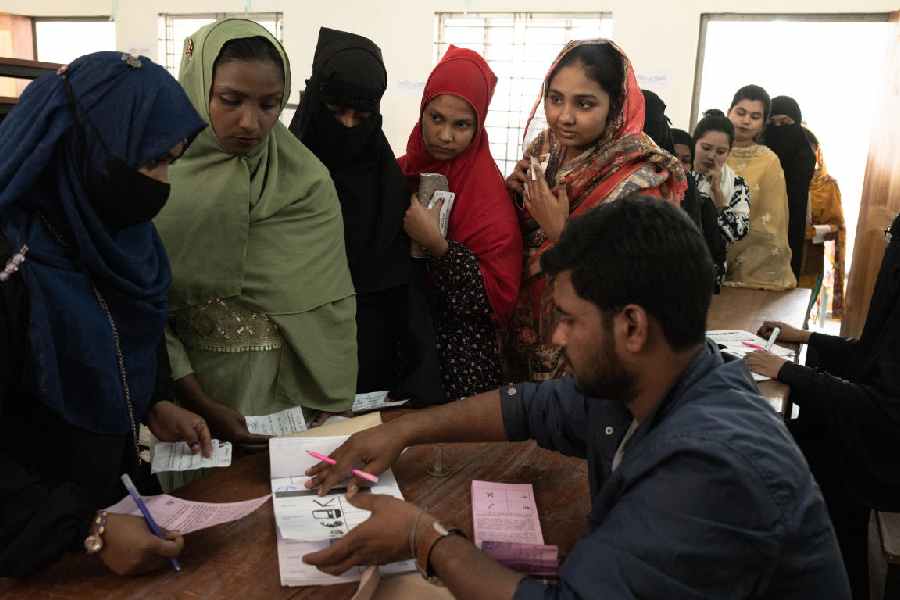
A polling official checks voter identity and hands out ballot papers in Dhaka on Thursday. Getty Images
In the months leading up to the vote, a different storyline had captivated observers. The rise of the Bangladesh Jamaat-e-Islami. Surveys suggested the country’s largest Islamist party’s support had climbed to between 30 and 35 per cent — an extraordinary leap from its historical ceiling of roughly 12 per cent. Some analysts wondered whether Bangladesh was on the cusp of a “Jamaat moment”.
But swelling vote share does not automatically yield parliamentary dominance in a winner-take-all system. To form a government, a party must translate votes into 151 seats.
Jamaat’s support, while historically high, was uneven and regionally concentrated, particularly in three out of Bangladesh’s eight divisions — Rajshahi, Khulna and Rangpur. It lacked the uniform national momentum that produces landslides.
Political scientists distinguish between normal elections, deviating elections and wave elections. This contest was best understood as a blend of the first two. It was not a realigning election marked by a permanent ideological shift. Nor was it a national wave in which voters across class, gender and geography rally behind a single banner out of spite and ideological shift.
Instead, quite a significant number of voters probably just made a temporary deviation — while the deeper party structure remained intact.
The anger was directed in part at the BNP itself. After the August upheaval that ended Awami League rule, the BNP’s local machinery performed poorly. Reports of petty corruption, bribery and extortion by grassroots leaders fueled resentment. In tea stalls and district towns, voters voiced exasperation with what they saw as arrogance and opportunism.
That discontent fed Jamaat’s surge. A portion of BNP loyalists defected. Swing voters, searching for an alternative, flirted with the promise of an “honest” Islamist slate.
Jamaat’s disciplined cadre and moral branding resonated, particularly among urban, educated voters hungry for a reset. But flirtation is not the same as commitment. The BNP’s base, historically broader and organisationally deeper, did not collapse.
The party made a calculated choice during nominations. It relied heavily on its old guard — candidates with entrenched name recognition and dense patronage networks — rather than gambling on new faces.
Jamaat, by contrast, fielded trusted but often lesser-known figures, constrained by a thinner bench in several divisions.
In rural Bangladesh, that difference mattered. Voters there are pragmatic. An MP is not simply a legislator but a broker of safety nets, dispute resolution and access to state resources.
Perceived honesty, while admirable, does not automatically guarantee those services.
Faced with uncertainty, many voters chose familiarity. They may have been “really, really pissed off”, but they preferred the devil they knew.
Jamaat also encountered self-imposed ceilings. Its equivocation on women’s issues failed to reassure a female electorate central to Bangladesh’s labour force and educational gains.
Women’s economic participation is not peripheral. It is foundational to the country’s development story. Ambiguity on gender rights is a political liability. And liability it was for Jamaat.
More fraught was Jamaat’s attempt to soften or reinterpret its historical role during the 1971 Liberation War. The war of Bangladesh’s liberation is anything but an abstract memory. It is the nation’s founding narrative. Even among conservative households, revisionism around 1971 touches a nerve. Voters may debate policy, but they draw red lines around history.
If Jamaat achieved its best electoral performance ever, it did so partly because of the BNP’s missteps. Extortion scandals and local mismanagement drove some voters into Islamist ranks. In a closely contested first-past-the-post race, even modest swings can flip dozens of constituencies.
Jamaat capitalised where it could, winning 76 seats with allies. That is no small feat. But it was not enough.
The election, however, produced a modest but noteworthy third force. The National Citizen Party (NCP), born from the 2024 uprising, secured six seats — in alliance with Jamaat. In a winner-take-all system that punishes fragmentation, that breakthrough signals a limited but real appetite for alternatives beyond the new BNP-Jamaat binary.
As Rahman prepares to assume office, he probably inherits a country recalibrated rather than a country remade. Turnout hovered around 61 per cent — a sign of engagement. The mandate is substantial, but it is built less on ideological conversion than on structural advantage and voter calculation.
Yes, anger can propel a surge. Moral rhetoric can lift a vote share. But in Bangladesh’s electoral system, organisation, networks and familiarity still rule. The BNP did not ride a revolution to power. It won because, in a moment of uncertainty, enough voters decided it understood the country better than its rivals — and because its rivals could not turn frustration into a national wave.