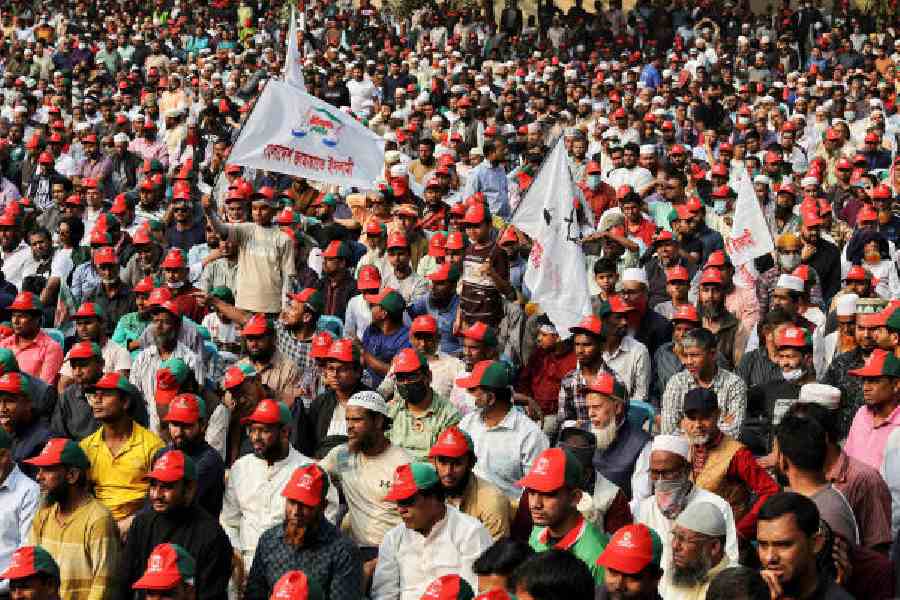
Not the landslide victory of the Bangladesh Nationalist Party (BNP) headed by Tarique Rahman, but the victory of Jamaat-e-Islami candidates in most of the seats along the Indo-Bangladesh frontier took centre stage in Bengal politics on Friday, triggering debates over whether it would have an impact on the poll outcome on this side of the border.
The BNP and its allies secured over 200 seats with a two-thirds majority, while Jamaat-e-Islami and its allies secured over 70 seats.
A source said the Jamaat secured at least 80 per cent of the seats along the border, amounting to at least 40 seats. Most of these seats are in the Bangladesh districts of Satkhira, Lalmonirhat, Panchagarh, Rangpur, Dinajpur and Chapai Nawabganj, which border Bengal.
Jamaat, which is known for its anti-Hindu and anti-India rhetoric, won, posing what some described as a fresh threat to India.
The BJP, on its social media platforms, posted a map of Bangladesh with the poll outcome to claim that the results had posed a major threat to Hindus because of Jammat's success, while alleging that the regime of Mamata Banerjee patronised infiltration.
“The election result in Bangladesh is an alert for Hindus in Bengal. The rise of Islamist fundamentalist forces along the Bangladesh border with our state and the alleged indulgence of infiltration by Mamata Banerjee jointly pose a threat to Hindus. We will urge Bengal voters that if they want to ensure the security of Hindus in our state, they should ensure the defeat of the Trinamool Congress government,” Union minister of state Sukanta Majumdar told The Telegraph.
Majumdar also claimed that he expected that the persecution of Hindus witnessed during the Muhammad Yunus regime would stop under the Tarique Rahman-led BNP government.
“We always want the people of Bangladesh, particularly Hindus, to live in peace. We congratulate the BNP on its victory. However, we want the new government to ensure that there is no incident of Hindu persecution as witnessed during the earlier regime,” added the Balurghat MP.
Since the fall of the Sheikh Hasina government in August 2024, incidents of Hindu persecution allegedly increased in Bangladesh, with Islamist fundamentalists being blamed. BJP sources claimed that such developments helped the party consolidate Hindu voters on this side of the border.
Multiple BJP sources said that Hindus in Bengal were heavily impacted by witnessing the alleged oppression of Hindus in Bangladesh, which could help the party consolidate Hindu votes more effectively than before. So the BJP is trying to use the victory of Jamaat-e-Islami in the border districts as a poll plank to consolidate Hindu votes in the run-up to the Assembly elections.
Although the BNP, which presents itself as a "liberal" and progressive party against the Jamaat alliance, was trusted by the majority of the Bangladeshi electorate, many pointed to the party’s past ties with Jamaat and similarities of views when Hasina ruled the neighbouring nation.
Biswanath Chakraborty, a political scientist, pointed out that the results in Bangladesh’s Bengal bordering seats, where a strong Islamist force like Jamaat won, could help the BJP escalate Hindu consolidation in Bengal. From Cooch Behar to South 24-Parganas, there are at least 90 Assembly seats in districts bordering Bangladesh.
“Developments in Bangladesh, particularly consolidation among the majority community, have always had a direct impact on the bordering seats on this side of Bengal. As Jamaat has won the bordering seats in Bangladesh, the BJP, which also depends on Hindu consolidation, may get an opportunity to escalate polarisation by highlighting the Bangladesh election result in that particular region,” Chakraborty said.
However, Zaad Mahmood, who teaches political science at Presidency University, argued that Jamaat has been a strong force in Bangladesh’s bordering areas for several years, but the overall election outcome would not necessarily benefit the BJP, despite Jamaat’s victories in those seats.
“A narrative had been built before the election that the Bangladeshi people would support a radical Islamist party like Jamaat. However, the election result proved that narrative wrong, as the people of Bangladesh showed their trust in a major, stable, organised and institutionalised party like the BNP. If Jamaat had come to power, the BJP might have benefited here in Bengal,” Mahmood said.
The Trinamool Congress, however, claimed that the BJP always celebrated Jamaat’s victories to promote divisive politics in Bengal.
“The people of Bangladesh have rejected fundamentalist forces in their election. Similarly, a fundamentalist force like the BJP will also be rejected by the people of Bengal in the upcoming election. The BJP always celebrates Jamaat’s victory to derive benefits from divisive politics,” said Trinamool spokesperson Arup Chakraborty.