Last Friday, the German Parliament passed a law requiring all 18-year-old men to complete military questionnaires and undergo medical examinations. Students walked out of classrooms to protest what they see as the first step towards reviving conscription as Berlin pours tens of billions of euros into rearmament. The prospect of a larger European war, once dismissed as unthinkable, is now shaping politics at the heart of the European Union.
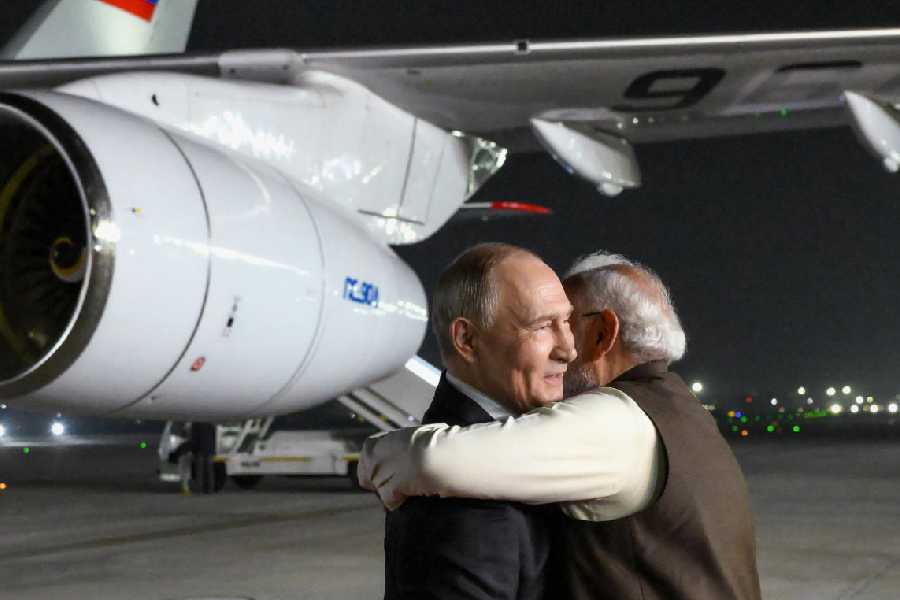
While German students were striking, the Russian president, Vladimir Putin, was being greeted in India with a hug and a limousine selfie on his first visit to the country since the full-scale invasion of Ukraine. Russian media lingered on the optics, noting that he was hosted in a “palace with 340 rooms”. At the same time, a report by The Washington Post revealed that a former, deep-cover Russian spy in the United States of America, Andrei Bezrukov, is now leading Moscow’s campaign to plug Russian hardware, software, and cybersecurity systems into India’s booming tech sector — pushing joint projects in quantum cryptography, Russian-made processors, and ‘sovereign’ laptops for the use of the Indian State.
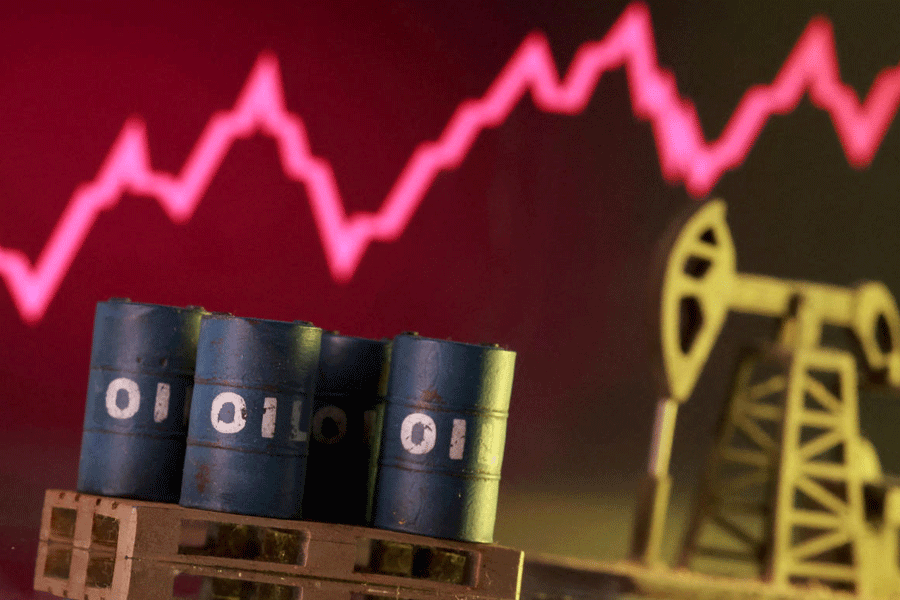
Four years into a grinding war, the West’s bid to make Putin a global pariah has clearly failed. Since the International Criminal Court issued an arrest warrant in 2023, his travel has been limited, but it has hardly been within Russia alone. India has emerged as one of his most important economic lifelines. Before the invasion, Russian crude accounted for almost none of India’s oil imports; by 2023, it supplied around 38% and in 2024 roughly 36% — about 1.8 million barrels per day of discounted crude.
This energy bonanza has pushed bilateral trade to a record USD 68.7 billion in 2024-25, nearly six times the pre-pandemic level, overwhelmingly in Russia’s favour: around USD 4.9 billion in Indian exports against nearly USD 64 billion in imports, mostly oil and coal. Putin and Prime Minister Narendra Modi now openly talk of hitting USD 100 billion in trade by 2030.
Arms ties remain deep, even as they slowly rebalance. Between 2020 and 2024, Russia supplied about 36% of India’s arms imports — down from 72% a decade earlier —but India accounted for roughly a third of Russia’s total arms exports in 2019–23. The relationship is shifting from a simple buyer–seller one towards joint research, co-development and production in India itself as both sides emphasised during Putin’s visit.
On paper, all this looks like strategic pragmatism: cheap oil, legacy equipment, long-standing defence cooperation, new tech ventures. But in the last decade, something more than trade and security has crept into the India-Russia relationship. What was once a largely transactional alignment is increasingly reinforced by a shared civilisational worldview — one that distrusts liberal universalism and elevates cultural hierarchy, strongmen, and a mythic sense of national destiny.
In Russia, this ideological turn is crystallised in Eurasianism, most famously articulated by the far-Right philosopher, Aleksandr Dugin. Eurasianism rejects the idea that the world should be organised around universal rights or liberal institutions. Instead, it imagines competing civilisational blocs built on religion, tradition, and hierarchy, with Russia cast as the sacred core of a Eurasian empire destined to confront the Atlantic, ‘liberal’ West.
In India, the governing ideology of Hindutva performs a parallel role. It recasts India not primarily as a constitutional republic founded in 1947 but as an ancient Hindu civilisation extending back to millennia. Citizenship becomes cultural rather than purely civic, minority protections are recoded as ‘appeasement’, and dissent is increasingly framed as betrayal of the nation’s soul.
These ideologies emerged from different traumas — post-Soviet collapse on one side, colonialism and Partition on the other — but today they share a political grammar: civilisational grievance, cultural purification, exalted leadership, suspicion of pluralism. Dugin has openly praised Hindu nationalism and called for an ideological alliance of “traditional civilizations” led by Russia and India against Western modernity. His words do not set policy, but they echo themes now visible in both countries’ rhetoric.
Seen through this lens, Putin’s warm welcome in Delhi is not just about hedging against China or dodging Western sanctions. It is also about the comfort of like-minded states that see themselves as guardians of besieged civilisations rather than merely modern nation-states bound by liberal norms.
This is where the partnerships around oil, arms and tech bleed into something more troubling. When India deepens economic and diplomatic ties with a state waging a war of territorial conquest in Europe, it signals the kind of world order it is prepared to normalise. During the Cold War, India’s Soviet partnership coexisted with a robust commitment to constitutional democracy and a non-alignment project rooted in anti-imperial solidarity. Today, foreign policy unfolds amid democratic backsliding at home: declining press freedom, aggressive use of investigative agencies against Opposition leaders, shrinking space for civil society, and the steady marginalisation of Muslims. In that context, alignment with Putin’s Russia looks less like ‘strategic autonomy’ and more like ideological comfort.
Strategic realists inside India push back hard against this interpretation. They argue that moralistic readings of foreign policy ignore the country’s hard constraints. China, not Russia, is India’s primary security challenge. Russia remains a critical supplier of spare parts and ammunition for legacy platforms that cannot be easily replaced. Cutting Moscow off overnight would sharply weaken India’s deterrent posture on the northern borders.
On energy, they note that discounted Russian crude has saved India billions of dollars, helped tame inflation, and supported growth in a country that still imports more than 80% of its oil. Roughly one-third to two-fifths of India’s crude now comes from Russia; replacing that with more expensive suppliers to satisfy Western opinion would mean higher fuel prices for Indian consumers and slower poverty reduction.
Strategic realists also point out that Russia’s share of Indian arms imports has fallen sharply over the last decade, while those from France, the US and Israel have risen — evidence, they say, that India is diversifying rather than drifting into a new dependency. They see the current oil and tech deals as opportunistic, not ideological: a way to exploit Russia’s isolation for India’s gain while quietly building closer ties with the US, Europe, Japan and Australia through the Quad and other forums.
On tech cooperation, they argue that engaging Russia in niche areas like quantum cryptography or secure hardware can strengthen ‘digital sovereignty’ and reduce over-reliance on Western platforms provided India negotiates stringent security safeguards and maintains diversified suppliers.
In other words, from a realist perspective, India is not endorsing Putin’s worldview; it is arbitraging his weakness.
The question is whether this neat separation between interests and ideas can actually hold. International alignments are never purely material. Over time, repeated choices about whom to protect, whom to excuse, and whom to punish shape a country’s own self-understanding. Strategic autonomy can erode into civilisational alignment without any formal declaration — simply through habit and narrative.
India’s freedom struggle drew on universalist ideas of liberty, equality, and self-determination, appropriated and reworked by Indian thinkers. Non-alignment was never about being neutral between justice and injustice; it was about defending sovereign choice against great-power coercion. A foreign policy that drifts into endorsing spheres of influence and civilisational blocs would be a sharp departure from that inheritance.
Russia’s turn towards authoritarian nationalism looks, for now, locked in. India’s trajectory is still open. The country retains independent courts, competitive elections, a federal system and a noisy, if embattled, public sphere. Those institutions — more than cheap oil or joint tech parks — remain the true basis of India’s global credibility.
Putin came to Delhi seeking validation, markets and a way around Western isolation. The real debate now is not whether India should have told him ‘no’ — it was never going to. It is about whether, in saying ‘yes’, India can keep the relationship firmly anchored in transactional realism, or whether it will slowly absorb the civilisational story that comes with it.
The answer will shape not just India–Russia ties but the kind of global order the world’s largest democracy helps to build.
Carol Schaeffer is a journalist based in Berlin, Germany, and is a senior fellow at the Atlantic Council in Washington D.C.