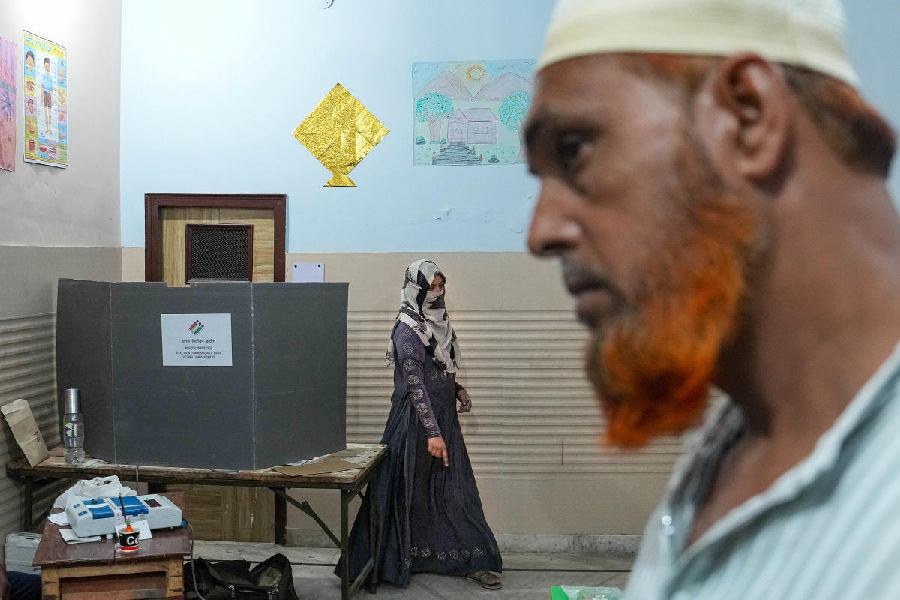
In a tea garden on the banks of the Neora river, we spoke to a group of Muslim men at a bazaar. It is a visibly syncretic space, with Rajbanshis, Adivasis, and Bengali-speaking Muslims interacting with one another alongside a masjid and a mandir that stand side by side. But the Muslim men tell me only they were ‘targeted’ in the Special Intensive Revision of electoral rolls; the polling booths in Muslim areas have seen more than 20% of voters being deleted.
“Bon ke diyechhe, kintu amar naam kata geyechhe” (My sister has been included, but my name has been cut).
“Chele ke rekhechhe, baba kata geyecche. Eta hote pare?” (They kept the son’s name but cut the father’s. Is this even possible?)
These remarks are consistent with what we have been hearing across the state about the SIR that was meant to clean up the electoral rolls. It is the latest in a series of narratives and policies that have harassed the Muslim community and threatened their citizenship and electoral representation in India, but this feels more personal. People are being struck off of the rolls because of who they are; families are being split, with only some members making it to the list. The State seems to be deciding who is and is not eligible for voting not based on lineage or religion but based on how it reads paper documents.
How do we contextualise the SIR exercise in Bengal with larger notions of Muslim citizenship and representation in India?
The political theorist, Robert Dahl, famously characterised political systems along two axes — contestation and inclusivity. Contestation means that all political formations and social interests are able to compete for power on an equal footing. Inclusion implies each citizen is given equal weight in expressing his/her preference among the options available. The most democratic system is understood to be the one that offers the highest levels of contestation and inclusivity. In this piece, I seek to historicise the principles of contestation and inclusivity with respect to West Bengal’s Muslim community.
A natural historical starting point to understand the patterns of Muslim representation in Bengal would be the Partition of Bengal into two regions, West Bengal in India and East Pakistan (later to become Bangladesh). There are three key ways in which this event fundamentally transformed Muslim politics in West Bengal: i) it altered the relationship of Muslims with the State; ii) it led to a demographic reorientation with Muslims becoming mostly a rural population; iii) it fragmented Muslim political leadership.
First, and foremost, while Bengal did not see the near complete transfer of Muslim and non-Muslim populations as on the western border of India, it witnessed high levels of communal violence around Independence, first within the province before the Partition and, then, a spiral of violence in East Pakistan against Hindus and reprisal violence in West Bengal against Muslims. The scholar, M. Reyaz, notes that the sum total of the Partition meant, “[Muslims] were advised to ‘mainstream’ their polity, prove their loyalty, and appear secular and nationalist.”
The Partition had other demographic and political effects as well. The urban, middle-class Muslim population moved disproportionately to erstwhile East Pakistan, generating a poorer, rural Muslim population in West Bengal — notably, the districts of Birbhum, Malda, Murshidabad, South 24 Parganas, and Uttar Dinajpur all display greater than 35% Muslim population according to the 2011 Census. But this migration also meant the exit of eminent Muslim leaders like Huseyn Shaheed Suhrawardy and A.K. Fazlul Huq from West Bengal. It would take time before other Muslim leaders such as A.B.A. Ghani Khan Choudhury and Abdus Sattar would rise — that too with influence only in the Muslim-majority districts of Malda and Murshidabad.
Until the entry of the Bharatiya Janata Party in 2016 as a serious player in West Bengal’s politics, all of the major parties, the Congress, the Left Front and the Trinamool Congress had their own bases of support among the Muslim community. Even a cursory look at the electoral map of West Bengal before 2016 shows this to be true. Historical trends reveal that the percentage of Muslim MLAs in the West Bengal assembly has largely fluctuated between 12%-15% across its political history (with a momentary increase of near 20% in 2011 and 2016 when the TMC first rose to power), generating significant numerical underrepresentation — the Muslim population was estimated to be 27% of West Bengal’s population in the 2011 Census.
Naturally, as the BJP rose to electoral prominence and actively constructed campaigns to repel the Muslim community, the latter tended to consolidate in favour of the TMC. Even then, surveys suggest that until now there may be more Hindus voting for the TMC than there are Muslims voting for the party. Only 47 (16%) of the candidates fielded by the TMC this time are Muslim. This is a trend observed across India. Even the small number of regionally-defined Muslim parties like the All India Majlis-e-Ittehadul Muslimeen and the Indian Union Muslim League rely on winning votes in small pockets within a state and require coalitions to come to power.
Despite the centrality of the Hindu-Muslim narrative applied to West Bengal’s politics, nearly 30% of the population identifies as scheduled caste or scheduled tribe according to the 2011 Census. But because these populations have reserved seats, the proportion of MLAs is nearly equivalent to their population. So there are approximately twice as many SC and ST MLAs as compared to Muslims despite the two populations being of similar size.
But it isn’t just about the probability of a Muslim citizen being able to elect someone from the same community. With the notification of laws like the Citizenship (Amendment) Act, media trials and the scapegoating of Muslims, the latter find themselves confronted with vicious polarising sentiments. Consequently, political activities that would be considered normal at other times — from expressing basic political preferences to attending a rally — have acquired an additional urgency. There has been a shift from questions of representation to a question of survival.
At the tea garden, a Muslim man removed from the electoral rolls was receiving legal help arranged by the local TMC politicians. At such a critical moment, linkages between Muslims and the political apparatus are not uncommon. With a hostile government at the Centre and an uncooperative electoral bureaucracy, a local politician appears to be the only help at hand for them.
Five years ago, the TMC won this assembly seat by a razor-thin margin. But most Muslim respondents are uninterested in discussing the prospects of the TMC or the BJP this time. They just want to make sure they don’t lose their right to vote. It is a reminder that there is much more at stake in this election than just who wins or loses the polls.
Neelanjan Sircar is an associate professor at Ahmedabad University