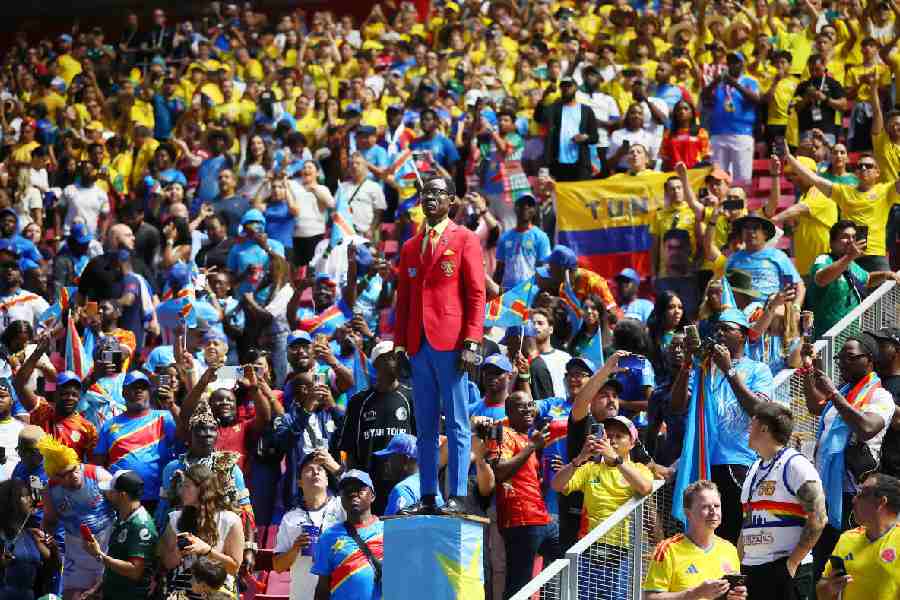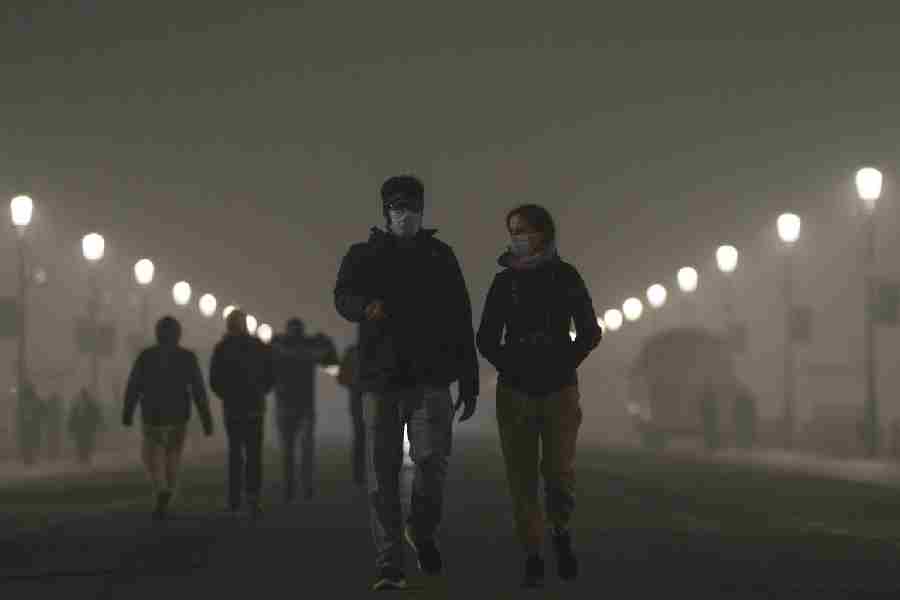
Delhi’s air is unhealthy the year round, but in December and January it’s poisonous. When the chief minister, Rekha Gupta, arrived at a smog-filled Arun Jaitley Stadium for a photo-op with Lionel Messi, she was greeted with derisive spectators chanting, “AQI, AQI!” The photo of Messi being given a gift-wrapped cricket bat by Jay Shah as the chief minister looked on summed up the state’s plan for tackling pollution: celebrity circuses.
In the Bharatiya Janata Party’s political idiom, Delhi has a triple-engine sarkar: Narendra Modi’s minions run Delhi’s municipalities, his state government and the Central government are embedded in the nation’s capital. Yoked together and pulling in unison, undistracted by spoilers like Arvind Kejriwal or the Congress, this juggernaut should be doing more than spraying Delhi’s smog with water-sprinklers and half-heartedly pausing construction. The conquest of the capital’s pollution is a good thing in itself, but it’s also a great political prize. If the BJP were to measurably improve Delhi’s air quality, it would have bragging rights to something other than its natural talent for division.
The global precedents are encouraging. London’s pea souper fog was dispelled by concerted government action in the 1950s. After the Great Smog of 1952 killed four thousand people initially, Parliament passed the Clean Air Act of 1956 which banned coal fires, created smoke free zones and regulated the use of coal in factories.
Closer home and closer to our own time, Beijing had become one of the smog capitals of the world by the time the 2008 Summer Olympics were staged there. Emergency measures like traffic shutdowns and the removal of factories mitigated the pollution, but five years later, Beijing was overwhelmed by smog in January 2013. Its AQI hit a high of 755, grounding flights and swamping hospitals with respiratory and cardiovascular emergencies. The government responded by implementing drastic measures to clean the air in the run-up to the 2014 APEC Summit. Xi Jinping saw the political mileage in making the temporarily blue skies of APEC Beijing a permanent feature. By the time of the Beijing Winter Olympics in 2022, Beijing’s clean air days had risen from 13 in 2013 to 300. The lifespan of Beijing’s residents was calculated to have risen by 4.6 years compared to what it would have been had the pollution levels of 2013 remained unchanged.
There is something recognisable about China’s government being galvanised into action by the prospect of an international summit in 2014. Indians, dilliwallahs in particular, will remember the way the Modi government leveraged the G-20 Summit in Delhi in 2023 to prettify bits of Delhi and turned the rotating presidency into a celebration of the prime minister as a geopolitical titan. The difference between APEC 2014 and G-20 2023 was that the earlier event led to a marked improvement in the quality of lives of millions of Chinese citizens in and around Beijing, while Delhi’s extravaganza made locals familiar with cutouts of the prime minister.
Beijing’s concerted plan to clean up its air consisted of relocating polluting industry, switching from coal to natural gas, electrifying the city’s vehicles, restricting car usage, better managing construction dust and incentivising farmers to stop agricultural burning. These measures sound familiar; they are the policies that Delhi and the Central government haven’t implemented with any seriousness for a decade, the same period in which Xi Jinping transformed Beijing if not into paradise (the city still doesn’t meet WHO standards) at least into a place where citizens can breathe without peril.
The difference between Delhi and Beijing should not be fatalistically put down to the difference in the capacity of a centralised party-State to effect change. The failure to improve Delhi’s air is frustrating because Delhi’s government has, in living memory, improved air quality through efficiently implemented policy. After the Supreme Court in July 1998 ordered all public transport to switch to compressed natural gas as fuel in less than three years, the Delhi government run by the Congress and the Central government, run by the BJP, more or less managed to meet their mandate with the help of an extension or two. Delhi was something of a global pioneer at the time and it managed this without a ‘double-engine’, let alone a ‘triple-engine’, sarkar.
The failure of Modi’s Central government to take the lead in cleaning up the air in the national capital for more than a decade is grotesque. Modi is keen to do yoga on camera and demonstrate the virtues of pranayama without stopping to think that controlled, expansive breathing is hard to do in a city where breathing is a hazard. The one time Delhi’s residents experienced marked improved air quality during this Modi interregnum was not through policy but catastrophe. The pandemic and the brutal lockdown that followed saw PM2.5 and PM10 levels drop by as much as 80% and 90% in parts of the Delhi Metropolitan Region.
In ‘normal’ times, though (if Delhi’s toxic winter can be considered normal), the BJP’s response to apocalyptic levels of air pollution is stout denial. The Union minister of state for health and family welfare, Prataprao Jadhav, told the Rajya Sabha that there was “no conclusive national data to establish a direct correlation between deaths or diseases occurring exclusively due to air pollution”. Not to be outdone, on the same day, December 18, the minister of state for environment, forest and climate change, Kirti Vardhan Singh, told the upper House that there was no direct link between higher Air Quality Index levels and lung diseases with no ‘conclusive data’ to establish such a link. Meanwhile, the Delhi government’s water sprayers were being actively used near pollution hotspots and monitoring stations to settle dust and lower pollution readings.
These responses by different tiers of BJP governments tell us something about the ruling party. Modi’s dispensation is very good at giving extractive industrialists and infrastructural oligarchs their head because it has subcontracted to them the work of building airports, ports, roads and mines. The hallmark of the Indian State in the time of Modi is a formal acknowledgment of its lack of capacity. The corollary to this acknowledgment is that the government lets its crony capitalists rip without regulation. In return, these modern-day zaibatsu, the Ambanis, the Adanis, the Tatas and the rest, buy electoral bonds and otherwise fund the political party machines that have given them a free run of the maidan.
Given that they are joined at the hip with these conglomerates, BJP governments are incapable of the kind of systematic, consistent, even-handed regulation that a Beijing-style clean up involves. The government would have to apply restrictions on construction and vehicles that would alienate the builder and transport lobbies that oil the sprockets of Delhi’s party machines.
An extraterrestrial historian of Delhi, unfamiliar with identity and ideology, might see Muhammad bin Tughlaq as Modi’s administrative ancestor. Tughlaq famously introduced copper coinage, taxed the peasants of the Doab into rebellion and abandoned Delhi for Daulatabad. The prime minister has performed two of Tughlaq’s governing experiments with mixed results: he demonetised the currency in 2016 and stirred farmers up with his farmers’ laws in 2020-21. If Delhi, already tarnished in BJP eyes by being the capital of successive medieval states and then Lutyens’ capitol, becomes unmanageably polluted, why not start from scratch? Perhaps we should brace ourselves for the third act in this Tughlaq sequel: a transfer of capital.
mukulkesavan@hotmail.com