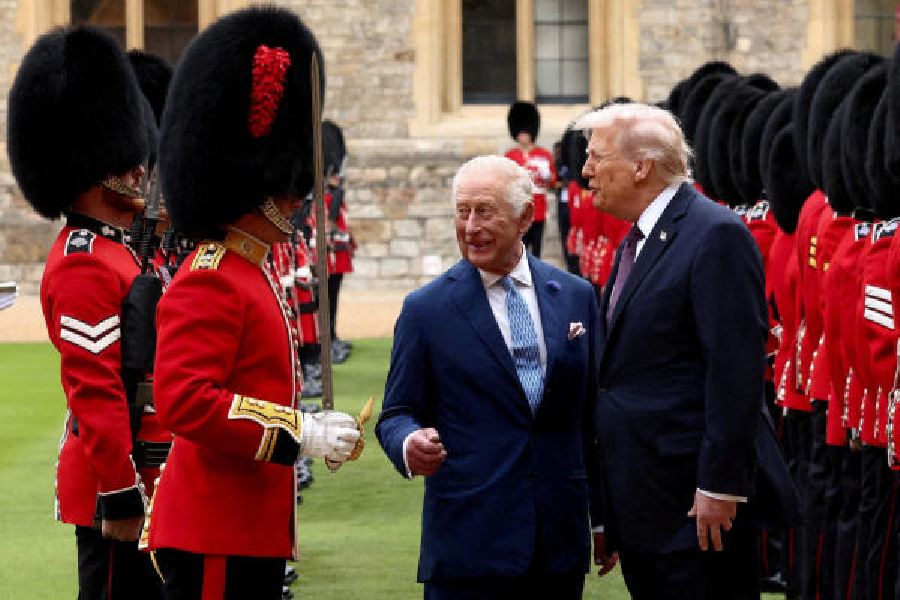
As Spain’s prime minister, Pedro Sánchez, bluntly told Donald Trump, those who set the world on fire deserve no applause just because they then show up with a bucket. The international system or what remains of it would be fully justified in taking the most stringent measures against such irresponsibility by the Gulf war belligerents who dangled humanity between war and peace for six weeks.
One isn’t certain if Israel or the United States of America ranks higher in the culpability stakes and whether Trump took orders from Benjamin Netanyahu or the other way round. The suspicion has been voiced that in their determination to get the better of Hamas, Israeli commanders (once suspected of lending Hamas a helping hand but now spoiling for a fight) may even have targeted and sacrificed some of their own people on that fateful night of October 7, 2023 when there were reportedly some 1,200 civilian casualties. If Israel did want to end the tragedy of confrontation with the Palestinians, it would not have ignored the two-state solution that has been pending for more than 30 years. The Palestine Liberation Organization’s acceptance of the principle was reflected in the 1982 Arab Peace Initiative.
It's the blame game all over again. Trump dismissed Keir Starmer with contempt as another Neville Chamberlain for refusing to bomb Iran. It was a different Neville Chamberlain who earned his admiration for urging Volodymyr Zelensky not to bother with arms when the Russians invaded Ukraine but to bravely press on regardless against Vladimir Putin. Trump knew that the award-winning Ukrainian 'actor, performer, script writer, producer' is a man of many parts. Like Mr Schwartz in the old Jewish tale, he may also have thought that Zelensky was like his prospective son-in-law, an upright young man whose stock reply to every question about his extravagant fiancée’s luxurious needs was "No problem, I study Torah and it says God will provide." Mr Schwartz was not a little worried because the youth called him “God”.
Moving to current affairs, no one is sure — at least no one was to start with — whether the Gulf truce permits continuing Israeli aggression in Lebanon. Or Houthi action in Yemen. The ravaging of Gaza is bound to lie as far beyond the ceasefire’s purview as Israel’s continuing stranglehold of the West Bank and Golan Heights.
Trump and Netanyahu are probably both equally guilty for not dissimilar reasons. The motivation is sheer greed for everything that is going, and not always going either … land, infrastructure, money, even people who are desperate to grab a one-way ticket out of India as reward for settling down in some humble position in the margins of a basically European society that is structurally colonial. The belief that certain Mizoram and Manipur tribes are descendants of ancient Israelis (Bnei Menashe) keeps the legend alive.
J.D. Vance attributed cracks in the ceasefire to a “legitimate misunderstanding” by Iranians who “thought that the ceasefire included Lebanon, and it just didn’t”. That hardly applies to Iranian drones attacking targets in Kuwait and Saudi Arabia, including the oil pipeline across the Arabian Peninsula that is a partial alternative to the Strait of Hormuz.
The question is: will the deal stick? Will Canadians have to keep juggling republic and royal to humour a whimsical president with a fondness for pomp and pageantry constantly threatening to annex Canada? Perhaps the lawless need the law more than the law-abiding. In those dark days of 9/11, the George Bush administration sought a location outside the US mainland as a legal 'Black Hole' where captives from Afghanistan and elsewhere and other suspected terrorists labelled "enemy combatants" rather than prisoners of war could facilitate long-term intelligence-gathering away from the benevolence of the US Constitution and the Geneva Conventions. The controversial arrangement was accused of more human rights violations than the malaise.
Canada’s problems began around 2011 when the Conservative prime minister, Stephen Harper, caused an uproar by replacing two artworks by a Quebec painter with a portrait of the Queen. The action was reversed only four years later. Trump’s bluster persuaded Prime Minister Mark Carney that the king himself must open Canada’s 45th Parliament to show Americans that relics of the Westminster ritual like the Mace or Speaker’s Chair (both also to be found in New Delhi’s Central Vista project) don’t demote Canada to America’s '51st state'.
In fact, the British monarch remains head of State of several independent Commonwealth countries, delegating his duties to local representatives. Trump may have been disturbed enough to consult the hated Immigration and Customs Enforcement mission when the current governor-general’s statement welcoming King Charles and Queen Camilla ended with "Welcome home, Your Majesties". Governor-general Mary Simon is indigenous Inuk on her mother’s side. The last time a monarch delivered Canada's throne speech was in 1977; the last to open Parliament was in 1957. The royal visit was thus not only a rare occasion but consequential in its timing. However reprehensible fighting a king with a pawn may be, the action, as Carney put it, "clearly underscores the sovereignty of our country".
Canada is in a cleft stick. Some Canadians may be impressed by royal razzmatazz but young people are mostly indifferent. Some even blame the Crown for the historic mistreatment of Simon’s ancestors. Quebec politicians want to cut political ties with the monarchy, the separatist Bloc Québécois party vows to abolish the ritual of swearing allegiance to the monarch and, as a former Bank of England governor, Carney might feel that the Crown can draw Canada closer to Europe. The palace promised a throne speech that would "mark a significant moment between the head of state and the Canadian people" as they met for the first time as king and subject.
The need for such manoeuvres became evident only when Trump began musing about annexing Canada as the "51st state", referred to the then prime minister, Justin Trudeau, as "Governor", and mentioned using "economic force" to force Canada into the US. The Canadian response was increased royal involvement in Canadian affairs, King Charles’s meetings with two prime ministers in short order, and publicly presenting a sword to the Usher of the Black Rod.
With the special relationship not feeling all that special right now, the king faces the unique task of wooing a republican president who is a closet monarchist. Skeletons rattling in his cupboard don’t help. Several US Congressmen want his brother, Andrew Mountbatten-Windsor, to come clean about his relations with Jeffrey Epstein. Embarrassment might increase if the king’s younger son and his wife, both US residents, insist on paying their respects during the visit.
The purpose of royal tours is to settle turbulence. The Windsors don’t shirk duty and King Charles cannot forget in this 250th anniversary year of American Independence how his mother visited the US in the aftermath of the Suez crisis to mollify Americans and pacify Asians when America was still reeling from the Watergate scandal and Richard Nixon’s inglorious exit.
"Mr President," Queen Elizabeth II told Gerald Ford, "we live in times of uncertainty… we must never lose sight of our basic values, nor underrate the worth of what we know to be certain."
The brevity of the official visit by Charles reduces the chance of many howlers. Buckingham Palace reportedly promises the visit will be "an impactful one". Not too impactful, hope Brits who have been spared scope for at least one potential gaffe.
In 1976, Nixon may not totally have abandoned hopes of a match between his daughter, Tricia, and Charles. After all, his daughter, Julie, had wed Eisenhower’s grandson. This time round, the royal offspring are all too young to be considered for matrimony however much the German-origin Trump might yearn for another infusion of ancestral blood.
And, now, next stop Islamabad.