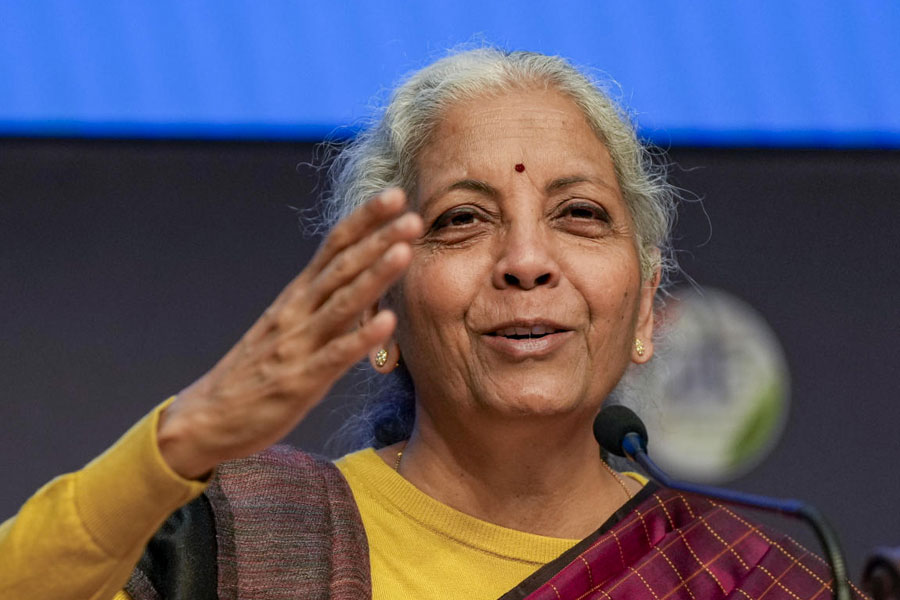
The Union finance minister, Nirmala Sitharaman, has asserted that India’s domestic consumption is the economy’s principal “shock-absorbing capacity” against the prevailing global headwinds. While Private Final Consumption Expenditure is projected to grow by 7% in FY26 and account for 61.5% of GDP, making consumption the largest component of growth, this does not ensure resilience. The rising share of consumption in growth often reflects weakness elsewhere. Private investment remains tepid with Gross Fixed Capital Formation being fuelled by State spending. Merchandise exports are facing pressure from global uncertainties. Public capital expenditure expansion has slowed. Consumption has thus become the default growth engine because the other engines are weaker. Of equal concern is that this consumption growth is increasingly sustained by debt rather than a durable rise in income. Data from the Reserve Bank of India show that household net financial savings improved only modestly to 5.1%-5.3% of GDP in FY24 after falling to a multi-year low even as household financial liabilities rose to near historic highs of 6.2%-6.4% of GDP. Household savings as a share of GDP fell to 18.1% in FY24, marking the third consecutive year of decline. Consumption financed by weaker savings and rising liabilities cannot be described as a stable macroeconomic cushion.
The falling rupee compounds the challenge. Indian consumption is dependent on imported crude oil, LNG, edible oils, fertilisers, electronics and industrial intermediates, all priced in dollars. A weaker rupee raises the domestic cost of sustaining consumption. The rupee remains under pressure, hovering around Rs 94 to the dollar, amid elevated crude prices, geopolitical tensions and portfolio outflows, while India’s trade-weighted valuation has weakened sharply. These feed directly into transport, fertiliser, food and manufacturing costs, eroding the gains from the goods and services tax rationalisation and income-tax relief. Thus, households continue to spend, but they receive less real purchasing power for the same expenditure. When domestic consumption depends on borrowing, amid stagnated wages and a depreciating rupee, it is evidence of household strain.
Moreover, an economy driven primarily by consumption risks lowering its potential rate of growth because even though higher spending raises current demand, potential growth increases only when productive capacity expands through investment, productivity gains and labour-force participation. India’s potential growth has already moderated from nearly 8% during 2003-08 to about 6.5%-7% in the post-pandemic period, with some estimates placing it closer to 6% in FY27. Low labour productivity limits output per worker; an uneven business climate and slow courts discourage private investment; the mismatch between skills and available jobs suppresses efficiency; and low female labour-force participation keeps a large share of productive labour outside the economy. Without correcting these structural weaknesses — this will need time — consumption cannot sustain long-term growth.