Symbolic art
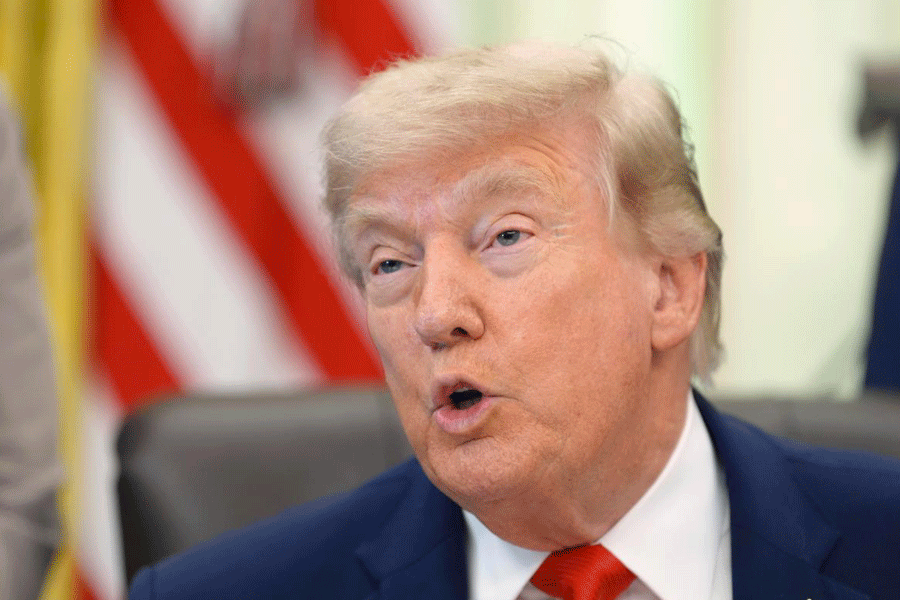
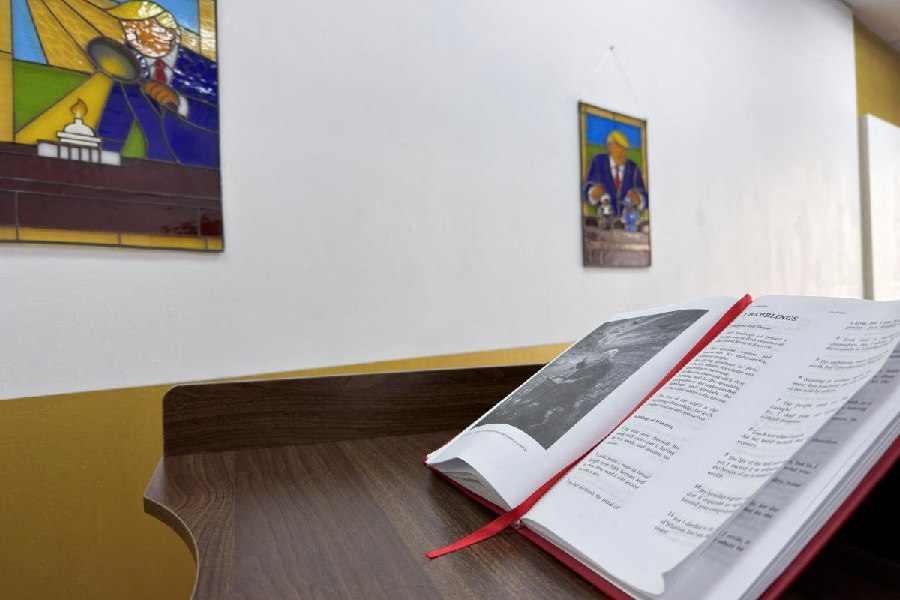
Sir — It is the function of art to hold a mirror to society. A recent installation in New York, The Holy Babble!, does precisely that by exploring Trumpism as a modern belief system. The work transforms a gallery into a chapel-like space, complete with stained-glass imagery, altar-style displays, and a 250-page text that recasts Donald Trump’s stream of repetitive, incoherent speeches in biblical language. Trump has, at times, unabashedly drawn upon Christian symbolism in his politics — most recently by sharing an Artificial Intelligence-generated image of himself as Jesus Christ. While the installation is intended as a critique, it is equally possible that Trump might interpret it as an affirmation, reinforcing his image and brand of Christian nationalism.
Darshana Jain,
Texas, US
Toxic campaign
Sir — Prime Minister Narendra Modi and the Union home minister, Amit Shah, have deployed their full might in the election campaign in West Bengal, aiming to wrest the state from the Trinamool Congress. During the course of the campaign, Modi not only reframed Netaji Subhas Chandra Bose’s iconic call, “Give me blood, and I will give you freedom”, while canvassing in the Matua belt by asking for votes in return for “azadi” from the TMC’s “jungle raj” but also invoked Rabindranath Tagore in his Mann ki Baat address.
These efforts are an attempt by the Bharatiya Janata Party to reshape the Bengali political sentiment. Yet politically aware Bengalis are unlikely to overlook the fact that a BJP rule in Bengal would bring with it a powerful organisational machinery backed by corporate funding, compliant institutions, and Central agencies with sweeping powers — trends observed in other states under its rule. Despite Modi’s confident assertions that “the lotus will bloom” in Bengal, it is equally possible that the state’s electorate will, once again, deliver a decisive verdict that keeps such ambitions in check.
Bidyut Kumar Chatterjee,
Faridabad
Sir — The remarks made by Amit Shah while campaigning for elections in Bengal are troubling. His description of Calcutta as a “city of slums” undermines the dignity of its residents. The Union home minister also threatened to hang TMC cadre “upside down” to straighten them out. In a democratic polity, such language from a Union home minister is inappropriate. It risks legitimising aggression, targeting livelihoods, and corroding the political fabric.
Inflammatory speeches set a dangerous precedent. Those in high office must uphold constitutional propriety rather than inflame divisions.
Mohammad Arif,
Dhanbad
Sir — The tendency to ‘Other’ fellow citizens appears to have become a defining feature of New India. Within this framework, it is perhaps unsurprising that the prime minister chose to label Jadavpur University as a hotbed of anarchy while campaigning in the South 24 Parganas. Such characterisations ignore the institution’s contributions, including its humanitarian efforts during the pandemic when students organised relief for the most vulnerable. Despite being the best state public university in India, according to the NIRF Rankings, Jadavpur University has been denied the Institute of Eminence status by the Centre. Modi’s hateful rhetoric reflects political frustration.
Kajal Chatterjee,
Calcutta
Sir — It is with a measure of disquiet that one encounters the recent description of Jadavpur University as a “hotbed of anarchy” by Narendra Modi. Such a description from the holder of the country’s highest executive office seems detached from the lived reality of an institution whose intellectual standing and global alumni network speak for themselves. To reduce a space of rigorous inquiry to a centre of disorder is to misunderstand the very nature of a university. Dissent is not an aberration but a defining feature of academic life.
Kaushik Chowdhury,
Calcutta
Poetic depth
Sir — People naturally gravitate towards convenience. While poetry predates prose, the latter evolved to make meaning more accessible, much as Charles Lamb did for William Shakespeare (“Verses parsed”, April 26). Poetry’s strength lies in its inventiveness. Niche readers will always value its density and richness. The real question is whether emerging Artificial Intelligence tools will deepen engagement with poetry or reduce it to easy paraphrasing, eroding its layered complexity.
Harsh Pawaria,
Rohtak, Haryana
Sir — In “Verses parsed”, Mukul Kesavan discusses some of Philip Larkin’s poems. We were taught Larkin’s “The Whitsun Weddings” and “Ambulances” by Professor Subir Kumar Dhar at Rabindra Bharati University. His lucid diction and evocative style brought the poems alive, transporting us from Calcutta to London.
Niamul Hossain Mallick,
East Burdwan
Heat myths
Sir — In a remark typical of saffron leaders, the Union minister, Jyotiraditya Scindia, suggested that carrying an onion in one’s pocket is a way to protect oneself from extreme summer heat. There is no scientific evidence to support the claim. The statement echoes earlier controversial assertions by Bharatiya Janata Party leaders. The party is a master in infantilising the masses.
Avinash Godboley,
Dewas, Madhya Pradesh
Sir — The Experimental Heat Index, launched by the India Meteorological Department, is used to assess the impact of heat. The index incorporates both temperature and humidity, offering a more accurate reflection. The severity of the crisis is evident. Rising heat is no longer a seasonal discomfort but an escalating concern for public health and the environment.
Dattaprasad Shirodkar,
Mumbai