 |
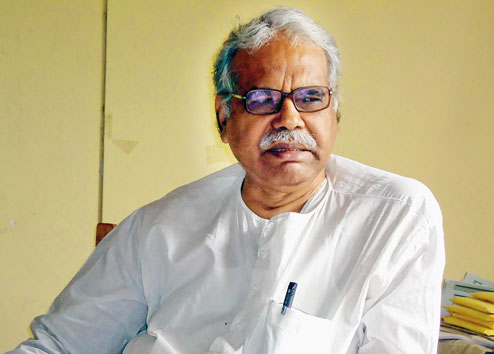
Hot seat - Janardan Pati,
Odisha CPI(M) secretary
What are your views on chief minister Naveen Patnaik’s recent statement about the possibility of a Third Front emerging before the 2014 general elections?
We don’t buy that. When elections are round the corner, all parties talk of a Third Front and then conveniently forget about it for the next five years. The Third Front is possible, but on the basis of policies. It will be a front for struggle, not an opportunistic poll alliance. Naveen babu and other parties don’t think of fighting the elections on issues concerning the common man.
Are you considering a tie-up with the BJD for the coming elections because your party does not appear to be in a position to win seats on its own?
It is too early to talk about it. Last time, we went for seat sharing with the BJD (one Lok Sabha and four Assembly seats) but lost because of them. This time, we are confident of getting 10 to 15 seats on our own.
The Supreme Court has ruled that Vedanta Group’s bauxite mining project in Niyamgiri hills has to get clearance from a gram sabha (village council) keeping in view the cultural and religious rights of the tribals and forest dwellers in Rayagada and Kalahandi districts. How do you view this verdict?
We welcome the court’s decision. Niyamgiri is not just the storehouse of bauxite ores, but also various medicinal plants. There are 36 streams on which several parts of Odisha and Andhra Pradesh are dependant. The state government should protect the place instead of handing it over to Vedanta. Just because someone needs a heart (Vedanta requires bauxite ores), it doesn’t give him the right to kill you (the tribals living in the area).
Do you think the powers that be would influence the village council’s decision, perhaps by coercion?
A former director of the Odisha Mining Corporation had resorted to manipulation to help the Vedanta group. But now I hope that the village council will consider the negative impact of the bauxite-mining project on the Dongria Kondh community. I hope the decision will not be in Vedanta’s favour.
How can Odisha develop without industrialisation?
But should you wipe out human civilisations in return? Must you bury Chilika Lake or destroy Khandadhar falls for an industry tomorrow? Why is the government not giving emphasis to agro-based industries? That will ensure higher agricultural production as well as generation of raw materials for industries besides creating more employment opportunities. China does not have minerals, but is a developing economy because of agro-based industries. Odisha must also explore the potential of marine-based industries.
The state government and Centre seem determined to make the Posco steel project a reality in Odisha. There is a difference of opinion among the Left parties on this issue too. What is your stand?
First of all, our party is not opposed to industrialisation but we don’t want civilisation to suffer. Second, we don’t want India to be a market for economic development of other countries. Like educational institutions or human habitats, it cannot come up at any random place. Thus, there should be a specific area for industries too.
So, will you not continue your agitation against the project if it is shifted to another place?
See, the project can be shifted to a swampy area just 5km from the proposed site, but it will cost Posco Rs 5,000 crore more. We have other conditions too. Posco should not be allowed to set up its own port because it will become the centre for smuggled arms, gold and narcotics. Who will control that? Let it be given a berth or two in Paradip port. It should also give minerals to other companies.
Coming to Maoist leader Sabyasachi Panda, there has been a lot of talk about facilitating his return to the mainstream, but he does not appear eager about it. The police have now intensified their operation against him. What do you think should be done for Sabyasachi to give up arms?
As far as I know him, I don’t think he believes in extremist politics or using arms. If Sabyasachi really wants social change, he should reach out to the people not from the jungle, but by joining an organised people’s movement. The police should give ample opportunity to all those who wish to return to the mainstream and not kill hem in so-called encounters. After all, the rebels are our own people. When murderers and rapists are given the chance to be heard in the court of law, so should Maoist rebels.
Of late, several rebels have surrendered before the police in various parts of the state, many of them stating that they have been disillusioned with the Maoist ideology. Would you say that the Maoist movement has been a misnomer in the country?
Yes, the movement will not be successful in India. Arms struggle has a precondition — it can only work in a country that has no scope for a democratic movement. China, Vietnam and Cuba have witnessed prolonged arms battle because democracy was absent in those three countries. So, in a democratic nation, the Communist party needs to make its presence felt by participating in elections.
Sabyasachi’s wife Mili Panda has expressed interest to contest the 2014 Assembly elections from the Ranpur constituency as an independent candidate. Would your party back her?
We are not sure if she is actually going ahead with that and for what reason. We cannot make decisions on hearsay. Our party candidate will contest from Ranpur. How can we support her then?
Comrade’s journey
Veteran communist leader Janardan Pati, 65, is chief of Odisha unit of the Communist Party of India (Marxist)
Born and brought up in Cuttack, he was a firebrand student leader and took part in several students’ movements throughout his academic career
After completing his matriculation from Bentkar High School, Cuttack, he studied science at intermediate level
He holds bachelor’s degree in history from Christ College and in law from Madhusudan Law College, both in Cuttack
He played active role in major students’ agitation in 1964
However, despite passing LLb, he didn’t apply for licence, as he was more interested in politics
Thereafter, he took admission in MA in history at Utkal University, Bhubaneswar
But discontinued, as he was already involved with the Students’ Federation of India as its state secretary. In 1972, he became CPI(M) state committee member
He was jailed for a brief period in 1975 during the JP movement
He was also one of the founder presidents of the Democratic Youth Federation of India and vice-president of the Centre of Indian Trade Unions, Odisha
He has been CPI(M) state secretary since 1992
What would you have been had you not been a politician?
I would have practised law. While I was drawn towards politics, many of my classmates from Madhusudan Law College, Cuttack, went on to become judges in Orissa High Court. Ananga (Kumar Patnaik), a Supreme Court judge, is also from my batch.
I remained involved in activities of the Students’ Federation of India as its state secretary and could not even complete my post-graduation.
I was also influenced by the Naxal movement, but only for a temporary period. Thereafter, I joined the CPI(M).