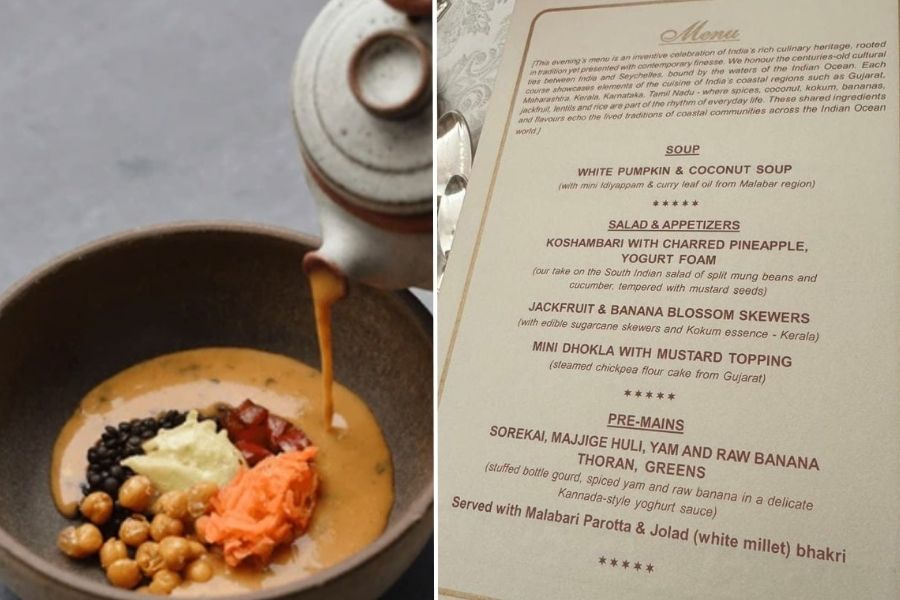
A curated banquet menu hosted by President Droupadi Murmu for the visiting President of Seychelles on February 10 has set off a social media debate, after a portion of the plated dinner went viral with claims that such menus do not “fill the stomach”.
Commenting on one such X post, MP Mohua Moitra claimed, “President Macron (Emmanuel Macron, President of France) returned after G20 dinner and asked for bread, cheese and cold cuts since he couldn’t eat anything at dinner”.
In an age where modern Indian cuisine takes centre stage in the culinary scene, such menus are common in fine dining, chef’s tables and tasting menus. My Kolkata got in touch with Kolkata chefs to review the menu.
Chef Sujan Mukherjee, who has worked with Taj hotels across India, said, “The menu is innovative and the chef has shown culinary brilliance in balancing traditional flavour and uniqueness to uphold the changing culinary culture of our nation. All dishes have proper accompaniments,” He added that portion control in plated service is key, noting that high-end dinners are about “class, elegance and uniqueness” rather than a stomach-filling meal.
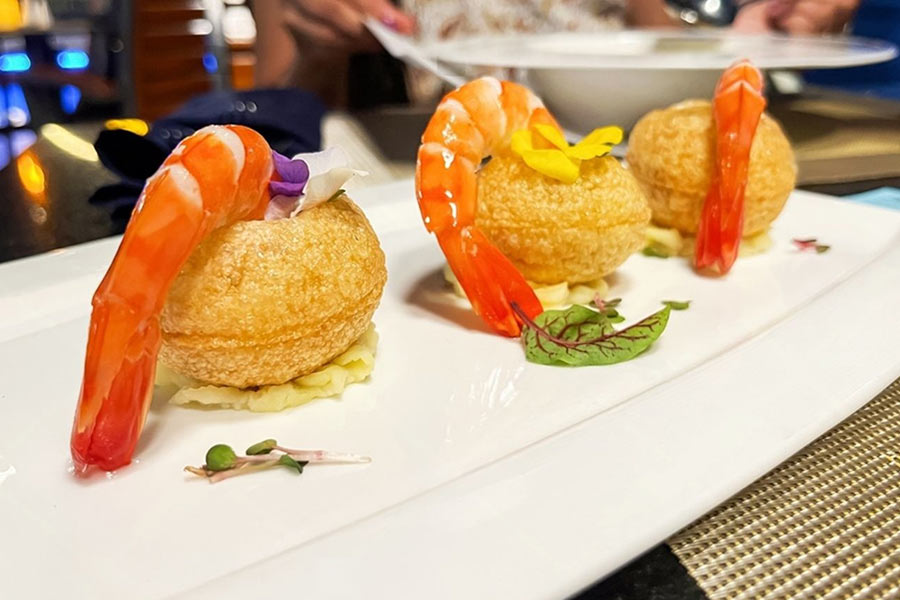
Representational image Shutterstock
The menu in question ‘celebrated’ coastal India and the Indian Ocean connection, featuring white pumpkin and coconut soup with mini idiyappam and curry leaf oil, koshamberi with charred pineapple and yoghurt foam, jackfruit and banana blossom skewers with kokum essence, mini dhokla with mustard topping, and pre-mains of sorekai, majjige huli, yam and raw banana thoran with greens, served with Malabari parotta and jowar bhakri.
Chef Shaun Kenworthy, known for presenting curated menus across India, felt such experimentation was expected at a formal dinner. “It’s nice to expect something interesting and a little bit more modern. India is growing up and exploring its ingredients, putting a new spin on the same flavours,” he said.
In Kolkata, several such food events are curated where food experiments take centre stage, and distinct flavours are brought together. Often, such menus tell a story. Chef Preetam Bhadra, among the first in Kolkata to introduce deconstructed menus, stressed intention. “Strangeness on the plate is fine as long as there is intention. If the menu carries memories and stories, modern finesse is fine. Without intention, it becomes hollow theatrics,” he observed.
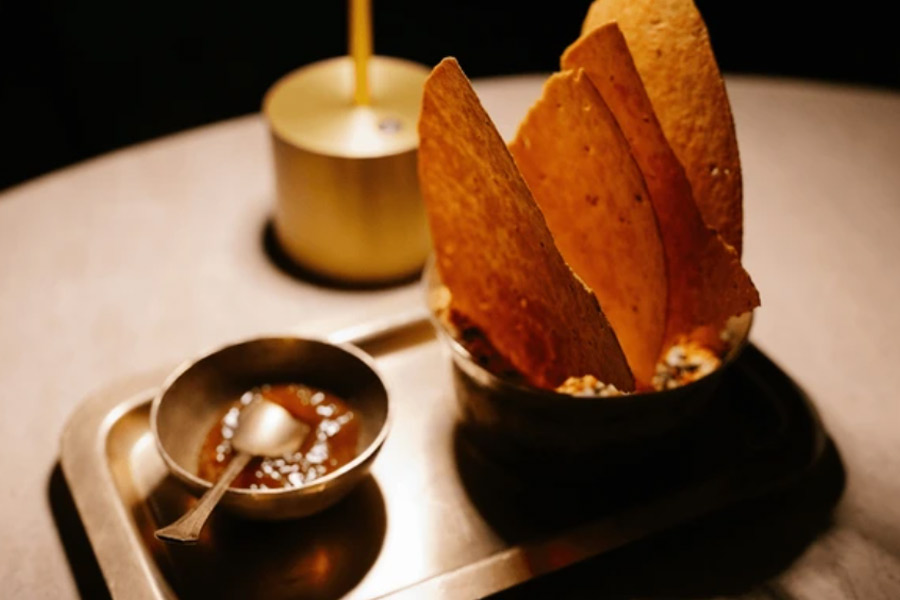
When it comes to experimentation with flavours, Sienna has made a name for itself not only in Kolkata but across India. Avinandan Kundu, co-head chef at Sienna, who presents Bengali cuisine with modern twists, said Indian food must move beyond stereotypes and evolve. “Food has to be tasty, that is the bare minimum. But it is very important to show the world that Indian food is not just a bowl of curry or takeaway”. Kundu also reflected that many restaurants across the country are pushing hyper-regional cuisines and micro-cuisines that people still do not recognise. “Influences have always shaped Indian food. Chilli, coconut milk or even the evolution from payesh to chhana-based desserts happened because people experimented. If we reject new interpretations without tasting them, we stop cuisine from progressing. Making food accessible or giving it a new format is not wrong as long as there is respect for the culture and ingredients. That is how Indian food will gain global appreciation,” he said.
Chef trainer Subhadip Saha of IHM Kolkata, Taratala, described it as “a classic menu served in a modern style”. He pointed out that elements like yoghurt foam in the koshamberi lighten the dish while retaining flavour, allowing diners to enjoy multiple courses without heaviness. “Majjige huli and thoran are traditional south Indian preparations we study in hotel management, but rarely see in fine dining spaces now. Bringing back these old gems in a refined format promotes India’s coastal vegetarian culture. Unlike many heavy Indian banquets, this appears designed as a lighter, well-balanced meal with thoughtful sequencing,” he said.