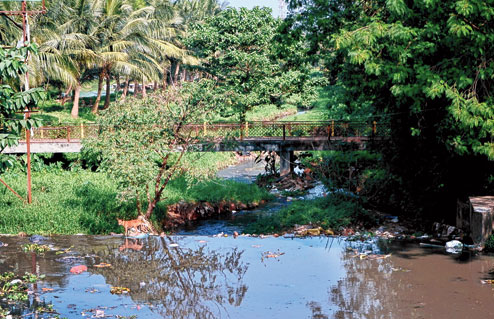
CLEAN GANGUA PLAN

Bhubaneswar, Nov. 20: The development authority would use a green technology pioneered by the National Environment Engineering Research Institute to treat wastewater of drainage channels across the city.
First, the wastewater of the drainage channel No. 10, which runs between Bidyut Marg and Janpath and is known as lake zone I, will be treated with the phytorid technology. The know-how involves a constructed wetland exclusively designed for the treatment of municipal, urban, agricultural and industrial wastewater.
Once the technology is used on lake zone I, it will be replicated on zone II between Janpath and the railway tracks. Both the zones fall under the same smart district.
The lake zones would ultimately serve as a waterfront, so that people can spend quality time there.
Explaining the technology, secretary of the Bhubaneswar Development Authority Ranjan Das told The Telegraph: "The system is based on treating the wastewater through various layers of plants such as elephant grass, cattails, reeds, cannas and yellow flag iris, which are normally seen in the natural wetlands and have filtration and treatment capabilities."
Apart from these "cleaning" plants, many ornamental ones such as golden dhuranda, bamboo, nerium and colocasis can also be planted for the use of wastewater treatment and landscaping purposes. The phytorid technology can be constructed in series and parallel modules or cells depending on the land availability and quantity of wastewater to be treated.
The system of treatment consists of three zones - inlet, treatment and outlet zones. The treated water coming out of the outlet zone is useful for gardening, fountains and irrigation. The plants are placed within beds of crushed bricks and different sizes of stones, so that the water level never goes up to drown the plants.
"The greatest benefit from adopting such technology is that there is no requirement of power and low capital cost compared to sewerage treatment process that is currently used across the city. The installation and maintenance cost is low and can be used for colonies, apartment blocks, hotels, corporation projects, educational institutes, railway station and public toilets," said environment expert Bijay Mishra.
Former urban development secretary Fani Bhusan Das on May 29 last year had told The Telegraph: "Use of plants and microbes for treating wastewater is now popular in Europe, and they are energy-independent projects. I also wanted similar project over a natural drainage channel near Sainik School in the city. During the chief ministership of Biju Patnaik, there was a plan to have such facilities in other areas of the city as well, but it was never implemented."
Resident Mrutyunjay Tripathy said: "The authority should speed up its act and quickly treat the water in other drainage channels and Gangua nullah. It will also help the Daya water remain treated."
Sources said the institute's experts would first do the survey within December 15 and file a report. Then only the state government will initiate action in this regard.
• Though state government has decided to formulate an exclusive master plan to clean Gangua nullah, the natural drainage carrier of the city, nothing has started yet
• BDA wants to clean natural drainage channels that carry city’s wastewater to Gangua and ultimately to Daya river
• Of 10 natural drainage channels running across Bhubaneswar, nine discharge waste into main channel
• As nullah bed is full of silt, it often triggers floods in nearby areas
• While in many places of comprehensive development plan of Bhubaneswar Development Authority shows width of Gangua as 114 metre, in reality it is hardly 14 metre
• Historians say the water body, which carries wastewater, was known as moat of Sisupalgarh Fort and its historical name was Gandhabati
• Gangua Bachao Andolan, an organisation based in Bhubaneswar’s Gangotrinagar has worked towards restoration of the heritage water body. It says that once cleaned, the channel bed can be developed into a recreation zone