 |
The plains of Bangladesh hover into sight just minutes after a flight from Calcutta takes off for Agartala, the capital of Tripura. In 45 minutes, as the aircraft prepares to land, one can see the neat row of barbed-wire fencing that separates the two countries.
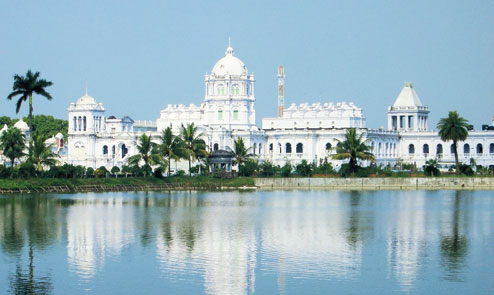
The airport, a neat white structure, is, however, not a patch on Agartala’s railway station, which has been modelled on the lines of the Ujjayanta palace. A former princely state, the royal edifices that abound make for an interesting study of heritage buildings, spectacular and regal. The magnificent Ujjayanta palace stands in the heart of Agartala , occupying one square km. With three high domes, it sports a mixed architectural style and was built in 1899-1901 by the then king, Radha Kishore Manikya, in the style of the Lake palace in Udaipur. It even sports a Moghul garden on the bank of a lake!
 |
 |
 |
| (From top) A rubber plantation, latex being collected and rubber mats drying in the sun. Pictures by author |
The other places that merit a visit in Agartala include the museum, Nehru Park, Rabindra Kanan, Nazrul Kalakshetra and the heritage MBB College, built by the last king, Maharaja Bir Bikram Kishor Manikya.
Travelling in Tripura is a pleasure because the roads are well maintained and navigable even in interior areas. The drive to Sonamura, for instance, takes one past two tourist destinations: the Sipahijala wildlife sanctuary and the Rudrasagar lake with the imposing Neermahal reflected in its clear waters. A boat ferries tourists from the road to the island palace, although in winter, when the water level dips, the voyage is time-consuming. The Tripura government has set up a picturesque resort, Sagarmahal, near Melaghar for tourists who wish to stay awhile taking in the beauty of the red-and-white “water palace”, built by Maharaja Bir Bikram Kishore Manikya in 1930.
 |
 |
 |
| (From top) The Charilam bridge, a welcome sign and Agartala railway station, modelled on Ujjayanta Palace |
The biodiversity haven of Sipahijala, 24km from the capital, has 456 floral species and an array of animals. Rhesus macaque, capped langur, pigtailed macaque, spectacled monkeys and slow loris are some of the visible fauna. It is also supposed to be a clouded leopard habitat, along with elephants and deer. For visitors who are not fortunate with sightings, the sanctuary has a ticketed enclave where the animal species can be viewed in captivity. But that hardly offers the thrill of natural sightings.
 |
| Tripurasundari temple |
Tripura also abounds in religious tourism. We visited the shakti peeth, Tripureswari or Tripurasundari temple, 55km from Agartala, where Sati's right foot is said to have fallen. Tiny bleating lambs were being dragged to the sacrificial arena, red marigold garlands signifying their imminent deaths. The temple was built in 1501 by Maharaja Dhanya Manikya and sports a man-made water tank that has large fishes and tortoises waiting for pilgrims to feed them. On the way back, one can stop at Bhuvaneswari mandir in Sipahijala district, where animal sacrifice is thankfully a ritual of the past!
 |
| Rock art at Unakoti |
Beyond the temples, the route to Gomati district passes through rubber plantations. Although townsfolk claim that rubber cultivation was affecting the climate adversely, the drive through these forests can be a memorable experience. We stopped to enter the plantation by the roadside to watch a farmer collect latex from empty coconut shells, tied to the trunk of the trees, into a bucket. The houses alongside the road had latex sheets drying in the sun, indicative of the local trade. Venturing too close to inspect these rubber “mats” however, is an attack on the olfactory nerves!
 |
| Neermahal on Rudrasagar |
The state also offers marvellous rock art at Unakoti, Debtamura and Pilak. Most of these “carvings” are huge and the ones at Unakoti are Shaivite in nature. The distinctive styles are rock-cuts and stone images, certainly worth a visit. So is Dumboor lake in Amarpur subdivision, so called because it is shaped like Shiva's drum (the dumboor), stretching across a vast 41 square km.
For a state tucked into Bangladesh on three sides, Tripura certainly offers diversity on the tourist platter.