The percentage of Muslims on the logical discrepancy lists far exceeds their share in the population in four Assembly constituencies in Calcutta, a study has found.
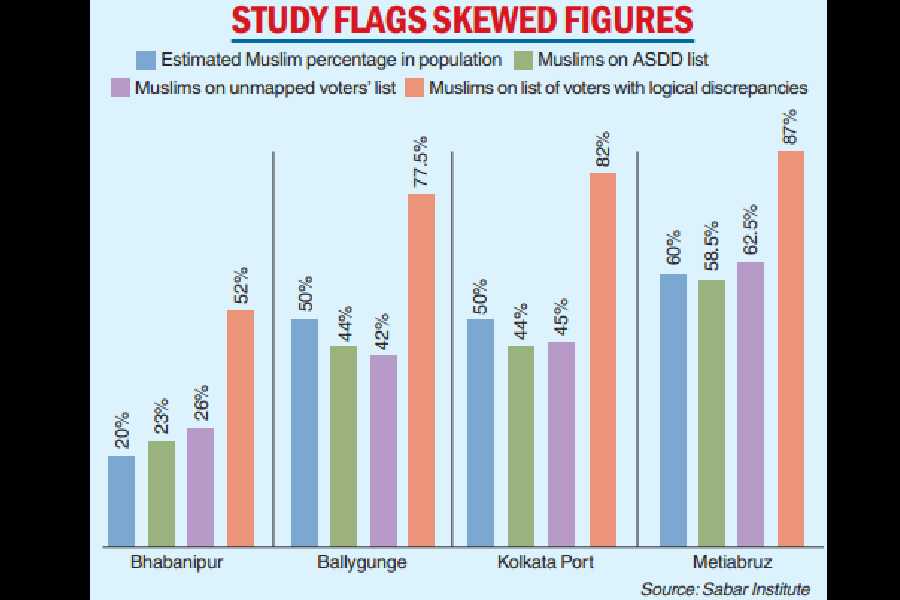
An analysis of the logical discrepancy (LD) lists in Ballygunge, Bhabanipur, Kolkata Port, and Metiabruz suggests a disproportionate representation of Muslim-identifiable names relative to their baseline demographic distribution.
The lists of absent, permanently shifted, dead and duplicate (ASDD) voters, and unmapped voters broadly reflect the areas’ demography, the study says, but the same does not hold true for the logical discrepancy lists.
The findings are from a study conducted by Sabar Institute, a Calcutta-based research organisation that works on addressing social disparities and fostering social cohesion.
The Election Commission released the draft electoral rolls on December 16. It excluded more than 58 lakh registered voters who were marked dead, duplicate, shifted or absent.
In Bhabanipur, the Assembly seat represented by chief minister Mamata Banerjee, Muslims constitute 20% of the population. The Muslim share in the December 16 ASDD list was around 23%, while the share in the unmapped voters’ list was around 26%. However, the list of voters identified with logical discrepancies shows a Muslim representation of 52%.
In Ballygunge, Muslims make up an estimated 50% of the constituency. The Muslim share in the unmapped and ASDD voters’ lists was 44% and 42%, respectively. However, Muslim representation rises sharply to 77.5% in the logical discrepancy list.
The estimated Muslim population figures were extrapolated using the 2011 Census data as the reference point, the researchers involved in the project said.
On January 24, the Election Commission uploaded a list of around 30 lakh voters categorised as “unmapped voters”, whose records could not be linked with the last revision of rolls conducted in 2002.
The same day, another list was released identifying nearly 1.2 crore voters with “logical discrepancies”.
Logical discrepancies include an alleged mismatch in a parent’s name and an age difference of 15 years or less, or 50 years or more, between a voter and a parent.
Many have alleged that the lists were not displayed at SIR hearing centres or other designated locations, limiting public access to the information.
“While ASDD deletions and unmapping procedures operate under publicly articulated and codified criteria, the logical discrepancy category lacks disclosed operational standards or classification protocols. This opacity raises questions regarding the process,” the researchers — Souptik Halder, Ashin Chakraborty and Sabir Ahamed — said.
In Kolkata Port, Muslims make up 50% of the electorate, but their share in the LD list is 82%. The ASDD list has 44% Muslims, and the unmapped list has 45%.
In Metiabruz, the unmapped and ASDD lists have 62.5% and 58.5% Muslims, respectively. The Muslim population share is 60%. The LD list here has 87% Muslims.
“The use of artificial intelligence (AI) in tracing logical discrepancies is questionable. It reeks of a human bias that seems to have affected the software,” Chakraborty told Metro.
Calls, messages and an email to Manoj Agarwal, the chief electoral officer of Bengal, seeking a formal response, went unanswered.
Several Opposition leaders and political commentators have alleged that the contentious SIR exercise was exclusionary at its core and designed to harass minority communities.
Given the sheer scale of the exclusion lists, manual classification of individuals by religion based on their names for the research would have taken several months, Chakraborty said.
To expedite the process, the researchers used a machine learning model developed by Rochana Chaturvedi of the University of Illinois, Chicago, and Sugat Chaturvedi of IIT Delhi, titled “It’s All in the Name”. The algorithm is designed to infer religious identity from nomenclature patterns.
By combining this automated classification system with manual verification, the researchers analysed the religious composition of the SIR exclusion lists.
“A large section of the minority community does not have enough resources. Naturally, they do not have enough documents. For them, the fear of disenfranchisement is real,” said Ahamed, a member of the research team and part of a collective that promotes shared living.