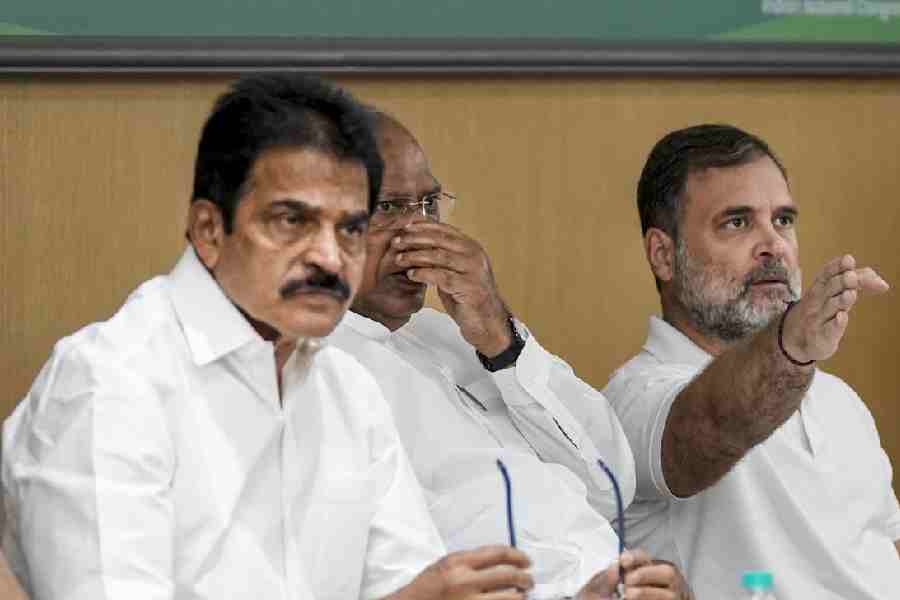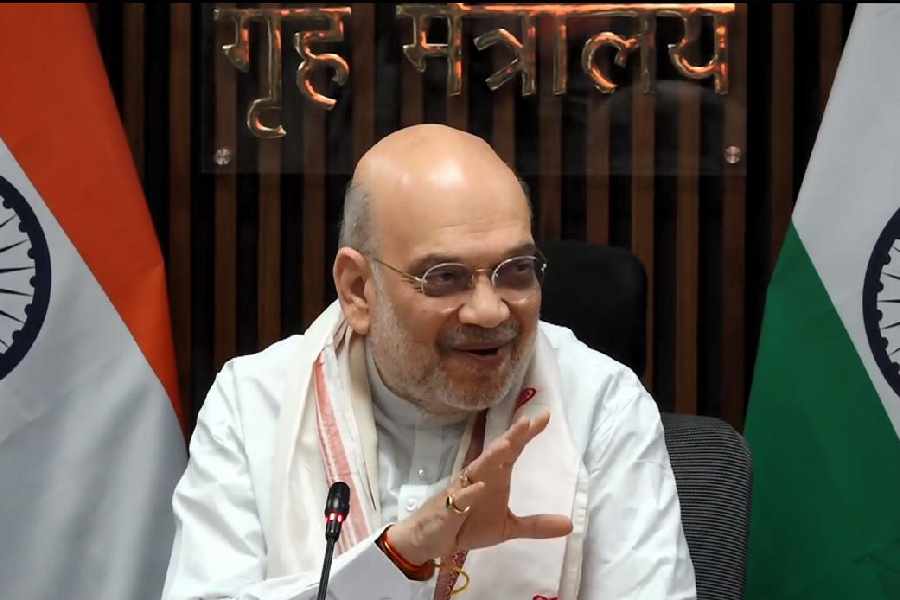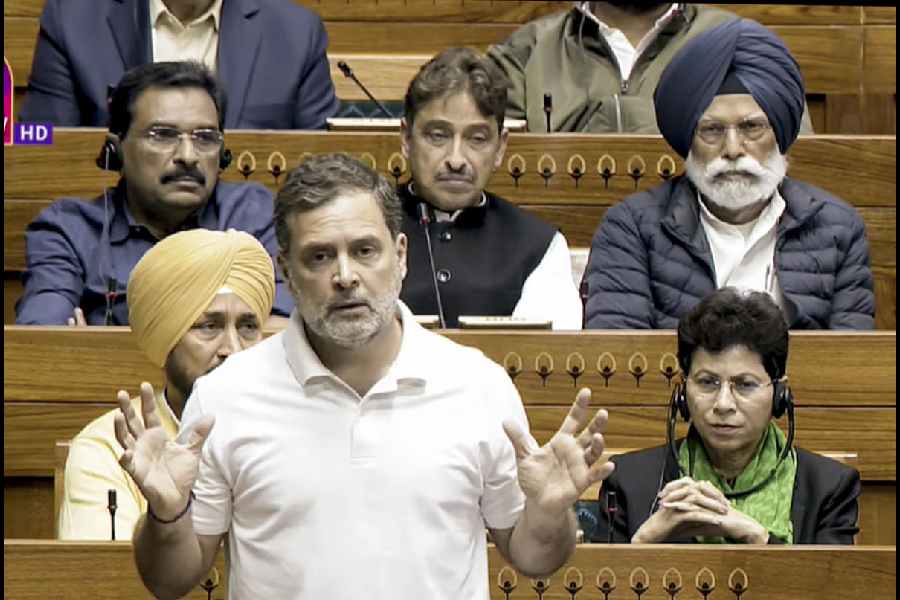
Rahul Gandhi on Wednesday accused Prime Minister Narendra Modi of buckling under pressure and compromising the country’s interests through the Indo-US trade deal, drawing a martial arts analogy in the Lok Sabha to claim Washington had India’s government in a “choke”.
“America says we cannot buy oil from a particular country. This effectively means our energy security is being dictated externally — that energy itself is being weaponised against us,” the leader of the Opposition said during his intervention in the budget discussion.
“This is a wholesale surrender. It is a tragedy.... He has surrendered because he wants to protect the BJP’s financial architecture, on which there is a case in the United States.”
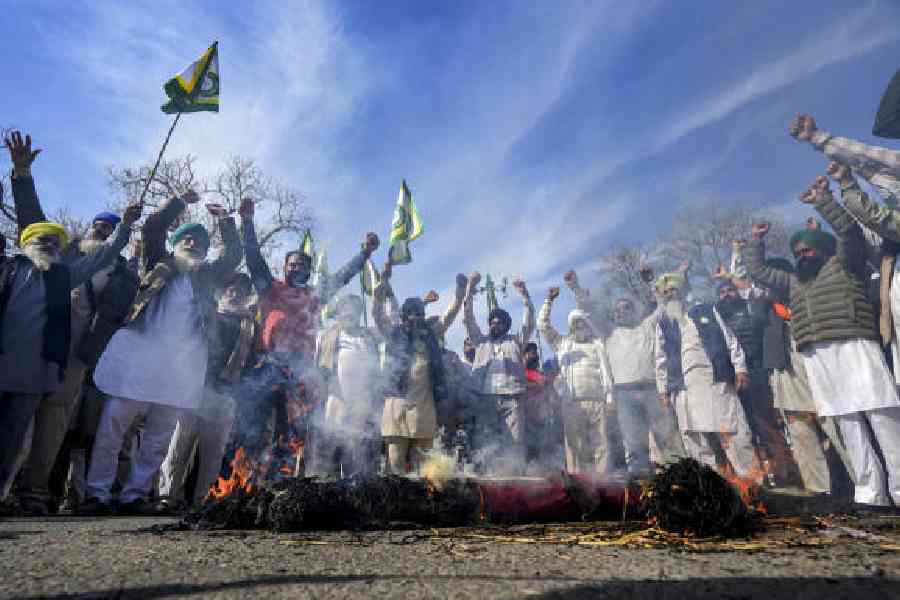
He added: “For the first time in history, our farmers are facing a storm. You’ve opened the door to crush poor farmers. No Prime Minister has ever done this.”
This was Rahul’s first full speech in the House this session after he had been unable to complete his address on the motion of thanks to the President’s address. Rahul had then been barred from quoting from an unpublished book by former army chief Manoj Naravane, leading to uproar and a deadlock.
Rahul’s remarks on Wednesday triggered vociferous protests from the Treasury benches. The controversy quickly spilled outside the House with senior ministers rushing to denounce his statements before the media as “wild” and “unsubstantiated”.
Parliamentary affairs minister Kiren Rijiju announced the government would move a breach of privilege motion against Rahul and demand “expunging of lies spoken by Gandhi”.
“He has made a serious allegation against minister Hardeep Singh Puri without giving any notice. It is a serious breach of privilege,” Rijiju told reporters.
“We will file the necessary notice with the Speaker. The LoP did not make any useful substantive contribution to the budget discussion. He was only making wild allegations.”
Puri, the Union petroleum minister, speaking separately at the BJP headquarters, accused Rahul of indulging in “buffoonery” by invoking his name in connection with the Epstein files.
He acknowledged having met US sex offender Jeffrey Epstein three or four times as a “private citizen” during what he described as a peace initiative, but asserted there were no allegations of wrongdoing against him in the files.
“My name was mentioned in the context of some developments elsewhere — the Epstein files.… I want to clarify that these facts are all public,” Puri said.
“Three million emails have been released, covering the period from May 2009, when I joined as India’s ambassador to the UN in New York, until I became a minister in 2017.
“During this period, there are references to only three or four meetings, and my interactions were entirely professional, related to the Independent Commission on Multilateralism and other international work.”
Inside the House, Rahul provoked a furious reaction from the ruling side when he suggested that the Prime Minister had acted under compulsion.
He then referred to certain files, followed by the mention of two industrialists, triggering renewed pandemonium.
BJP member Jagdambika Pal, who was in the Chair in the absence of the Speaker, ruled that the “unsubstantiated allegations” against people in high office and those not members of the House would not go on record.
Rahul maintained he was prepared to substantiate his claims.
The leader of the Opposition had begun his speech on an unusual note, holding forth on martial arts — a discipline he said he practised to stay fit. This left the ruling side momentarily puzzled about the possible direction of his speech.
As murmurs rose from the Treasury benches and the Chair questioned the relevance of martial arts to the budget debate, Rahul requested: “Allow me to be a little creative.”
He explained that the foundation of martial arts lay in establishing a “grip” on the opponent. Once that grip was secured, the next step, he said, was the “choke”.
“The focus of the choke is the neck of the opponent. Once you choke your opponent, the fear is visible in his eyes. The opponent tries to resist for some time but eventually realises that he has been choked and he surrenders with a tap,” Rahul said.
He later extended the analogy to his broader criticism of the government, alleging India had been “choked” by the US in the trade deal.
Rahul then broadened his attack, arguing that in a rapidly destabilising world, nations were engaged in silent contests masked by diplomatic niceties while technology reshaped the battlefield.
“At the centre of that struggle sits AI, and at the centre of AI is data,” he said, accusing the government of bargaining away India’s “greatest strategic asset” — its data — to the US.
Speaking to reporters outside Parliament, Rahul again referred to the Epstein files.
“There are department of justice files on Epstein naming Hardeep Puri and Anil Ambani. In an ongoing case against Adani, summons have been issued. The Government of India has not responded for the last 18 months. There is direct pressure on the Prime Minister,” he said.
“The main thing is that no Prime Minister would do this in a normal situation. In a normal situation, no PM would do what has happened in terms of data, farmers, energy security and defence. Someone would do this only when there is a certain grip on them.”
Replying to the budget debate in the evening, finance minister Nirmala Sitharaman mounted a counterattack. She alleged the previous UPA government had “sold the interests of the poor and the farmers” during negotiations at the World Trade Organisation in 2013.
“They surrendered before the WTO. The LoP has no moral right to level charges against Modiji,” she said, crediting the Prime Minister with rescuing the country after 2014, as the Opposition protested.
Speaking to reporters, Rijiju described Modi as the “strongest Prime Minister ever” and asserted that “no power” could buy or sell India.
“No one can sell this country, and no one can buy it. Yet Rahul Gandhi claimed someone has sold India. No one can even imagine such a thing,” he said.