All six stanzas of Vande Mataram will be sung or played before Jana Gana Mana when both feature at government events, a Union home ministry order says, while also nudging schools to begin their day with Bankim Chandra Chattopadhyay’s song.
Standing during the playing of Vande Mataram will be mandatory at official events — an honour so far reserved for the national anthem, composed by Rabindranath Tagore.
The order, dated January 28 but uploaded on Wednesday, carries all six stanzas and dubs this the “official version of the national song”, making it clear that all six must be played or sung.
Yet, only the first two stanzas had been anointed as the national song by the Constituent Assembly in 1950 after the Congress adopted these two stanzas on Tagore’s advice in 1937, with the rest deemed problematic for the country’s secular ethos.
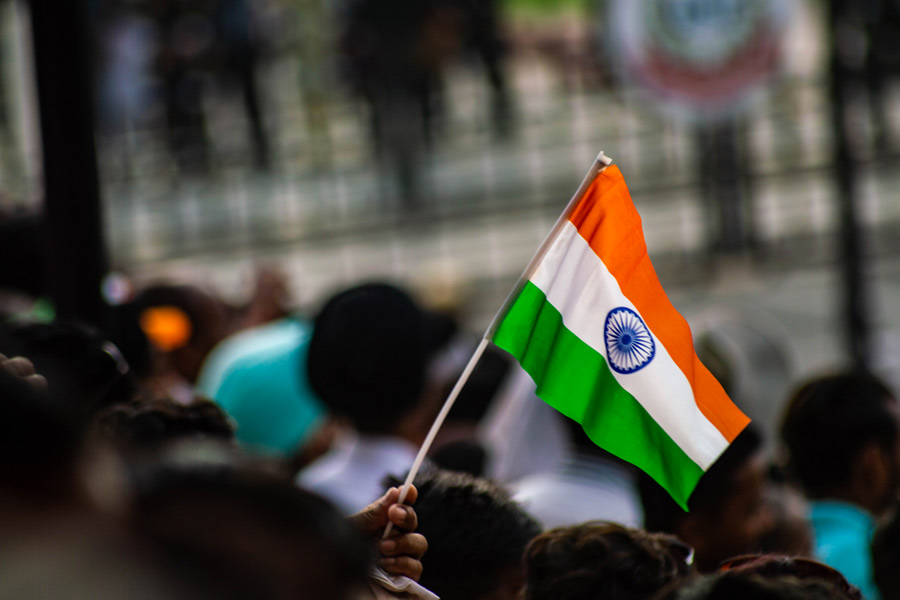
According to the ministry order, the occasions where Vande Mataram will be played include the “unfurling of the Tricolour”, appearing to suggest it will precede the national anthem at Republic Day events.
Prime Minister Narendra Modi had, during a parliamentary debate in December, accused Jawaharlal Nehru of truncating
Vande Mataram at the behest of Muhammad Ali Jinnah and thereby sowing the seeds of Partition.
Yet, Tagore’s objections to the latter stanzas — mentioned by several Opposition members — formed an unmissable subtext.
Many, including some Opposition speakers, had suggested the Modi government appeared intent on playing Bankim and Tagore against each other in the run-up to the Bengal elections.
The ministry order says Vande Mataram should be sung or played over 3 minutes and 10 seconds to mark occasions such as the President’s arrival at government events, governors’ speeches, and cultural occasions or ceremonial functions other than parades.
Home ministry sources said there had so far been no official protocol about the singing or playing of Vande Mataram and that the full, six-stanza version — with its latter part invoking Hindu goddesses — had not been sung in official events till now.
“When the national song and the national anthem are sung or played, the national song will be sung or played first,” the ministry order says.
“Whenever the official version of the national song is sung or played, the audience shall stand to attention. However, when in the course of a newsreel or documentary the national song is played as a part of the film, it is not expected of the audience to stand as standing is bound to interrupt the exhibition of the film and would create disorder and confusion rather than add to the dignity of the national song.
“There should be an adequate public audition system so that the gathering in various enclosures can sing in unison with the choir; printed lyrics of the official version of the National Song may be circulated amongst the participants, wherever required.”
It adds: “School authorities should make adequate provision in their programmes for popularising the singing of the national song, national anthem and promoting respect for the national flag among students.”
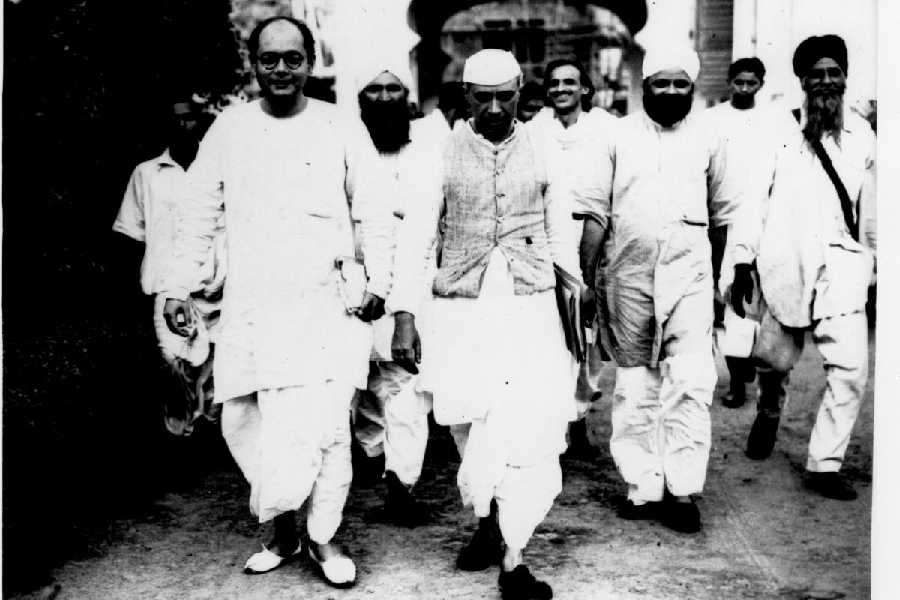
Mridula Mukherjee, a retired JNU history professor, had told The Telegraph in November that the 1937 decision to adopt the first two stanzas had been taken by a Congress committee and not Nehru alone. The committee had Nehru, Maulana Azad, Subhas Chandra Bose, Tagore and Acharya Narendra Dev, among others.
Historian Sugata Bose says in his book, The Nation as Mother and Other Visions of Nationhood, that it was Tagore who suggested adopting only the first two stanzas for singing at Congress gatherings. Bose had suggested that Tagore’s advice be taken.
The book says Tagore had written privately to Bose that the song, containing the adoration of Durga, was wholly inappropriate for a national organisation that was the meeting place for different religious communities.
According to the book, “He (Tagore) wrote in Bengali: ‘Bengali Hindus have become restless at this debate, but the matter is not confined to Hindus. Where there are strong feelings on both sides, what is needed is impartial judgment. In our national quest we need peace, unity, good sense — we do not need endless rivalry because of one side’s obstinate refusal to yield’.”
However, even the adopted version remains contentious. “Vande Mataram” can be translated both as “I praise thee, Mother” and “I bow to thee, Mother” — with the second formulation problematic for Muslims who are not supposed to bow before anyone but God.