
Jorhat, Sept. 29: Undeterred by low returns, Assamese films should continue to be made and directors, actors and producers in the state have to travel the extra mile to push their films a la Bollywood.
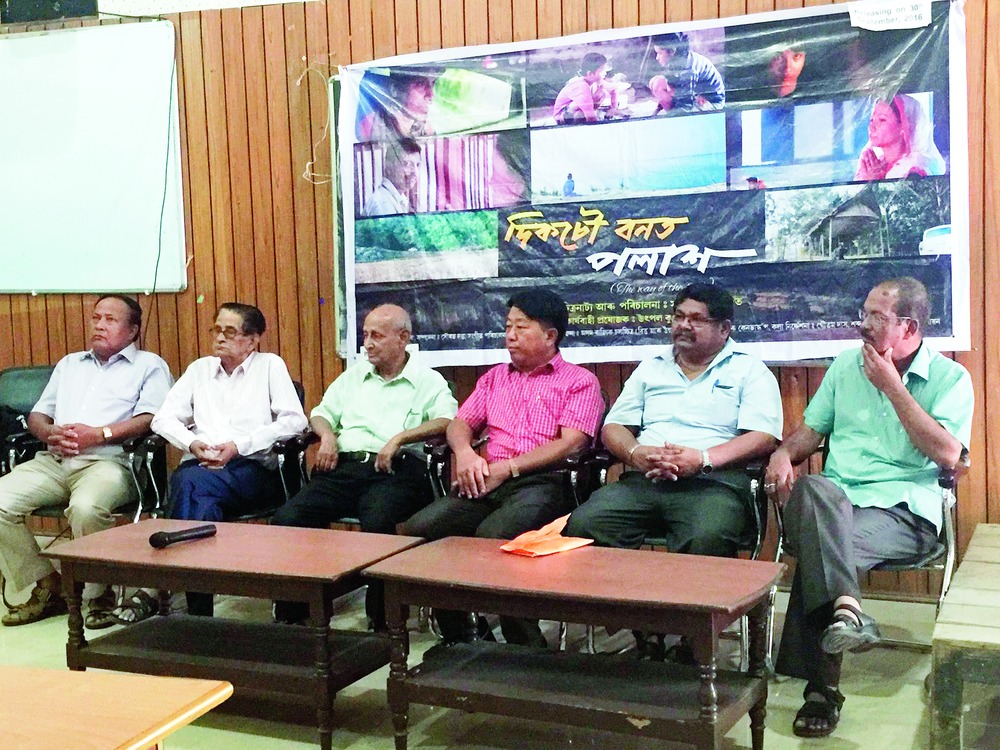
This was the message director Sanjib Sabhapandit of Jangsai Jonak and Jatinga Ityadi fame and producer Utpal Kumar Das conveyed to the students recently at a promotional of their new film, Dikshow Bonot Palax (The way of the Soul), set to be released tomorrow.
Along with them is the protagonist of the film - legendary Kulada Kumar Bhattacharjee, 84, popularly called "Amal" after he played the boy's role in Rabindranath Tagore's Dakghar in 1945 at Cotton College. He also worked for BBC Asia (Bengali).
Narrating the theme of the film which is set in Jorhat and Mokokchung in Nagaland, Sabhapandit said the story is a different take on love and explores its different meanings. Some elements were taken from Ernest Hemingway's F or Whom The Bell Tolls and Franz Kafka's Metamorphosis. "Though the story is essentially about love, there are different layers interwoven into the main theme which evolves along with the story until all the strands are brought together," he said.
Set in 1937, the story is about a youth from Assam who visits Mokokchung, returns to don the mantle of a xatradhikar and then revisits the place 60 years later.
Sabhapandit denied that the film was made with a deliberate intent to improve Assam-Nagaland relations.
The coordinator of the Assam-Nagaland Border Peace Coordination Committee, Tamgsu Wati Ao, said he had arranged filming in Nagaland and the script seemed very appealing to him.
Bhattacharjee who essayed the hero's role said the film should be enjoyed by one and all.
The promotional turned into a serious discussion on the future of Assamese films given the fact that the hall owners are averse to screen Assamese films because of poor turnout.
Sabhapandit was confident that this film will be considered one of the best of Assamese cinema.
"Creativity is uppermost in a filmmaker's mind," Bhattacharjee said.
"When we talk about an Assamese film being screened in the halls in Assam, the map which comes to our mind is sans 'Bodoland', Karbi Anglong and Cachar belts. Within this limitation we have to find the audience who will appreciate our work.
Bhattacharjee said in the conflict between art and profit, more Assamese films should be made. "Otherwise a vacuum will be created which will be filled up by Hindi films. There is need for people's support," he said.