 |
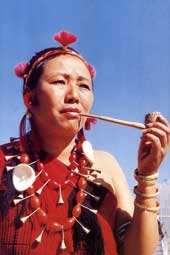
| Smoking a peace pipe: A Naga woman enjoys a puff |
lThe writer is the author of the book Naga Imbroglio and a former editor of The Nagaland Observer
The birth of the New Year finds the Naga people pre-occupied with two things — the forthcoming Assembly elections slated for sometime in February and the reported return of the NSCN (I-M) leaders, Isak Chisi Swu and Thuingaleng Muivah, to India for talks. Both are important and one could very well affect the other. The elections are important because they are important to keep the democratic process in society going. The coming Assembly elections have added importance in view of the boycott by the Opposition parties in the last elections. The future/career of many Naga leaders, especially those who had spent so much in the last elections without contesting, are at stake. Proper elections are, therefore, important so that the already difficult situation is not further vitiated with leaders venting personal frustrations and bitterness. Possible violence during and immediately after elections, too, must be avoided, or at least, contained.
Most people also have their eyes directed towards Delhi for the reported scheduled talks between the Union government and the NSCN (I-M) leaders in the second week of January. All want to see an end to the five decades of armed conflict and violence. There is hope. Yet this hope is tinged with a sense of trepidation because there is also a real dilemma. Everyone knows that a political settlement of the Naga issue is imperative. But the people also want a settlement that will be acceptable and workable. They do not want another 16-point agreement or a Shillong Accord, which managed to leave many dead in their wake and to polarise society. The question before most people, therefore, is whether a workable and acceptable settlement can be arrived at without reconciliation and without including all sections in adequate and transparent consultations.
In the circumstances, what seems to be of utmost importance is to pursue further the process of consultations started by the Naga Hoho and the churches on August 9 when they invited representatives of all factions to a meeting in Kohima. That meeting did not take off, as it should have, because of lack of quality representation from the various factions. But this process should not be stopped. On the other hand, it should be taken further and also include more and more stakeholder groups in society. The process of reconciliation was also firmly laid down at the combined Naga tribe reconciliation function in Kohima on December 20, 2001. At the function, different Naga tribe hohos, churches and other mass-based NGOs adopted a declaration stating the need for healing and to go beyond our own hurts as we also may have provoked others to hurt us. These are not just pious religious sentiments or idealistic propositions but practical necessities in a situation where each tribe has a distinct cultural view of the world of its own. There is hardly any other alternative.
The Naga issue has wider ramifications for the region and the neighbours are important, as at least three other states will be directly affected in any attempt to settle this issue, thanks to the fragmentation of the Naga areas because of the hasty manner in which the state of Nagaland was created. If, for instance, the Naga leaders had, at the time, taken a firm stand with Pandit Jawaharlal Nehru and insisted that all the Naga areas on the Indian side of the international border be included within the new state, things may not have become as difficult as they are today.
No adequate settlement will be possible without the goodwill and support of the neighbours. And then, there is the larger implication involving the Nagas of Myanmar. Nothing less than thinking in terms of what is right for the region as a whole, unaffected by international boundaries, will finally work. Even now, the various insurgent outfits in the Northeast appear to have adopted a wait-and-watch attitude before deciding whether or not to hold talks with the Union government.
The single biggest dilemma before the present negotiating parties, and any future ones, will revolve round the issue of Naga integration. Even leaving aside, for the moment, the wider question of the Nagas of Myanmar, will the states of Assam, Manipur and Arunachal Pradesh agree to give up the Naga-inhabited areas within their states? The agitations, especially in Manipur in the wake of the extension of ceasefire beyond the boundaries of Nagaland last year, have shown that this is not going to be easy by any stretch of the imagination. And the Union government is unlikely to make an agreement in secret with the Naga side and impose it on three other states. The ramifications could be terrible and there is the question of whether such imposition will really work.
This was where the Naga Hoho’s initiative, last year, in reaching out to the neighbours in friendship was so important. The Nagas and their neighbours will continue to remain neighbours, settlement or no settlement. It is ideal if neighbours, at person-to-person level, could arrive at an understanding of what is clearly a common problem.
The issue can be circumvented if the Naga side could give up on its own the question of integration of all Nagas-inhabited areas. But how could they? The very fact of negotiations with the Union government, and the involvement of a chief minister of an Indian state, means that the issue of Naga sovereignty is already acknowledged, at least implicitly, as no longer feasible. If the Naga side also gives up the issue of Naga integration, what will it bring home to the Naga people after so many decades of fighting and with thousands of lives lost, both in factional clashes and with the Indian army in the cause of Naga independence? The dead may not only turn in their graves but the possibility of their ghosts rising up in the form of those still living to seek vengeance is only too real and terrible to imagine. The need, therefore, for intra-Naga reconciliation and transparent inclusiveness are apparent. No clever tactics or short-cut methods will work except through force of military might and suppression of people’s genuine feelings. Even then, it can only work in the short term, leaving the issue open to be raised again at some future date.
There is also need to adequately appreciate the geo-politics of the region. As a Naga writing this, there is possibility of misinterpretation by some as wanting to make the Naga issue bigger than what it is. That is not my intention. But the fact is the Northeast forms a racial faultine of two major races of the world and the Naga issue could very well also represent a spearhead of a racial struggle if the Nagas were not so small or insignificant. Almost all the insurgent outfits also belong to the Mongoloid stock. Even in Assam, to my understanding, the Ulfa origins are Ahom related.
nThe views expressed here are the personal opinions of the author and do not purport to represent the views of any organisation.