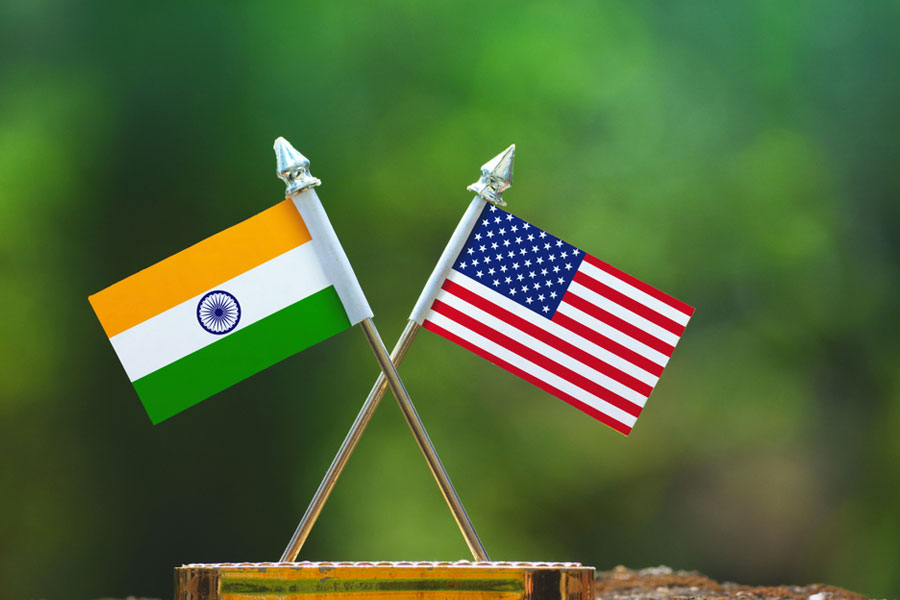
India and the United States opened high-level trade talks on Tuesday aimed at recalibrating a proposed bilateral trade agreement after changes in US tariff policy disrupted a framework negotiated earlier this year, with both sides seeking to conclude an interim pact before July 24.
Commerce and Industry Minister Piyush Goyal met US Trade Representative Jamieson Greer in New Delhi as negotiators worked to resolve outstanding issues and secure favourable tariff terms under the first phase of the proposed Bilateral Trade Agreement (BTA).
"Warm welcome to @USTradeRep Amb Jamieson Greer, @USAmbIndia Amb Sergio Gor and their delegation to @DoC_GoI. Looking forward to productive discussions on the bilateral trade agreement between (India & US)," Goyal said in a post on X.
Greer's two-day visit comes days after Prime Minister Narendra Modi and US President Donald Trump met on the sidelines of the G7 summit in France on June 17, giving fresh momentum to negotiations that both countries view as key to deepening economic ties.
The meeting at Vanijya Bhawan, the headquarters of the commerce ministry, is also being attended by Commerce Secretary Rajesh Agrawal and India's chief negotiator Darpan Jain. It follows chief negotiator-level discussions held in New Delhi from June 2 to 4.
The talks are focused on revisiting a framework agreement announced in February after a US Supreme Court ruling struck down sweeping tariffs imposed by the Trump administration, forcing both sides to reassess commitments made under the proposed deal.
Agrawal had said on June 15 that the discussions were expected to focus on giving final shape to the framework agreement. On June 17, Trump said the two countries were "very close" to finalising the trade pact.
Earlier this month, Goyal said India and the US were moving towards resolving all pending issues and were likely to execute the "very, very vibrant" first phase of the BTA by the middle of next month.
India and the US formally launched BTA negotiations on February 13, 2025, and announced the contours of the first phase of the agreement in February this year. The framework was built around the 50 per cent tariffs imposed by the US on Indian goods.
However, the US Supreme Court struck down those tariffs on February 20. Subsequently, the Trump administration imposed a temporary 10 per cent tariff on imports from all countries under Section 122 of the Trade Act for 150 days beginning February 24, with the measure set to expire on July 24.
The changes have heightened the importance of the ongoing talks as both countries seek to preserve the benefits envisaged under the original framework.
According to the proposed arrangement, the US had agreed to reduce tariffs on Indian goods to 18 per cent from 50 per cent. It had also removed a 25 per cent tariff linked to India's purchases of Russian oil and planned to lower the remaining duties to 18 per cent. The court ruling, however, altered that framework.
India, in turn, proposed eliminating or reducing tariffs on all US industrial goods and a broad range of agricultural products, including Dried Distillers' Grains (DDGs), red sorghum for animal feed, tree nuts, fresh and processed fruits, soybean oil, wine and spirits.
New Delhi also indicated its intention to purchase USD 500 billion worth of US energy products, aircraft and aircraft parts, precious metals, technology products and coking coal over the next five years.
A clause in the February joint statement allows either side to modify its commitments if agreed tariff levels change, prompting both governments to revisit elements of the proposed deal following developments in US trade policy.
Meanwhile, the US Trade Representative launched two Section 301 investigations in March covering about 60 economies, including India. One probe focuses on alleged excess industrial capacity, while the other examines forced-labour concerns in global supply chains.
Securing preferential tariff treatment has emerged as a key objective for New Delhi. Under the original framework, Indian exports would have faced an 18 per cent tariff, lower than the 19-20 per cent duties imposed on competing economies such as ASEAN nations, Sri Lanka, Pakistan and Bangladesh. With all countries now subject to the same 10 per cent levy, India is seeking to regain a competitive edge through the trade pact.
The US was India's second-largest trading partner in 2025-26. India's exports to the US rose 0.92 per cent to USD 87.3 billion during the fiscal year, while imports increased 15.95 per cent to USD 52.9 billion. India's trade surplus with the US narrowed to USD 34.4 billion from USD 40.89 billion in the previous fiscal year.