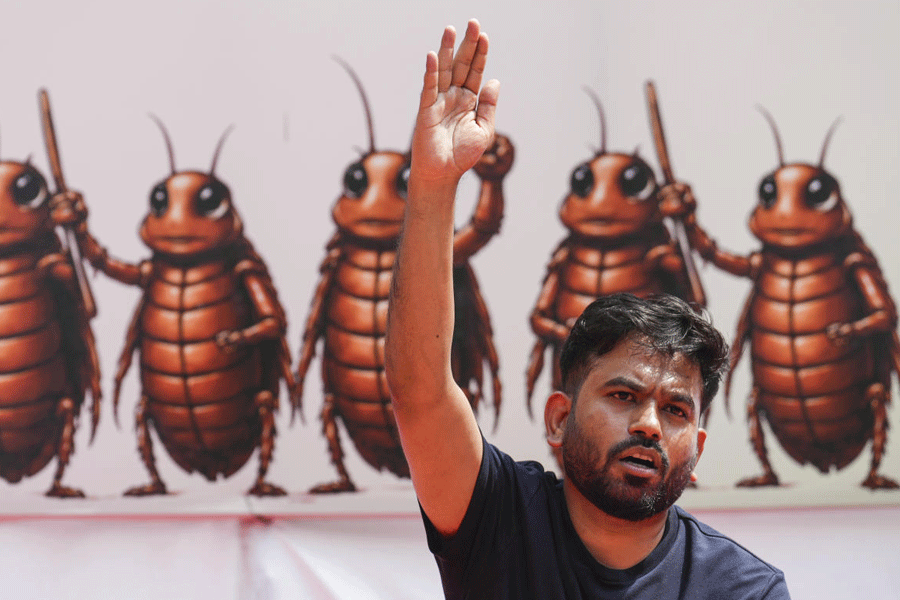
Under the searing summer sun at Jantar Mantar, the designated epicentre of Indian dissent, a new kind of protest has taken hold. For four days, hundreds of young people have gathered under the banner of the Cockroach Janata Party (CJP), defying lack of official permissions and braving what they call a logistical siege by the state that has allegedly cut off water supplies and intercepted food deliveries at the barricades.
At the centre of this sits an unlikely leader who admits he has absolutely no plan.
Abhijeet Dipke, the soft-spoken founder of the CJP, told The Telegraph Online that the mechanics of India's loudest youth rebellion are entirely improvisational.
Triggered by systemic educational collapses, rampant paper leaks and the suicides of at least 16 students, the movement’s immediate demand is the resignation of Union education minister Dharmendra Pradhan. But beyond that immediate horizon the roadmap dissolves into uncertainty.
"We are still taking it one step at a time," Dipke said, repeating a phrase that has become a defining philosophy for the movement.
In conventional Indian politics, movements rely on manifestos, organisational committees and multi-year electoral calculus. Dipke, who until last month was an introverted observer in Boston, offers none of that. Asked if this momentum can be sustained for the next three years to influence the general elections, he rejected the premise.
"I think it would be too early to comment on that," he said. "It’s not whether we are going to contest elections or not. That’s not the point."
Critics note that speakers on the CJP dais focus heavily on the single scalp of a minister rather than proposing structural overhauls of India's broken education system; Dipke defended the omission as sequential.
The vision, he claimed, is still a work-in-progress being drafted with policymakers in the background. For now, the raw theater of immediate accountability takes precedence over policy white papers.
"How can we expect the system to get fixed when the person who failed to do his job is still in his position?" Dipke argued. "First, we need to know if the education minister is ready to accept his mistake. Once that fear gets into the minds of those in power, then you will see systemic changes."
Dipke is aware of the ephemeral nature of fame and public anger. He acknowledged that the hundreds filling Jantar Mantar today out of love and frustration could easily vanish by next week.
"I’m not a delusional person," he said. "I’ve worked in politics before. I know nothing is permanent. Today this movement is getting attention; tomorrow it might not. Changes take years and decades, but I shouldn't go down without trying."