Book: SON OF NOBODY
Author: Yann Martel
Published by: Canongate
Price: £20
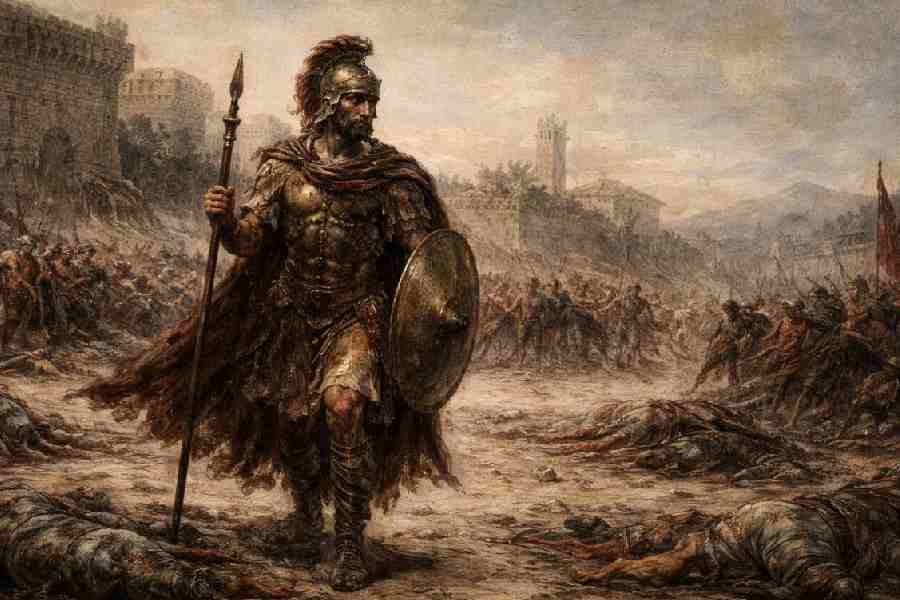
Alexander Pope began his mock epic, The Rape of the Lock, with a formal invocation, announcing that a trivial quarrel could be elevated to epic scale. The gesture was playful; yet it exposed how the epic form could be turned inside out. Yann Martel’s Son of Nobody operates within that same tradition of reversal, though its intentions are more sombre. Instead of inflating the trivial, Martel deflates the monumental. The Trojan War, long preserved as the site of aristocratic heroism, is retold through the voice of an obscure soldier, Psoas, whose achievement is merely surviving the war, not performing heroic feats. The novel thus adopts the framework of the epic while quietly dismantling its assumptions about heroism, authority and memory.
Martel structures the novel around a fictional discovery. Harlow Donne, a Canadian academic, travels to Oxford on a fellowship and begins working on fragments of papyri. Among them, he uncovers pieces of a lost epic, the Psoad, narrated by Psoas, described as the son of nobody. The narrative unfolds through an unusual design. Each page is divided horizontally. The upper portion presents Donne’s translation of the Psoad, written in verse that echoes classical cadence without imitating it slavishly. The lower portion contains Donne’s commentary in prose. At first, these notes read like academic annotations, offering contextual explanations, references to Homer, and reflections on translation. Gradually, however, the commentary becomes personal. Donne begins to write about his failing marriage, his daughter left behind in Canada, and the unease that accompanies his intellectual ambitions. The structure thus establishes two parallel narratives, one ancient and one contemporary, which unfold in alternating tonal registers.
This formal arrangement encourages comparison between the two strands without forcing direct equivalence. The Psoad recounts the experience of a soldier drawn into a war shaped by elites, while Donne’s commentary reveals a man caught in the disintegration of his domestic life. As the fragments accumulate, the poem grows darker, and Donne’s voice grows confessional. The reader moves between battlefield scenes and domestic recollections, between collective violence and private estrangement. Martel uses this design to explore how epic narratives intersect with personal histories. The war described by Psoas does not culminate in triumph. It produces exhaustion, grief and dislocation. Donne’s life follows a similar trajectory, though on a smaller scale. The structural symmetry emerges gradually, creating continuity rather than contrast.
This strategy situates Son of Nobody within a broader lineage of revisionist retellings. Writers have repeatedly returned to classical epics to foreground marginal figures. Euripides shifted attention to the defeated women of Troy. Contemporary novelists such as Madeline Miller and Pat Barker have reinterpreted myth through sidelined voices. Tom Stoppard’s play, Rosencrantz and Guildenstern Are Dead, famously reframed Hamlet from the perspective of minor characters trapped within events they cannot control. Martel’s novel adopts a comparable logic. Psoas exists within a familiar narrative, yet the focus moves away from princes and divine interventions toward fatigue, hunger and fear. Heroism appears less as a defining trait and more as a temporary response to survival.
Martel’s language reinforces this shift. The Psoad avoids ornate description in favour of precise observation. The poem records bodies, debris and silence rather than strategic manoeuvres. The effect is cumulative. Psoas’s experience unfolds as a sequence of interruptions and displacements. The absence of the certainty of righteous triumph becomes central to the narrative. In the meantime, Donne’s prose adopts a reflective tone that gradually exposes vulnerability. His scholarly voice disintegrates as personal confession takes precedence. The interplay between verse and commentary produces a layered narrative that resists a single, interpretive centre.
Such a retelling resonates with contemporary anxieties about war and bearing witness. Modern audiences observe conflicts through mediated images while remaining distant from decision-making. Martel’s novel mirrors this condition. Psoas bears witness to destruction without influencing its course. Donne observes his own life unravel while immersed in the past. The novel thus presents war as an enduring pattern and the act of witnessing as a shared human condition. By revisiting the Iliad from the vantage point of anonymity, Son of Nobody questions the tradition that elevates exceptional figures while leaving ordinary lives unrecorded. The result is a measured reconsideration of the epic form, one that replaces grandeur with endurance and triumph with memory.