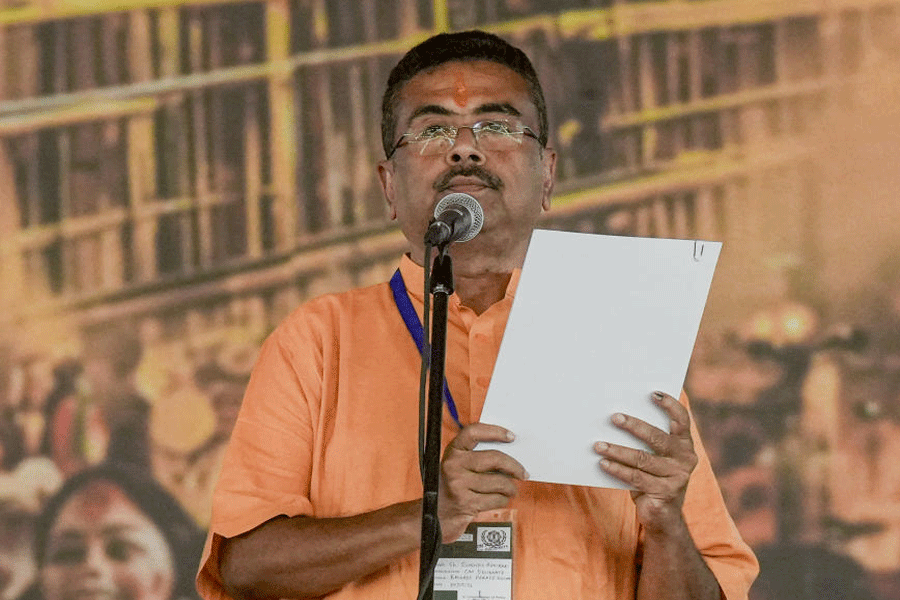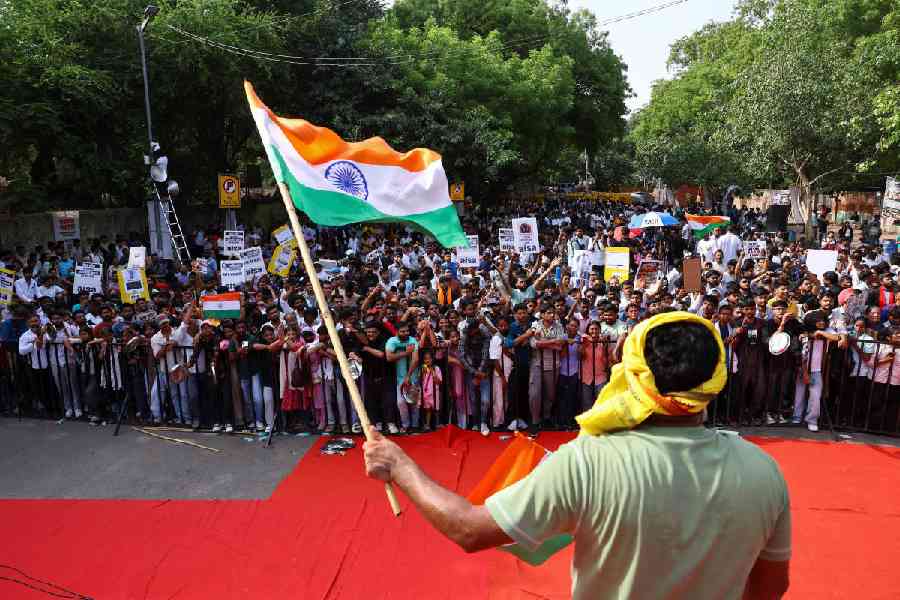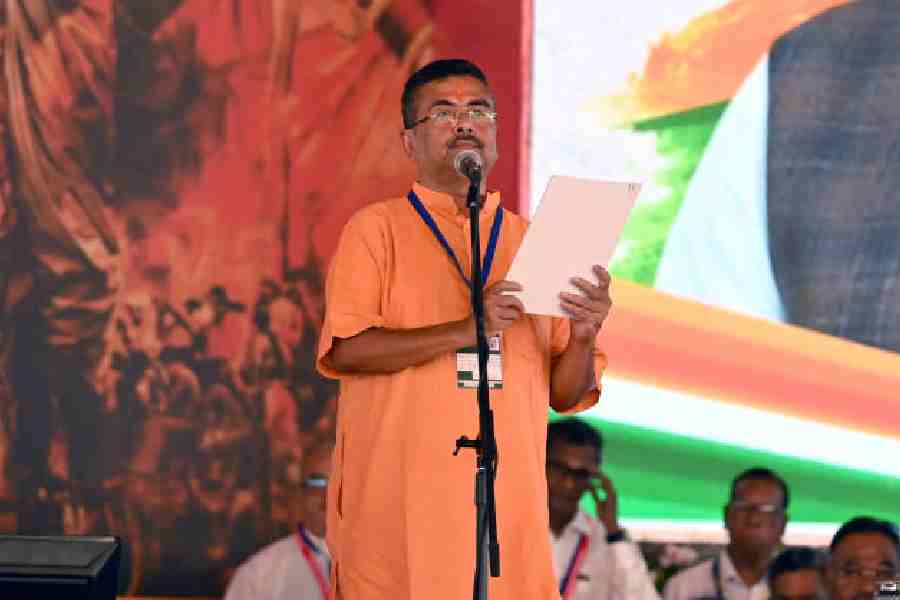
“Ami, Suvendu Adhikari…” As Bengal’s man of the hour began taking his oath of office at 11.32 on Saturday morning, the murmur of thousands at Brigade Parade Ground gave way to a loud, sustained cheer. Followed by a deafening roar.
It lasted only a few seconds, but it said everything about the weight of the moment — Bengal had its first BJP chief minister.
At 11.34am, Suvendu, 57, finished taking his oath, administered by governor R.N. Ravi, signed the register and walked over to Prime Minister Narendra Modi. He bowed before Modi, who clasped his hand, patted him on the back, pulled him into a hug and turned to wave at the crowd.
Union home minister Amit Shah, a long-standing backer of Suvendu who had declared his name as the BJP’s chief ministerial pick on Friday evening, greeted him with similar warmth. On the dais, 20 chief ministers of the BJP and NDA-ruled states bore witness.
Modi had paid tribute to the people of Bengal even before the ceremonies began, stepping forward with folded hands to acknowledge the sweeping mandate that had delivered the party 207 MLAs. He even prostrated himself as a gesture of gratitude to the people.
“Congratulations to Suvendu Adhikari Ji on taking oath as West Bengal’s Chief Minister,” Modi wrote on X. “He has made a mark as a leader who has remained deeply connected to the people and understood their aspirations from close quarters. My best wishes to him for a fruitful tenure ahead.” Suvendu responded in kind, writing that Modi’s blessings and guidance would “illuminate his path” as he worked toward a “Viksit Bengal” within the vision of a “Viksit Bharat”.
Five other MLAs-elect were sworn in alongside Suvendu — a cabinet assembled with deliberate symbolism. Veteran Dilip Ghosh of Kharagpur Sadar represented the old guard of the Bengal BJP. Agnimitra Paul of Asansol Dakshin represented women. Kshudiram Tudu of Bankura’s Ranibandh spoke for the tribal community; Ashok Kirtaniya of Bongaon Uttar for the Matua community; and Nisith Pramanik of Mathabhanga in Cooch Behar for the Rajbanshi community. Later in the evening, Suvendu said the ministers would be allocated departments on Monday.
The change of power registered itself almost instantly in small, telling ways. Suvendu’s social media biography shifted from “Leader of the Opposition” to “Chief Minister of Bengal.” At the state Assembly and at Nabanna, the nameplates bearing Mamata Banerjee’s name were quietly replaced with his.
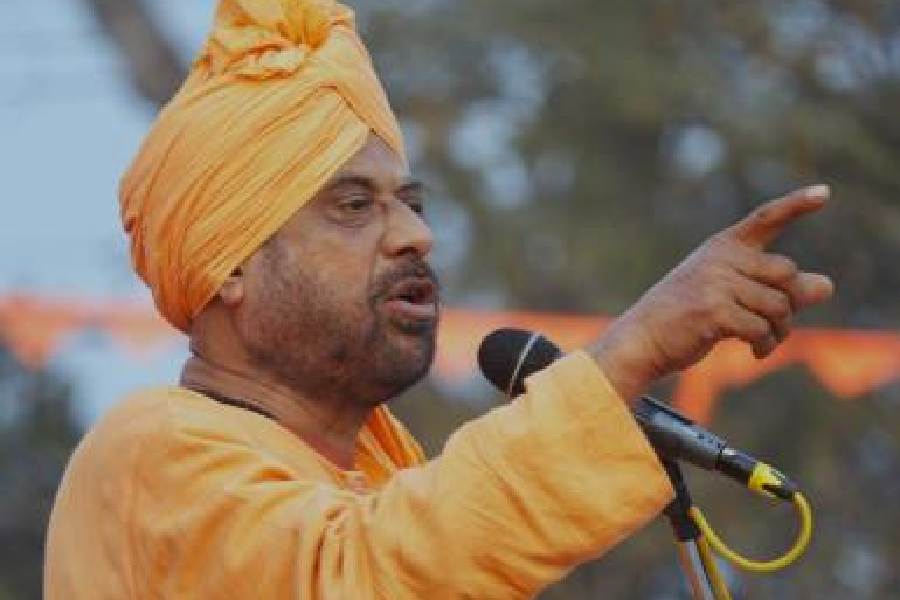
Suvendu arrived at Brigade Parade Ground in a modified open-roof SUV, flanked by Modi and BJP state president Samik Bhattacharya, moving through dense lines of cheering party workers. He wore a simple saffron kurta and a white dhoti with a pink border, paired with his characteristic black leather sandals — a look that could have belonged to a Bengali bhadralok of another era. Those who have followed Suvendu’s public life closely know his style well: white kurtas, white pyjamas, the same black sandals. Saturday was no different, except that he traded the pyjama for
a dhoti.
“It appears he has simply replaced his pyjama with a dhoti,” remarked one BJP leader with a smile. “We have to see whether the Bengali dhoti-kurta becomes his trademark attire, going forward. But we don’t doubt that he will keep himself simple, as he always has.”
The occasion itself had been framed with cultural care. The swearing-in fell on the 165th anniversary of Rabindranath Tagore’s birth, and the BJP leaned into it. A giant portrait of the poet presided over the dais, with both Modi and Suvendu offering floral tributes. The ceremony opened with Tagore songs — Hey Nuton, Dekha Dik Arbar — before moving through a programme of Rabindra Sangeet and Baul music.
Suvendu’s first act as chief minister was a visit to Jorasanko Thakurbari, the ancestral home and birthplace of Tagore, where he laid flowers at the poet’s statue and delivered his first public remarks in office. The new government, he said, would be guided by Tagore’s ideals while upholding the culture of Bengal and Bengalis. He invoked Swami Vivekananda’s exhortation — Charaiveti, Charaiveti, keep moving forward — as the government’s performance mantra.
“The party formed under the leadership of a dhoti-punjabi-wearing Bengali icon like Syama Prasad Mookerjee needs no one’s approval to function,” Suvendu said. “Now I am the chief minister, and I belong to everyone. This is not the time for politics or attacking one another. Our focus is on Charaiveti, moving ahead.”
He made clear early that there would be no honeymoon period. “I will start working from Monday,” he said after visiting the Bharat Sevashram headquarters at Ballygunge. Before that, he had already held his first administrative meeting at the PWD tent on the Maidan, with chief secretary Dushyant Nariala, home secretary Sanghamitra Ghosh, and director-general of police Siddh Nath Gupta in attendance, alongside newly elected BJP MLAs Tapas Roy, Jagannath Chattopadhyay, and Shankar Ghosh.
By evening, the first appointments had been made. Retired IAS officer Subrata Gupta, who was the Election Commission of India’s special observer for the Assembly polls, was named adviser to the chief minister. Shantanu Bala, a 2017-batch IAS officer, was appointed as his private secretary. The machinery of government was alreadyin motion.