Book: GLYPH
Author: Ali Smith
Published by: Hamish Hamilton
Price: Rs 899
Ali Smith is renowned for her surprising ability to play with the nuances of language, bending and moulding it to reflect the tone and the theme of her writing. Glyph also displays this remarkable feat, where language changes character to echo the content and the plot. Acting as a sort of sibling to her previous novel, Gliff, Smith’s attempt at duology also showcases her linguistic creativity. To highlight this further, Smith introduces her primary character, Patricia, on a Duolingo unit, translating from Italian to English and vice-versa. Her occupation is also a deliberate way to distract her from the footage of a newborn child in a hospital that “is the only one left partially standing in a mostly flattened city”. This, coupled with the two wartime stories she had heard as a child and narrates in the beginning of the novel, tells us all we need to know — Glyph is about war and its atrocities.
At its heart are two thematic tales of the great wars. The second tale, told to Patricia and her sister, Patch, when they were little girls by an elderly woman, is about a hapless soldier who became a casualty of war by being flattened to the ground, possibly by a tank. Flat cities, flat soldiers — flat characters are of cardinal importance here. The two sisters conjure the ghost of the flat soldier who is named ‘Glyph’ by Patch because she claims that it’s the only sound that comes out when he tries to speak. The ghost becomes an occupation, a hobby for the two sisters. They make up stories about his boyhood and youth. After they finish their last exchange about their young soldier, they return home to discover their mother has died. Telltale images of their dysfunctional home also cleverly spill through the carefully-arranged words of the narrative. Their mother stays mostly in bed. This becomes an indication of depression when we learn that her death was brought about by her taking too many pills. Their mother’s premature death triggers different reactions in the two. Patricia quietly takes charge of the home, while Patch hides in the shed. Patch’s coping mechanism is not accepted by their abusive father and when he forces her out of her refuge, Patricia stands up to him, underlining, once and for all, that he could no longer bully them with his strength.
The language shifts in tone throughout the first part — it is light and playful and replete with puns when it is engaged with by the two sisters, but dark and heavy when it describes the atmosphere of their sombre home.
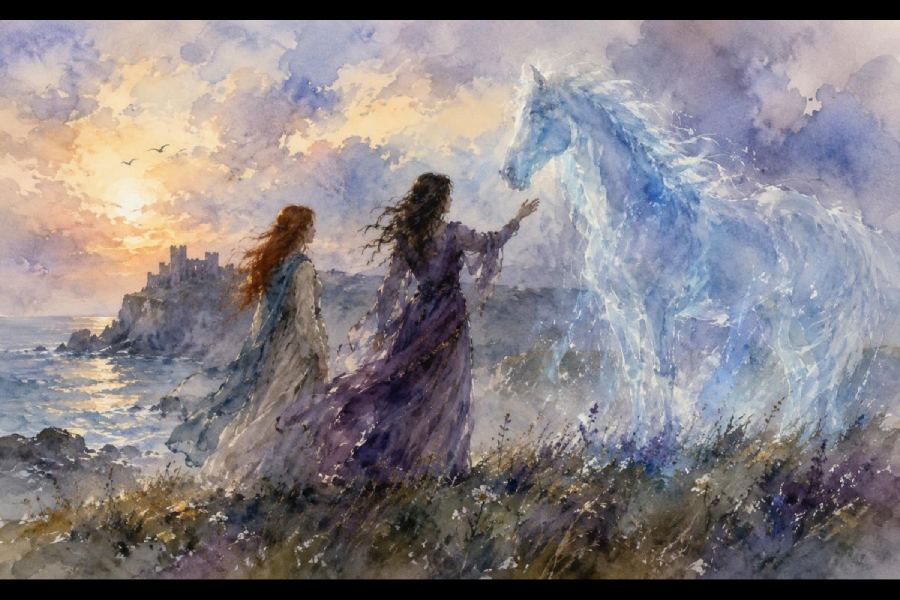
The first tale about a soldier, who was court-martialled for putting a blind horse out of its misery, features in great depth in the second part of the novel. By now, we have learnt that the two sisters have fallen apart, hardly conversing or keeping up with each other. Cracks in Patricia’s sanity come into focus when Patch remembers how they fought after their father’s death over the division of property. In a rare moment of fondness, Patch sends her sister Gliff, a dystopian novel about two sisters and a horse, saying she “thought it was rather good about siblings”. While Patricia acknowledges that the part about the siblings was good, the book unsettles her. It reminds her of the other wartime story, and this results in her having visions of another ghost, a horse this time.
The words, ‘gliff’ and ‘glyph’, are phonetically similar; but the first is a Scottish expression for being startled, while the second means to carve or engrave. The two sisters stand on either side of the narrative and are inexplicably connected yet independent — like Gliff and Glyph. As Patricia falls apart, it is Patch who comes and mends her. With Patch is her adopted daughter, Bill, a rebellious teenager who is intimately involved in protesting against the apartheid and the genocide that lurk relentlessly in the background. She witnesses the strange yet endearing exchange between the two sisters where they use words to make extensive puns and work towards healing their relationship.
The end, however, fails to settle the reader. Giving glimpses from Ovid’s Metamorphoses, Smith ensures that the resolution between the sisters is hardly indicative of a happy ending.