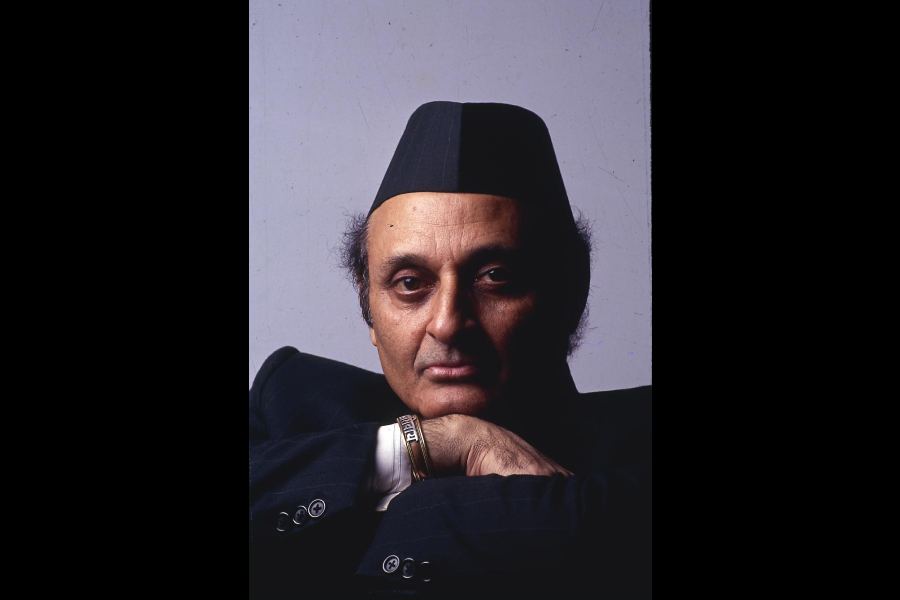
Book: A Statesman and a Seeker: The Extraordinary Life and Legacy of Dr Karan Singh
Author: Harbans Singh
Published by: Speaking Tiger
Price: Rs 999
This authorised biography provides a useful overview of an extraordinary achievement of Karan Singh — the length of time he has been in public life and in the public gaze. From 1952 to 1965, he was Sadr-i-Riyasat of Jammu and Kashmir; from 1965 to 1967, the governor of Kashmir; from 1967 onwards, for over a decade, he was a member of the Union cabinet; in 1989, he was appointed ambassador to the United States of America; from 2005 to 2014, he was president of the Indian Council for Cultural Relations; and for 18 continuous years, from 2000, he was a member of the Rajya Sabha.
Merely listing these portfolios and offices does not do justice to the dramatic quality of Karan Singh’s life trajectory. In June 1949, just a little over 18 years old, he had become regent of the princely state in the wake of irreconcilable differences between his father, Hari Singh, and Kashmir’s then prime minister, Sheikh Abdullah. The tenure as regent continued till he was elected Sadr-i-Riyasat or president of the state, representing the transformation of a hereditary monarch into a constitutional figurehead but also representing the contradictions that confronted the Dogra dynasty in the age of democracy. In early 1965, this designation changed to governor as part of the larger process of bringing J&K’s administration in line with other states.
During his tenure as Sadr-i-Riyasat and then as governor, J&K was a major theatre in the India-China war of 1962 and at the epicenter of
the India-Pakistan war of 1965. There were also deep internal fault lines — the Jammu vs Kashmir divide, the significant neglect of Ladakh, the religious and the communal subtexts to a large part of its politics.
By the mid-1960s, Karan Singh was striving for a larger stage than J&K. His scholarly and academic interests and pursuits had also consolidated and increasingly formed an important adjunct to his public life.
He was minister of health and family planning from 1973 onwards and held the portfolio through the eventful Emergency years. This was the Sanjay Gandhi era and his ministry’s area of responsibility was where massive excesses were committed in the name of family planning. In the book, however, Karan Singh comes across as someone in part unaware of the extent of the excesses, in part deeply unhappy and considering resignation, and in part unable to do anything about what was happening in the domain of his responsibility.
In the post-Emergency period, there was a schism with Indira Gandhi — something which he regretted. Inevitably, he received feelers to join the BJP in the early 1980s which he did not entertain. In any event, the schism was temporary; Rajiv Gandhi would send him to the US as ambassador and he would serve as a Congress MP later for many years.
While the book offers a comprehensive picture of Karan Singh’s personal, spiritual and political life, it does have two principal weaknesses. Firstly, too sharp a focus on Karan Singh implies that the wider context is largely viewed from his point of view and is not entirely objective.
Secondly, and more seriously, the book is unbalanced as a biography. The period up to 1980 takes up two-thirds of the book. The next 45 years are raced through with striking omissions and gaps. This is a pity. We miss Karan Singh’s views on the India-Pakistan diplomacy that led to the attempted softening of the Line of Control and the final failure of that initiative; or the 2019 legislative changes that converted J&K into two Union territories. This perspective would have been especially valuable given his unusual perch to assess an issue that still remains at the centre of our national radar.