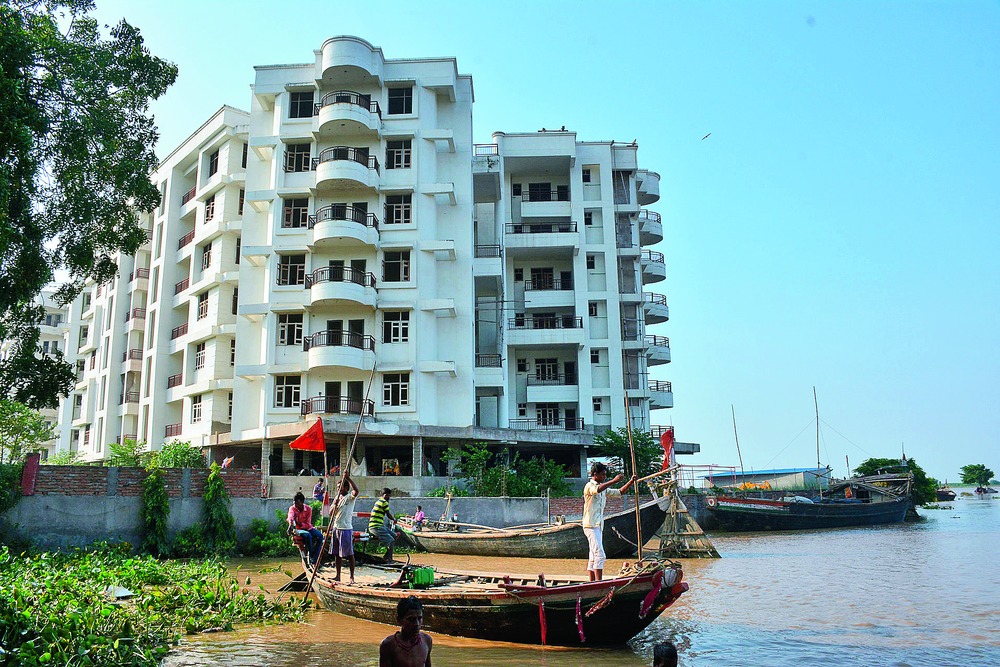

A number of buildings inside the city's flood protection wall were caught in floodwaters over the past few days. These buildings came up despite a ban on construction within the wall since 2012.
And construction activities have been going on, almost unabated. "The buildings have come up on the dry riverbed where the Ganga used to flow till a few decades ago, before it shifted course," said an engineer with the state water resources department. "Consequently, the soft soil of the riverbed is unfit for construction. The situation becomes particularly risky when river water starts flowing in its original course during excess water discharge into the river or during a flood-like situation."
Last September, the Eastern Zonal Bench of the National Green Tribunal, based in Calcutta, had issued a notice on the Patna Municipal Corporation (PMC) asking it to show-cause builders on why these buildings built in violation of environment norms should not be demolished. The tribunal's order the year before had categorically said no building should come up inside the flood protection wall.
There are around 30 buildings on the Ganga riverbed, all built in violation of environment norms. During recent hearings, the tribunal has observed gross negligence of its directives and slapped a fine of Rs 25,000 fine on the chief secretary for non-compliance of its order prohibiting construction of apartments within the flood protection wall. The PMC and the state government have been asked to submit affidavits to the tribunal's Eastern Zonal Bench by September 16 to state their position vis-à-vis construction activities inside the flood protection wall.
Patna municipal commissioner Abhishek Singh told The Telegraph on Tuesday that the current status regarding construction activity inside the flood protection wall would be communicated to the tribunal at the next hearing. "Till 2014, there were 23 apartments under the PMC's jurisdiction inside the flood protection wall," Abhishek said. "However, new areas like Kurji, Patliputra and Mainpura were recently added. We will make a fresh survey with regard to such buildings in the expanded municipal boundary of PMC. Besides, an inquiry might also be initiated to look into the possibility of floodwaters entering through the drainage lines of these buildings. We will communicate the updated report to the state government as well."
According to an order issued by the Patna Regional Development Authority (it merged with PMC in 2006) in 1996, there is a ban on construction of high-rises beyond the 25km-long Ganga flood protection wall, which separates the city from the riverbank. PMC had in February 2012 asked builders of apartments on the dry riverbed on the northern fringes of Patna to stop all activity regarding sale of flats.
A vigilance inquiry was initiated on nine such buildings between Dujra and Kurji and it is still on. Besides, showcase notices were served on 30 such apartments. A ban is also in effect on registry of the identified under-construction apartments.
Patna High Court in July 2013 ordered for a blanket ban on construction of all apartments on the dry riverbed. But residents claim construction still goes on in these buildings.
The state urban development and housing department has put fresh curbs on construction activity on the dry riverbed. As per new building by-laws notified by the state government in January 2015, no new construction is permitted up to 200m south of the protection wall and no construction would be allowed north of it.
In the first week of February 2012, PMC had issued notices to certified architects empanelled with it to explain how they approved maps of eight buildings on the riverbank. This was around the time PMC had asked builders to stop all activity regarding sale of flats. According to Sections 314 and 315 of the Bihar Municipal Act, 2007, only a certified architect can approve a building plan and maps. Also, under the Bihar Apartment Ownership Act (Amendment), 2011, civic bodies can only sanction maps of property approved by government-authorised architects. But PMC officials claim these norms are seldom followed.
"Under the earlier system, certified architects had the absolute authority to approve maps, and the only mandatory criteria for them was to submit a copy of the sanctioned maps," said a senior official in PMC requesting anonymity.
"Many certified architects, however, did not submit copies of maps of the buildings they approved. As a result, the corporation was at times in the dark with regard to construction of these buildings."