We'll get nuclear material back: Trump
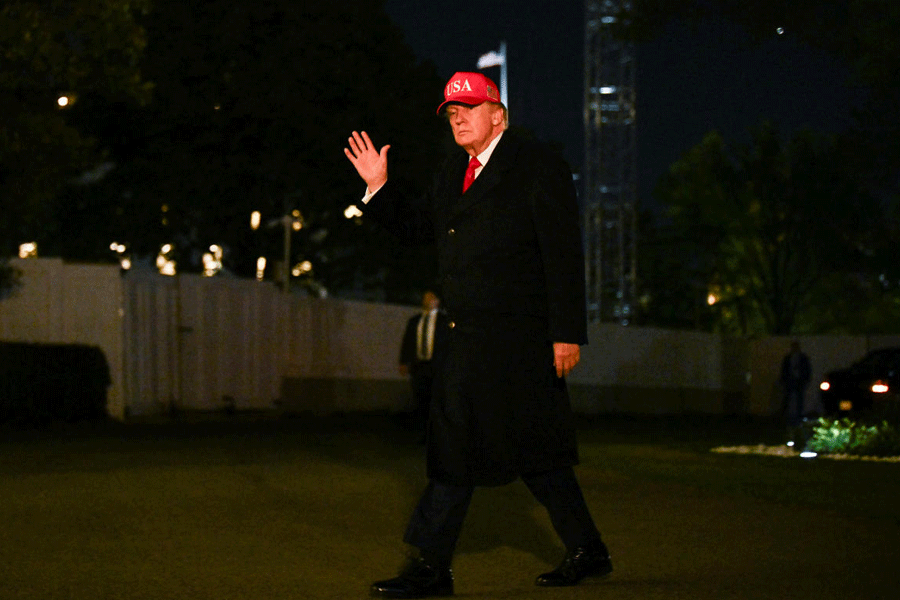
"We'll get nuclear material back. We've been called by the other side and they want to make a deal very badly. Iran did not agree to not having a nuclear weapon. Vice President Vance has done a good job," said Donald Trump at a press conference on Monday.
"34 Ships went through the Strait of Hormuz yesterday, which is by far the highest number since this foolish closure began," said the US President.
China calls US-Iran ceasefire 'very fragile'
Chinese foreign minister Wang Yi on Monday said the current ceasefire between the US and Iran is "very fragile" and urged the global community to "unequivocally oppose any actions that undermine the ceasefire or escalate the confrontation."
Wang made the remarks during a phone call with his Pakistani counterpart, Mohammad Ishaq Dar, Wang's ministry said. The priority is to prevent the resumption of hostilities and "to preserve the hard-won momentum of ceasefire," Wang said.
China would be pleased to see Pakistan playing a greater role in helping resolve the conflict, Wang said, adding that Beijing too stands ready to make its contributions.
Nato allies refuse to join Trump's Strait of Hormuz blockade
Nato allies said on Monday they would not get involved in US President Donald Trump's plan to blockade the Strait of Hormuz, proposing instead to intervene only once fighting ends, in a move likely to anger Trump and increase strains in the alliance.
Trump said the US military would work with other countries to block all maritime traffic in the waterway, after weekend talks failed to reach an agreement to end the six-week conflict with Iran.
The US military later specified that the blockade, due to have started at 1400 GMT on Monday, would only apply to ships going to or from Iranian ports.
Since the start of the war on February 28, Iran has largely blocked off the strait for all ships apart from its own. It has been seeking to make its control of the strait permanent and possibly collect levies from ships that use it.
"The Blockade will begin shortly. Other Countries will be involved with this Blockade," Trump said in a post on Truth Social on Sunday.
But Nato allies including Britain and France said they would not be drawn into the conflict by taking part in the blockade, saying instead they were working on an initiative to open the waterway, where a fifth of global oil supplies normally pass.
Netanyahu says fighting to continue in Lebanon
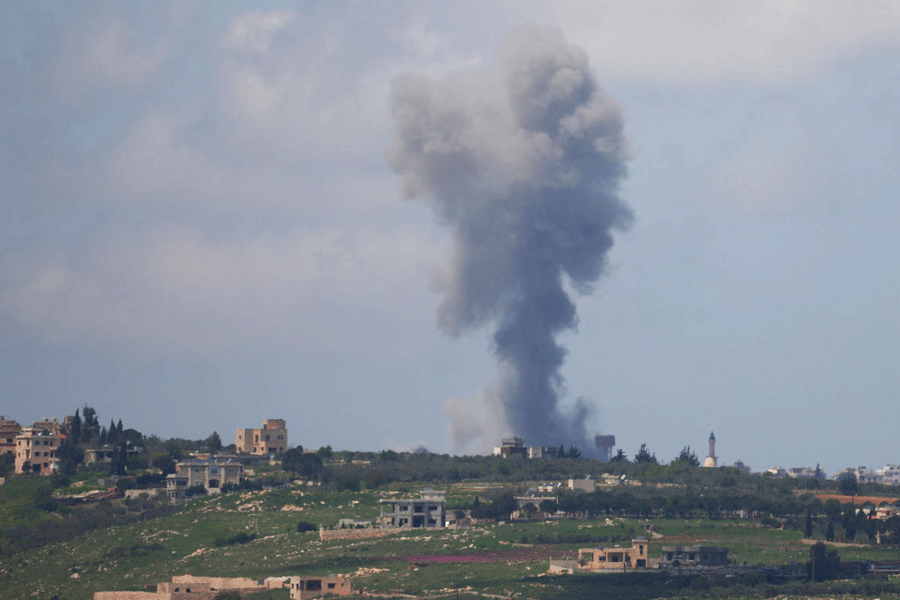
Prime Minister Benjamin Netanyahu said fighting is continuing in Lebanon on Monday, focused on the Bint Jbeil area, a strategic point that has been the site of fierce battles between Israel and Hezbollah over the years.
Speaking at a cabinet meeting, Netanyahu said that Israel's military is expanding beyond the five hilltops it controlled in southern Lebanon since the ceasefire with Hezbollah in 2024 towards a "solid, deeper security zone, which both prevents the danger of invasion and keeps the threat of terrorism away."
Previously, Netanyahu said Israel wants to control the territory 8-10 kilometres (5-6 miles) from the border in southern Lebanon to remove the threat of short-range rockets or anti-tank missiles targeting Israeli cities and towns on the border.
Israeli Prime Minister Benjamin Netanyahu said on Monday that US Vice President JD Vance called him on Sunday after leaving Islamabad, briefing him on weekend talks with Iran that failed to reach a deal.
Have good contact with Indian govt on passage of Indian ships: Iran ambassador
Iran ambassador to India: Have good contact with Indian govt on passage of Indian ships, want to help India
Germany says US blockade of Hormuz is pressure tactic, not end of talks
The German government expects negotiations over a US blockade of the Strait of Hormuz to continue, a spokesperson said on Monday.
"The supposed blockade ... does not mark the end of this diplomatic process," the spokesperson said, referring to an announcement by US President Donald Trump. "We see it as a move to ramp up the pressure."
The spokesperson also cited a statement from US Central Command, which he said "does not mention a blockade of the Strait of Hormuz, but rather a blockade of Iranian ports - that is a different approach."
EU's von der Leyen: There can be no stability in Middle East while Lebanon is in flames
EU's von der Leyen: There can be no stability in Middle East while Lebanon is in flames
UK and France to co-host talks this week on possible defensive naval mission for Hormuz
Britain and France will this week co-host talks aimed at restoring freedom of navigation in the Strait of Hormuz, including discussions on what President Emmanuel Macron described as a possible strictly defensive naval mission.
The talks are intended to bring together Britain, France and other countries willing to join a peaceful multinational mission aimed at restoring freedom of navigation in the strait.
"This strictly defensive mission, which will be separate from the warring parties, is intended to be deployed as soon as the situation allows," Macron said in a post on X.
Tensions in the Gulf have intensified after the United States said it would begin a blockade of maritime traffic entering and exiting Iranian ports, while Iran has effectively shut the Strait, a route that carries about a fifth of the world's oil consumption.
British Prime Minister Keir Starmer said the continued closure of the Strait of Hormuz was deeply damaging global shipping and was adding to cost-of-living pressures.
"This week the UK and France will co-host a summit to advance work on a coordinated, independent, multinational plan to safeguard international shipping when the conflict ends," Starmer posted on X.
Britain has previously convened representatives of more than 40 countries that share the aim of restoring freedom of navigation. The United States was not involved in those talks.
Pakistan merchant ships allowed to cross Strait of Hormuz after initially being denied permission
Two merchant ships from Pakistan were allowed to cross the Strait of Hormuz and sail to Kuwait and the UAE on Monday after initially being denied permission to pass.
Two merchant ships, Shalimar and Khairpur, of the Pakistan National Shipping Corporation (PNSC) are the first Pakistani ships to go into the Persian Gulf since the war broke out between Iran, the US and Israel.
Initially, the two ships were stopped by Iranian authorities and told to go back from the Strait of Hormuz on Sunday, a PNSC official said. “But shortly afterwards they were allowed to cross the Strait of Hormuz into the Persian Gulf,” he added.
The ship captains, Asif and Shaheen, are now on their way to Kuwait and Das Island, from where they will bring back vessels loaded with millions of litres of diesel and crude oil.
On Friday, MV Selen, became the first Pakistani vessel to reach the Karachi Port since the reopening of the Strait of Hormuz in the wake of the ceasefire between Iran and the US.
Two Iranian-linked tankers exit Gulf via Hormuz ahead of US blockade, data shows
Two oil tankers linked to Iran exited the Gulf on Monday via the Strait of Hormuz ahead of a planned U.S. blockade on Iranian ports and coastal areas, shipping data from Kpler and LSEG showed.
The tanker Auroura is laden with Iranian oil products while the New Future tanker is carrying diesel loaded from the Hamriyah port in the United Arab Emirates, Kpler data showed.
Israel military will have full control of south Lebanon town within days, says official
Full operational control of the southern Lebanese town of Bint Jbeil will be achieved within days, with Iran-backed Hezbollah militants limited in there ability to attack northern Israel from the area, an Israeli military official said on Monday.
"Only a small number of terrorists remains in the area of Bint Jbeil," the official said, adding that the military "eliminated terrorists as they were exiting the hospital in Bint Jbeil, as well as located numerous launchers and weapons."
Macron: confirms conference with UK to examine possible defensive naval mission for Hormuz
France will soon organise with Britain a conference aimed at restoring freedom of navigation on the Strait of Hormuz, President Emmanuel Macron said on Monday, adding that any such naval mission would be done on a strictly defensive basis only.
"With regards to the Strait of Hormuz, we will be organising in the coming days a conference with the United Kingdom and those countries willing to join us in a peaceful multinational mission aimed at restoring freedom of navigation in the strait," Macron said on X.
"This strictly defensive mission, which will be separate from the warring parties, is intended to be deployed as soon as the situation allows," he added.
China urges restraint over US blockade of Strait of Hormuz, backs talks
China urged calm and restraint by all sides on Monday, following U.S. President Donald Trump's threat to blockade the Strait of Hormuz after the failure of weekend talks in Islamabad aimed at ending the Iran war.
Before the war, most Iranian oil exports were shipped to China, the top global importer of crude.
Keeping the key Strait of Hormuz waterway safe, stable and unimpeded served the interest of the international community, foreign ministry spokesperson Guo Jiakun told a regular press conference, when asked about the blockade threat.
"China hopes the relevant parties will abide by the temporary ceasefire arrangements, remain committed to resolving disputes through political and diplomatic means, and avoid a resumption of hostilities," he said.
China stood ready to "play a positive and constructive role" in resolving the crisis, Guo added, calling the opening talks in the Pakistani capital a step in a direction conducive to easing tension.
After the marathon talks failed, the U.S. Central Command said its forces would begin a blockade of all maritime traffic with Iranian ports from 10 a.m. ET (1400 GMT) on Monday.
China and Pakistan had backed peace talks in March while urging an immediate ceasefire in the Iran war and restoration of normal navigation in the Strait of Hormuz, a conduit for about a fifth of global oil and gas supplies.
Guo rejected reports that China had plans to supply weapons to Iran as "groundless smears and malicious associations".
Last week, Trump threatened immediate tariffs of 50%, with no exemptions, on imports from countries supplying Iran with military weapons.
"China has consistently taken a prudent and responsible approach to arms exports," Guo said, adding that its strict controls were in line with domestic laws and international obligations.
Iran, Saudi foreign ministers discuss Iran-US talks in Islamabad, Iranian foreign ministry
Iran's and Saudi Arabia's foreign ministers discussed Iran-U.S. talks in Islamabad during a phone call, Iran's foreign ministry said on Monday.
The phone call comes after weekend talks failed to reach a deal to end the war, jeopardizing a fragile two-week ceasefire.
Pope says he will continue to speak out against war after Trump attack
Pope Leo told Reuters on Monday that he plans to continue speaking out against war after U.S. President Donald Trump's direct attack on the leader of the 1.4-billion-member Church.
In comments aboard the papal flight to Algiers, where the first U.S. pope is starting a 10-day tour to four African countries, the pontiff also said the Christian message was being "abused".
"I don't want to get into a debate with him," Leo told Reuters. "I don't think that the message of the Gospel is meant to be abused in the way that some people are doing."
"I will continue to speak out loudly against war, looking to promote peace, promoting dialogue and multilateral relationships among the states to look for just solutions to problems," he said, speaking on English.
"Too many people are suffering in the world today," said Leo. "Too many innocent people are being killed. And I think someone has to stand up and say there's a better way."
Turkey warns against 'all or nothing' Iran-US stance on nuclear issue
Turkey's foreign minister raised concerns on Monday about Iran or the United States proposing any new regulations for transiting the Strait of Hormuz, and said he saw difficulties around proposals to re-open the waterway with an international force.
Foreign Minister Hakan Fidan - who is in close touch with the U.S., Iran and mediator Pakistan - said in comments reported by state-owned Anadolu Agency that Hormuz should be opened through diplomacy, after weekend U.S.-Iran talks failed to reach a deal to end the war.
Negotiators should use "convincing methods" in talks with Iran and Hormuz should be opened as soon as possible, he said, adding that "nobody wants" the strait to become part of the war.
"There are many difficulties to intervening here with an international armed force. Especially as the war continues, how much will it narrow, expand? We see many countries are not keen on this," Fidan said.
"The problem is whether there will be proposals on new regulations from now on, particularly from Iran," which could decide to be "more active" on the strait, he added.
In retaliation for U.S.-Israeli attacks, Iran effectively closed Hormuz, through which about a fifth of global energy supplies transit, sending energy prices soaring.
Starting on Monday, the U.S. military said it would begin a blockade of all maritime traffic entering and exiting Iranian ports and coastal areas. Washington has sought help to re-open the strait from allies, who have not expressed interest.
Fidan said the U.S. and Iran were "sincere" in their ceasefire talks, but added that they could encounter problems if they approached the issue of Iranian nuclear enrichment from an "all-or-nothing" perspective.
A source said Fidan spoke on Sunday with U.S. and Pakistani officials involved in the talks.
Spain reopens its embassy in Iran’s capital: Report
Spain reopens its embassy in Iran’s capital: Tasnim
UK will not back blockade of Strait of Hormuz, PM Starmer says
British Prime Minister Keir Starmer said on Monday that whatever the pressure, Britain would not be dragged into the Iran war nor be involved in a blockade of the Strait of Hormuz.
"We're not supporting the blockade," he told BBC Radio 5 Live, adding that it was vital to get the Strait reopened.
"It is, in my view, vital that we get the Strait open and fully open, and that's where we've put all of our efforts in the last few and we'll continue to do so," Starmer said.
Britain had minesweepers in the region, he said, and while he could not discuss operational matters, the military capability was "focused from our point of view on getting the Strait full open".
The U.S. military said it would begin a blockade of all maritime traffic entering and exiting Iranian ports and coastal areas on Monday, after weekend talks failed to reach a deal to end the war with Iran.
The U.S. Central Command said that the U.S. blockade, starting at 10 a.m. ET on Monday (1400 GMT), would be "enforced impartially against vessels of all nations entering or departing Iranian ports and coastal areas, including all Iranian ports on the Arabian Gulf and Gulf of Oman."
Vessels transiting the Strait of Hormuz to and from non-Iranian ports will not be impeded, the U.S. military said.
President Donald Trump said on Sunday U.S. forces would also intercept every vessel in international waters that had paid a toll to Iran.
"No one who pays an illegal toll will have safe passage on the high seas," Trump wrote on social media, adding: "Any Iranian who fires at us, or at peaceful vessels, will be BLOWN TO HELL!"
Iran war to weigh on German economy through rest of 2026, ministry warns
Germany's economy is likely to feel the negative effects of the Iran war throughout the rest of 2026, with the best-case scenario being the gradual normalisation of energy and raw material prices, said the economy ministry in a monthly report.
"Further economic development depends significantly on a resolution of the conflict in the Middle East. However, even then, high energy prices, supply problems, and economic burdens are likely to persist for some time," it said on Monday.
Iran warns no Gulf port safe after US blockade threat
Iran threatened ports in the Persian Gulf and the Gulf of Oman after the US announced a blockade on Iran's ports and coastline.
"Security in the Persian Gulf and the Sea of Oman is either for everyone or for no one," according to the Islamic Republic of Iran Broadcasting, IRIB.
"No port in the region will be safe," the Iranian military said.
An Iranian Armed Forces spokesperson said on Monday that U.S. restrictions on vessels in international waters was illegal and "amounts to piracy", and said Iran would decisively implement a "permanent mechanism" to control the Strait of Hormuz following U.S. threats to blockade it.