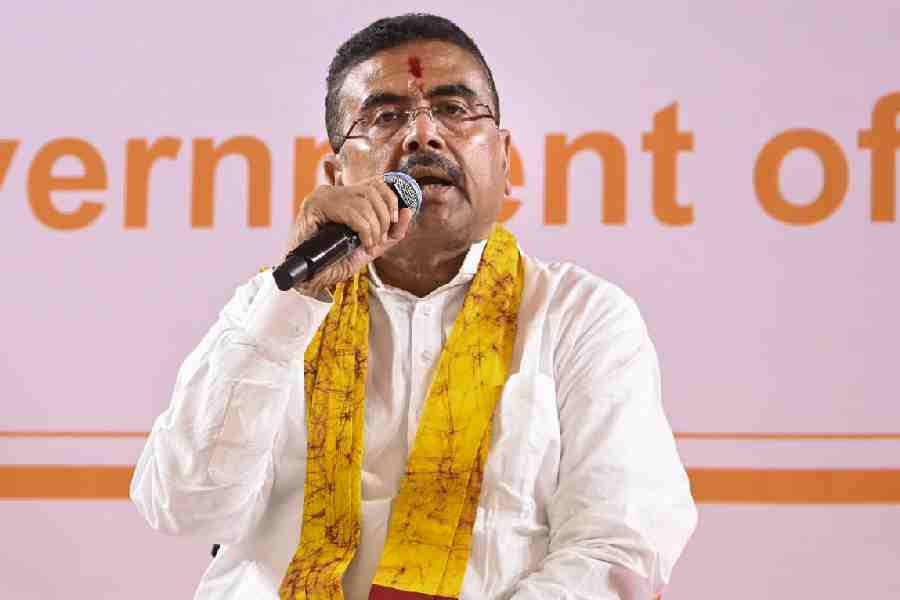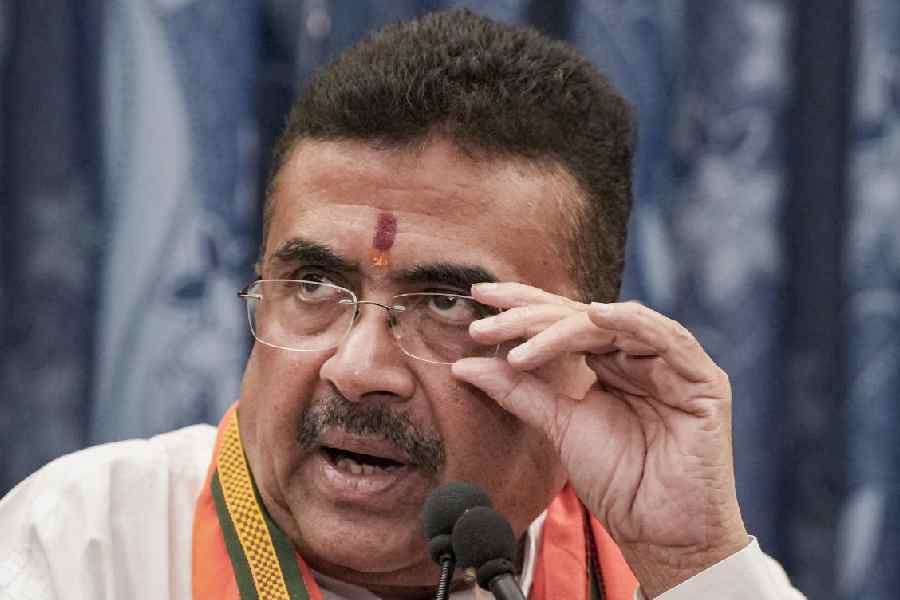
Bengal chief minister Suvendu Adhikari on Friday said his government would enact a stringent law against religious conversion, while also implementing the Uniform Civil Code (UCC) and the National Register of Citizens (NRC) in the state as part of measures to strengthen national security and preserve Bengal's cultural identity.
Addressing a programme at Rabindra Sadan to mark the 150th anniversary of 'Vande Mataram', Adhikari alleged that infiltration through the state's international border had contributed to religious conversion, 'love jihad' and demographic changes, posing a threat to Bengal's social fabric and national security, though he did not provide evidence to support the claims.
"Give us some time. A strict law against religious conversion, Uniform Civil Code and NRC will be introduced in Bengal," he said.
Claiming that his government had strengthened border security by providing land required for border infrastructure, the chief minister said holding centres had been set up in border districts to identify and send back "infiltrators" to their place of origin.
"Those entering illegally and engaging in activities that threaten India's culture and national security will be sent back," he said.
Drawing a distinction between illegal immigrants and refugees covered under the Citizenship (Amendment) Act (CAA), Adhikari said Hindus who had come to India after facing religious persecution were "not infiltrators" and would be granted citizenship under the law.
He asserted that his government would not allow any force to weaken Bengal's cultural identity or national character, describing the state as India's "cultural and spiritual capital".
Paying tributes to Bankim Chandra Chattopadhyay, Adhikari described the author of Vande Mataram as a visionary litterateur, journalist and administrator whose writings continue to inspire generations.
Calling Vande Mataram a "Sanjeevani Mantra" for the nation, he said the song symbolised patriotism and national unity.
He added that the state government had, for the first time, organised official programmes at Bankim Chandra's ancestral house at Kathalpara in Naihati and his residence in Kolkata to commemorate his birth anniversary.
The chief minister alleged that during an earlier visit to Bankim Chandra's Kolkata residence during the previous TMC regime, he had been prevented from entering as the premises had remained locked.
Recalling the Emergency imposed in 1975, Adhikari announced that a state-level felicitation programme would be held on August 9 to honour people who had resisted the Emergency and faced persecution.
He also accepted a proposal to constitute a coordination committee of "Loktantra Senanis" (democracy fighters) to facilitate the recognition process and said eligible persons would be issued official recognition certificates in accordance with government rules.
Adhikari further said the government had accepted proposals submitted by the Citizen Government Forum, including organising seminars on social, constitutional and national issues to promote civic rights and social justice, celebrating the birth anniversaries of eminent national personalities, and undertaking relief and charitable activities during natural disasters.
Later in the day, Adhikari inaugurated a BJP party office in Bhowanipore, his Assembly constituency, and said he would make himself available there for two days every month to meet local residents and hear their grievances. He said the office would serve as a point of contact between the people and their elected representative.
TMC MP Mahua Moitra launched a sharp attack on the BJP government in Bengal over the proposed Uniform Civil Code and a controversial law-and-order bill, accusing the ruling dispensation of trying to "uproot" the opposition through intimidation and divisive and draconian policies.
Addressing reporters after a meeting at TMC supremo Mamata Banerjee's Kalighat residence, Moitra alleged that the BJP government had launched an "operation" aimed at weakening the TMC at the grassroots level by preventing party workers from holding meetings and rallies.
"There is an operation underway to eliminate the Trinamool Congress by uprooting it from its roots. Workers are allegedly being threatened with false cases and police action if they organise programmes," she claimed.
Drawing a parallel with the Emergency era, Moitra asserted that political voices could not be suppressed indefinitely and urged party workers not to be intimidated by the administration ahead of the TMC's annual July 21 martyrs' rally.
"The voices of millions of voters cannot be silenced. Even during the Emergency, people could not be suppressed. July 21 will take place, and our leader will show us the path ahead," she said.
The sharpest attack, however, was reserved for the state's proposed Bengal Public Safety and Control of Anti-Social Activities Bill, 2026, which Moitra described as more stringent than some of India's most controversial security legislations.
Holding up copies of the proposed legislation, she claimed it was "far harsher" than the Emergency-era MISA and the UAPA.
"A person can allegedly be detained for up to a year without trial. There are no adequate judicial safeguards. It gives enormous powers to the police based merely on suspicion," she alleged, warning that the legislation could have far-reaching consequences for civil liberties in the state.
The BJP, however, dismissed the allegations, accusing the TMC of resorting to fear-mongering after losing power.
Senior BJP leaders said the proposed legislation was aimed at tackling organised crime, political violence and lawlessness that had allegedly flourished during the previous regime.
"The TMC is uncomfortable because for the first time there is a government determined to act against criminal syndicates and restore rule of law. The bill is intended to strengthen public safety, not curb democratic rights," a BJP leader said.