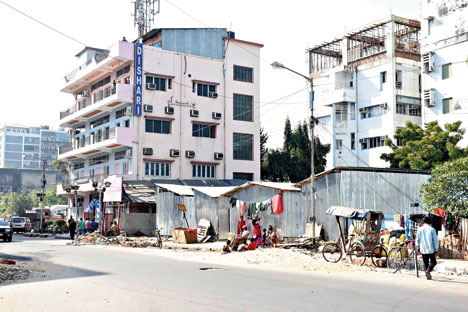

Salt Lake will not miss its Dharavi. Barely weeks after the Karunamoyee slum was demolished, a portion of the slum-dwellers are settling into their new homes, this time near City Centre.
The corporation estimated 1,200 families to have been living in the Karunamoyee slum, opposite Mayukh Bhavan, and after eviction on December 26, only 128 families were able to furnish identity cards.
These families have now been shifted to tin houses, built by the government on three empty plots in the Dishari-Rabindra Okakura Bhavan circuit. The rest of the slum-dwellers, who could not prove their citizenship, have dispersed.
Weapons in old slum
The old slum, on the fringes of Central Park, was sprawled over two acres. To put it in context, FD Park is about 3.5 acres. The slum housed 1,200 families of rag-pickers, labourers etc.
The slum, which The Telegraph Salt Lake had earlier visited, used to have heaps of garbage all around. The walkway would be slushy and the huts were simply sheets of tarpaulin spread over bamboo sticks. Saris and lungi would spread out as substitutes for walls.

There were places of worship of two faiths inside the slum, clubs where residents held meetings and played cards or carrom and even a room for an NGO to hold classes for the kids. They had toilet and water facilities provided by the municipality, as well as dish antennae to watch TV. Electricity was drawn by hooking lines illegally. They had also hired a generator.
But the real revelation came when the JCBs went on demolition mode around 8.30pm that December night. “In the scramble to collect their belongings, we saw some slum-dwellers dig up the ground and unearth hidden weapons,” said an official of the Calcutta Metropolitan Development Authority (CMDA). The land belonged to the urban development department and the CMDA was in charge of the eviction. They had sought help from the police and Bidhannagar Municipal Corporation for the move.
“Out came swords, machetes, axes and all kinds of other weapons. The only things missing were guns and bombs. They had been hidden underground,” he said. “We had heard rumours about that slum being a crime den, but that night we saw it for ourselves.” The police allowed them to take all belongings away.
“The slum had to be cleared with a lot of tact as violence could have broken out any moment,” said the official. “Many CMDA engineers, officers and policemen in high posts stayed on the spot till 5am to ensure that the eviction was smooth.”
Mujibar Rehman, who has now moved into the new quarters, recalls his life in the old slum. “The shanties housed people mostly from Malda, Murshidabad, North Dinajpur as well as many Bangladeshis who had migrated illegally,” says Rahman, describing himself as a native of Malda who works as a part-time PWD worker.
“The Bangladeshis would be hired by garbage cleaning cars to collect waste door-to-door in Salt Lake. Others worked as carpenters, labourers and electricians. The Bangladeshis have now escaped to the Dhapa slums,” says Rehman.
Camping near City Centre
Chased out of the shanties in the dead of the night, the slum dwellers with ID proof spent a few days on the streets before being rehabilitated in tin huts, built by the CMDA.
There are three sites for the new huts— the first is a set of 32 huts between Dishari and the sub-divisional hospital. This spot has six toilets for common use too. Twenty eight huts have come up next to Netaji Subhas Open University, opposite hotel De Sovrani along with six toilets.
The last plot, opposite International Eye Bank and behind Rabindra Okakura Bhavan, has 68 huts with 13 toilets.


The huts have been built on a common concrete floor. CMDA had been making the huts for three months. “The tin huts have been built on empty plots. Some construction waste had been lying there, which was cleared beforehand. We expect the huts to be permanent residents for the slum dwellers. They will not have to pay rent for this,” said Supriya Maity, director general, CMDA.
The residents are trying to adjust to their new surroundings. Though they are grateful to have a roof above their heads, unlike most of their old neighbours, they are still full of complaints.
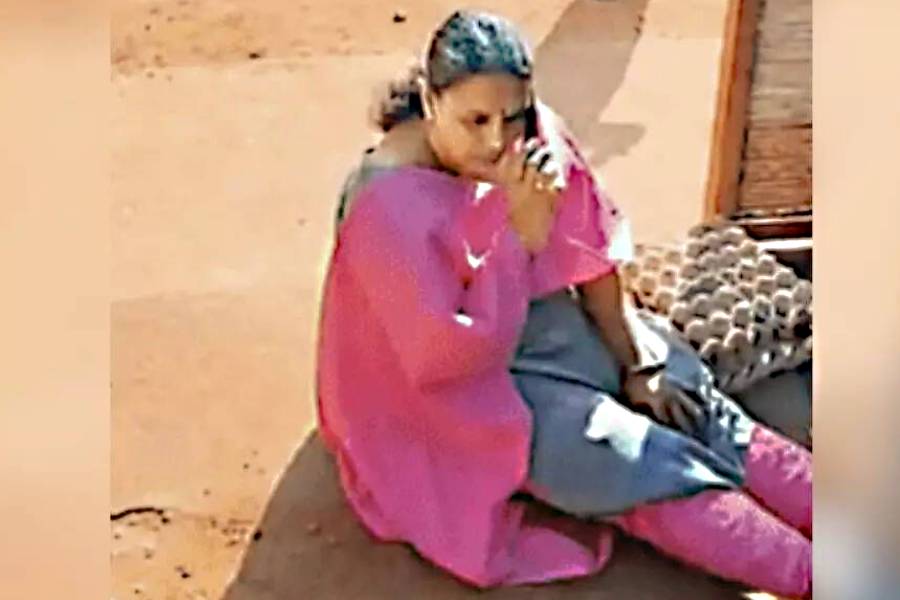
The men are parking their cycle van on the footpath outside, the nightie-clad women are basking in the sun, cooking and washing. Toddlers are crawling on the roadside and washed clothes are drying from clothes line spread out across the length of their huts, inside and outside.
“The shift wasn’t sudden. We were informed about it three months ago,” says Anjali Khatoon, who claims to hail from Murshidabad but has now found a home next to Dishari. “Our papers were checked and we were given time to shift our belongings. But we don’t have electricity yet. I’m missing my TV serials at night.”
There is a tap for the new huts but residents aren’t satisfied with the water quality. “It’s smelly and dirty,” says Rubina Bibi, a construction worker who came here six years ago from North Dinajpur. “So we’re going back to Central Park to get water.” The distance should be a 10-minute walk. But that water source has now been blocked and the supply taken to the fairground extension.
Ansar Ali, who works as a driver for one of the police vans in Bidhannagar south police station, has been allotted a shelter near De Sovrani. “My biggest grouse is the lack of electricity,” he says. “We’re managing now as it’s winter. But we’ll suffocate without fans in summers.”
The government, however, is tight-lipped about providing power. Officials say they will think about it after the book fair arrangements are ready.
Another time bomb waiting to explode is garbage. Dustbins are overflowing and heaps of garbage have started accumulating on the footpaths. “We have been here for almost two weeks but no BMC garbage van has come to remove our waste. We have no choice but to heap kitchen waste on the footpath,” said Lakshmi Malakar, who now lives in the plot opposite International Eye Bank.
Nearly 70 kids of the slum would attend classes conducted by Seed Society, an NGO, inside the old slum. “They would learn singing, dancing, painting and study. But now we don’t know where to send the kids, even though many have fled.
Only about 30 kids have moved into the new slum,” said Sakhi Daloi, originally from Berhampore.
Unwelcome neighbours
People in the DD Block neighbourhood are clearly miffed about the exodus of slum-dwellers. “They should have been moved elsewhere,” says an employee of hotel De Sovrani. “What’s the meaning of uprooting them from Karunamoyee and giving them permanent residence at an even more posh locality?”
The hotel hosts high-end seminars and IT conferences and is worried about the surroundings ruining the ambience. “As it is, waste generated from the Sub-divisional Hospital is not collected regularly. The pavements are strewn with hospital waste. And now we have a slum outside the hotel! And what if they are upto any mischief?”
Mithun Ghosh, the proprietor of Dishari, is in a fix too. “Suddenly I have three slums in my vicinity! I’m sure I’ll lose business if the place gets dirty as no one would want a celebration in the midst of garbage.”
Inputs from Brinda Sarkar