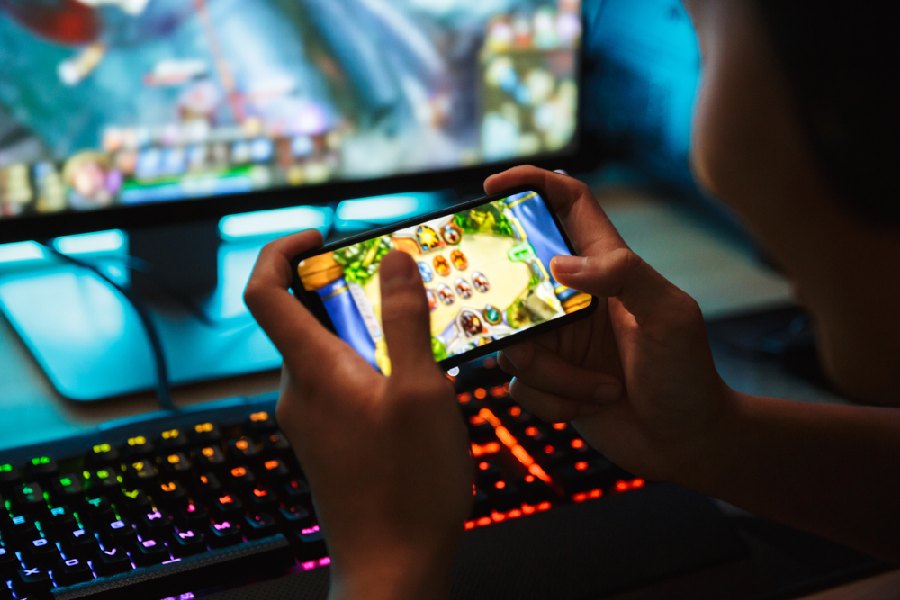
Many schools are raising alarms over a growing dependence on online gaming among children and adolescents, warning that excessive gaming is drawing students away from academics, physical activity and real-world social interaction, while also triggering emotional and behavioural challenges.
Several school heads shared instances where gaming addiction had disrupted students’ lives. One school reported that a high school student had to be sent to rehabilitation after his academic performance declined and he began missing school regularly due to constant engagement with online games.
In another case, a promising athlete withdrew from all sporting activities in Class VII. When the school reached out to the parents, they discovered that the boy had become deeply immersed in online gaming, to the extent that he had lost interest in co-curricular activities.
Concerns have intensified after three minor sisters in Ghaziabad, who had been addicted to a Korean task-based online game and had not attended school for three years, died after allegedly jumping off the balcony of their ninth-floor apartment around 2am on Wednesday. Their parents had restricted their cellphone usage.
Educators said such extreme cases underscore a growing problem. “Gaming is a huge issue, especially in the age group of 8 to 13,” said Pratima Nayar, principal of the junior school at Calcutta International School.
“While gaming itself is a concern, it often leads to other problems, such as the use of abusive language, because children are so intensely involved that they begin making personal attacks on one another,” she said.
Nayar added that the emotions built up during online gaming often spill over into classrooms and playgrounds because children are unable to regulate their emotions. They may be forced to abort a game and report to school while still carrying competitiveness, aggressiveness or anger, which then manifests in the classroom or on the sports field, she said.

Withdrawal
Teachers have also noticed a gradual disengagement from physical activities and an overdependence on online recreation.
“Gaming has become an important recreation for children, with very little involvement in other activities. They have limited in-person interactions, and many have shunned companionship,” said Terence John, director of education and development at the Julien Day Group of Schools.
Addiction factor
Gaming, more than other features on a digital device, keeps children hooked because of its interactive nature, John pointed out.
“Gaming lures children because they are active participants. They are challenged and strive to overcome those challenges. Many other online activities involve passive
viewing and do not hold their interest in the same way,” he said.
Seema Sapru, principal of The Heritage School, highlighted the “unending nature” of online games and the instant gratification they provide as key factors behind addiction.
“The praise showered on players gives them a sense of validation. Before a game ends, something else is introduced to lure them further. Levels are raised, and engagement increases,” she said.
Sapru stressed that gaming itself is not inherently harmful. “There are people who build careers in gaming. The problem arises when gaming turns into obsession,” she said.
Role of parents
One principal cited multiple instances where parents have approached the school feeling helpless, saying their children locked themselves in their rooms for hours while gaming. When parents intervened, the children threatened self-harm, the school head said.
Apala Dutta, principal of Birla Bharati School, said children and adults alike struggle to distinguish between healthy screen use and digital over-engagement. “Children increasingly feel more confident and happier in the online world,” she said. “This means we, as adults, must build stronger real-world connections around them.”
Principal Dutta spoke of the need for parent workshops and supportive home environments. “Tragedies like the one in Ghaziabad are a wake-up call. We must reaffirm our commitment not only to academic success but also to the emotional well-being of children and healthy identity development, which is rapidly eroding,” she said.
Online world
Mental health professionals said the issue runs deeper than it appears. Psychotherapist and school counsellor Farishta Dastur Mukerji said a significant proportion of adolescents she works with spend 50% or more of their time online. “Adolescents inhabit a separate online world. If you are not part of it, you cannot fully imagine or understand it,” she said.
She explained that online communities are often anonymous, which creates additional risks. “It is an invisible community. The person you are interacting with could be anybody, and this anonymity poses serious challenges that children, adolescents, and young adults may not fully comprehend,” she said.
Dastur Mukerji noted that trends such as online gaming dares are not new but intensified during the Covid pandemic when many children were pushed into the digital world. “The incidence has increased significantly in the post-Covid period,” she said.