 |
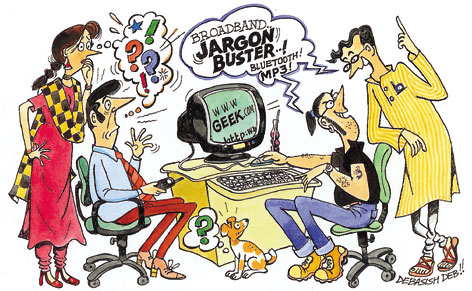
They pop up in everyday conversations and in your daily dose of newspapers and magazines. You probably use them yourself, too, without errrr… quite knowing what they mean. And they make you want to look for a place to hide when your kids or maybe peers have lengthy conversations with friends peppered with some of them.
If you haven’t guessed it, we are referring to jargons… of the tech kind. With technology playing an all-important role in our lives, a brush with tech code is quite inevitable. Makes sense, therefore, to be slightly better informed about their meanings.
Techtalk holds out a fig leaf to hide your ignorance. Or better still, it hands over a power tool to help you put in your four bits worth the next time the geeks try to freak you out.
But beware, this is just a revelation rivulet, there is an ocean of tech terms left unexplored…
KB, MB, GB
Short for kilobyte, megabyte and gigabyte, these are units of computer memory or data storage capacity. Information is stored in a computer in the form of binary digits, or bits, through a sequence of zeros and ones. 8 bits=1 byte, 1024 bytes=1 KB, 1024 KB=1 MB and so on. You will come across these terms while dealing with a variety of computer-related subjects like computer hardware (capacity of a hard disk, RAM module, etc), digital cameras and mobile phones.
The dots
Why do some websites end with .com while others with .net or .org? Because they all indicate the kind of website it is — Com is for commercial, Net for network, Org for organisation, etc. Some of the other common dots are .gov for government and .edu for educational institutes. The Internet Corporation for Assigned Names and Numbers (ICANN) manages and co-ordinates these domain names and ensures that users can access websites by typing in the valid addresses.
Check out www.icann.org
MP3
Simply put, it helps compress a song (not in length but in size) for easy transfer over the Internet. Short for MPEG-1 Audio Layer3, MP3 is an audio compression standard that squeezes the song without noticeable sound quality loss. For instance, a song that takes up 40 MB of space on an audio CD (in wave format), can be packed into only 4 MB when converted to MP3 format, allowing hundreds of songs to be fitted in a single CD, which can otherwise accommodate only around 10. Software called encoders are used for this function, the most popular being the lame encoder. MP3 was initially only computer readable, but newer audio systems can play MP3 CDs now. The standard was developed by Moving Pictures Experts Group (MPEG) and formalised by International Organisation for Standardisation.
Check out www.mp3.com
Wi-Fi
Increasingly becoming popular in the West and crawling its way into India, Wi-Fi, or wireless fidelity, allows you to roam with your laptop and stay connected to other computers, wirelessly. But the connectivity is only within a particular range. Working on radio frequency, Wi-Fi lets you access a network and even surf the Net. No physical connection through wires is required. 802.11b, the most commonly used Wi-Fi standard, offers data transfer speed (or bandwidth) of 11 Mbps. Some establishments like airports, coffee shops and hotels offer free Wi-Fi Internet service. All you need is a Wi-Fi-enabled laptop and permission to join in from the network you are trying to access. Most new laptops come Wi-Fi enabled.
Check out www.wi-fi.org
Bluetooth
Another technology to remain connected wirelessly, but within a much shorter range. Developed by a consortium of IT and communication giants including Ericsson, IBM, Intel, Nokia and Toshiba, it is a short-range radio technology for Internet and mobile devices for wireless communication among them. Radio chips are placed in the devices — ranging from laptops to mobile phones and handhelds — to enable this.
Check out www.bluetooth.com
Hacking
It is the process by which people (often brilliant but malicious programmers) break into other people’s websites and give those accessing or managing the website a glimpse of hell in the virtual world. Hackers often deface websites with offensive messages and photographs. Hacker groups are known to proudly leave their name on the website after hacking in. For some it’s a fun trip, for others it’s pure power. Some hackers get into classified websites to gain confidential information. But there’s a flip side: hackers are often the most sought-after when it comes to securing a website — it takes a hacker to beat a hacker.
HTML
Or Hyper Text Markup Language is what dreams… er, websites are made of. It’s technical stuff and the language must be learned before you can start ‘writing’ pages in HTML. But site-building software like MS FrontPage allows you to design sites without knowing the language. However, the software automatically converts everything, text, pictures and multimedia, into HTML.
...and elsewhere in the world
 |
Movie watching is set to get better, with the advent of high-definition DVDs (HD DVD). And now there’s the promise of a video player that provides compatibility with today’s DVDs and the next generation variety.
Japanese electronics giant Toshiba unveiled the prototype of its new HD DVD player, which enables a user to play the 30GB (gigabyte) capacity double-layer DVD discs with blue laser diode pick-ups.
Toshiba is expecting to put it on the market next year. US software giant Microsoft’s next generation operating system (OS) Long Horn will support this HD DVD format on the device.
The player features a single-lens optical head mechanism that integrates both red and blue laser diodes.
So, it supports both the next-generation HD DVD-ROM format (version 0.9) recently approved by the DVD Forum and backward compatibility with today’s DVD ROM discs.
It will allow DVD fans to enjoy the richer image quality of HD DVD and also watch current DVDs.
HD DVD uses a blue laser and a 120mm-diameter disc that can record over two hours of high-definition movie content. A dual-layer, single-sided read-only disc offers a large 30GB capacity, while a single-layer single-sided rewritable disc has a capacity of 20GB.
The HD DVD format promotes maximum compatibility with current DVD standards. It is also PC-friendly.