The discussion around climate change often revolves around melting glaciers, forest fires or vanishing ice caps. But sometimes, the crisis is much closer to home than we care to admit. That was the uncomfortable truth highlighted at the screening of Code Red: The Sunderbans, directed by Suman Mukhopadhyay with research by environmental journalist Jayanta Basu, at Rabindra Sadan on Saturday as part of UNICEF’s Youth Conclave.
The film makes one thing clear from the outset: what happens in the Sunderbans does not stay in the Sunderbans.
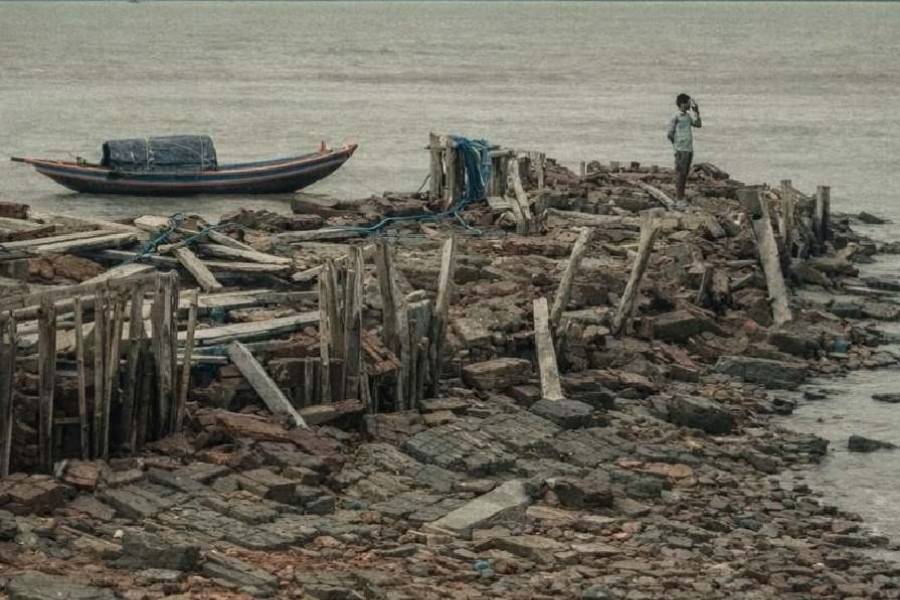
For years, the delta has been romanticised as a wild, mysterious land of mangroves and Bengal tigers. But beyond the image lies a far more urgent reality. Nearly five million people live there, many just a few metres above sea level. And that ground beneath their feet is steadily crumbling.
The documentary avoids dramatic narration. A farmer talks about saltwater creeping into his fields after every cyclone, ruining crops that once sustained entire families. Children describe growing up with cyclones — Aila, Amphan, Yaas, Bulbul — as milestones of their childhood. Women recount how earning livelihood comes at the cost of your health.
These are not isolated tragedies. The sea level is rising, and low-pressure disturbances and cyclones have become fairly regular. Low lying islands are on the brink of extinction.
And when land disappears, people move.
Every major cyclone that tears through the Sunderbans pushes more families toward the mainland. Many arrive in the outskirts of Kolkata looking for work, shelter and stability. Informal settlements expand. Pressure on housing, healthcare and infrastructure increases.
The mangroves of the Sunderbans also act as a natural shield, absorbing the force of cyclones before they reach inland areas. As those ecosystems weaken, cities like Kolkata become more vulnerable to extreme weather events, warns Basu. In other words, the fate of the Sunderbans and Kolkata are tied together. One cannot afford to ignore the other.
Mukhopadhyay draws inspiration from Badal Sircar’s Bhoma, a play set in Sunderbans to take his narrative forward. An exploitation of subaltern classes, a powerful work that highlighted systemic neglect decades ago, Bhoma echoes the tragedy unfolding in Sunderbans now. The communities of the Sunderbans, long marginalised, are now on the frontlines of a global crisis they did little to create.
Code Red also touches upon the victims of tiger attacks. Women who’ve lost their husbands to the feline beast of the mangroves are forced to go crab-hunting. Spending hours in waist-deep saline water often leads to skin diseases.
Even the men who migrate out of the delta aren’t faring any better. A group of young men from Kumirmari island reveal that they worked temporarily in a stone quarry in Asansol, until they were all diagnosed with silicosis. At least 27 men aged between 18-24 have died on the island till 2022, an elderly resident shared.
And then, there are natives who refuse to relocate. “This is where I was born. Why would I move to somewhere else,” asks one septuagenarian from Kumirmari, interviewed by the makers.
The issue of systemic corruption also crops up in the documentary. Subhash Acharya, former joint director of the Sunderban Development Board laments that cyclone relief has turned into employment opportunities for local leaders. “Only 25 per cent of the funds earmarked for creation of embankments post Aila have been utilised,” he says in the docu.
Javed Khan, minister of Disaster Management and Civil Defence, who was present at the screening, later said during a post-screening discussion, “The documentary was eye-opening”.
The film does not offer any solution or call-to-action. Instead, it leaves the audience with a clear warning: climate change in the Sunderbans is a present reality. Rising seas, shrinking islands and repeated cyclones are reshaping the social and economic landscape of the state. Migration patterns are shifting. And the protective natural barriers that once softened nature’s fury are weakening.
The question is no longer whether the city will feel the impact. It already does. The real question is how prepared we are to face what comes next.