|
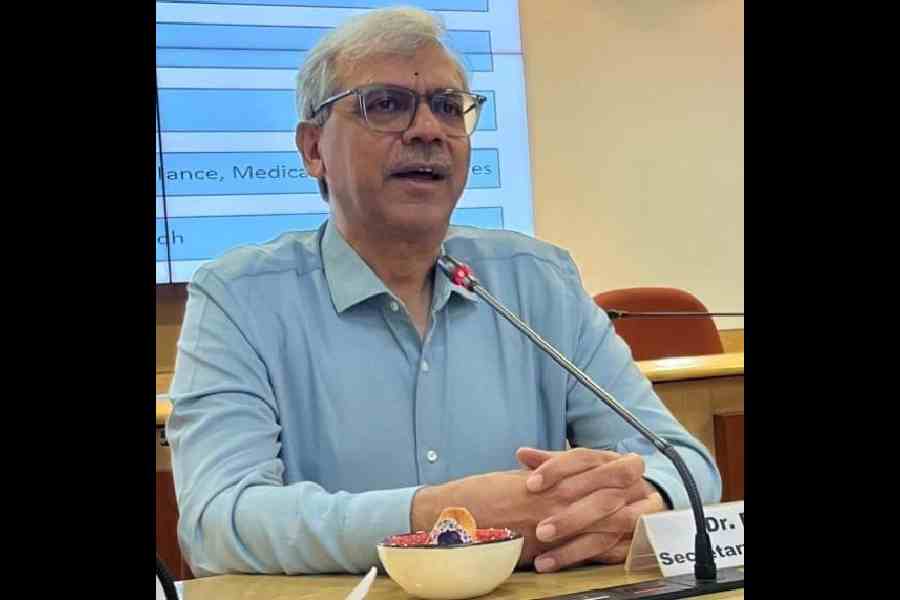
| SIGN OF THE TIMES: A collection on display at Autographex. Picture by Pradip Sanyal |
A scribble or a fine long stroke. Depending on whose hand the pen is in, it may become a real treasure. Though new-age Indians are a ferocious breed of autograph-hunters, autographs have no catalogued value here, neither is it an organised hobby.
“In India, autograph-collection is in its infancy. Though many people nurture the hobby in isolation, there is neither much interaction among them nor a single dealer in business,” says Prashant Arora, one of the founder-members of the Autograph Collectors Club of India, “the only forum of its kind in the country”. The club, set up in 1993 at the initiative of three collectors, organised its third exhibition, Autographex 2004, at Gaganendra Pradarshashala recently.
“The root of the problem is a lack of seriousness about the hobby. Whenever a celebrity is in sight, there are scores of hands that reach out to him or her with a scrap of paper. Most of them do it on the spur of the moment, show the trophy around for a month or so and then the autograph disappears from sight… Autographs are of great value, both educationally and materially,” explains Gopal Das Agarwal, convener of Autographex.
Agrees Nishant Singal, who is set to auction his collection on cricketers for charity later in July: “Attitude is a major handicap. Indians think it is juvenile to ask for an autograph, not realising that it is on the one hand a tribute to the person and on the other a piece of living history worth preserving.”
Kalyan Negal, secretary of Indian Philatelic Traders Association, who handles autographs only when they come on documents of a philatelist’s interest, lists three kinds of autographs: actual, favoured and studio. The first covers those that the personalities sign on documents involving their personal matters. He points out how a south Calcutta nursing home, where Satyajit Ray had been treated, has laminated the cheque he had signed. The second, the commonest variety, is solicited directly from a celebrity. The third, studio autographs, are signed in bulk, usually on photographs, and mailed to fans on request.
Comparing autographs to other collectibles, Negal points out how there are bodies like the Royal Philatelic Society of London to check the authenticity of a stamp. Catalogues are available with price guides. As for coins, regular seminars are held by the Numismatic Society of India. “But nothing is applicable to autographs.”
Yet, a look at the collections on display at Autographex showed how much a scribble can be worth. Consider the single entry by Patna collector Pradeep Jain — penned by George Bernard Shaw on September 30, 1941, it carries a few caustic lines typical of the Irish dramatist. Or the best of vintage Hollywood, Gregory Peck to Elizabeth Taylor, Anthony Hopkins to Dustin Hoffman, put up by Samidh Kumar Thakur.
The club, which has held autograph sessions with Shah Rukh Khan, Juhi Chawla, Anil Kapoor and R.K. Laxman for its 80-odd members, wants organisers of major events, like the Cricket Association of Bengal, to set aside a time slot for serious collectors. “It is humiliating to have to fight for your turn with those who never cared about the hobby,” says Singal.