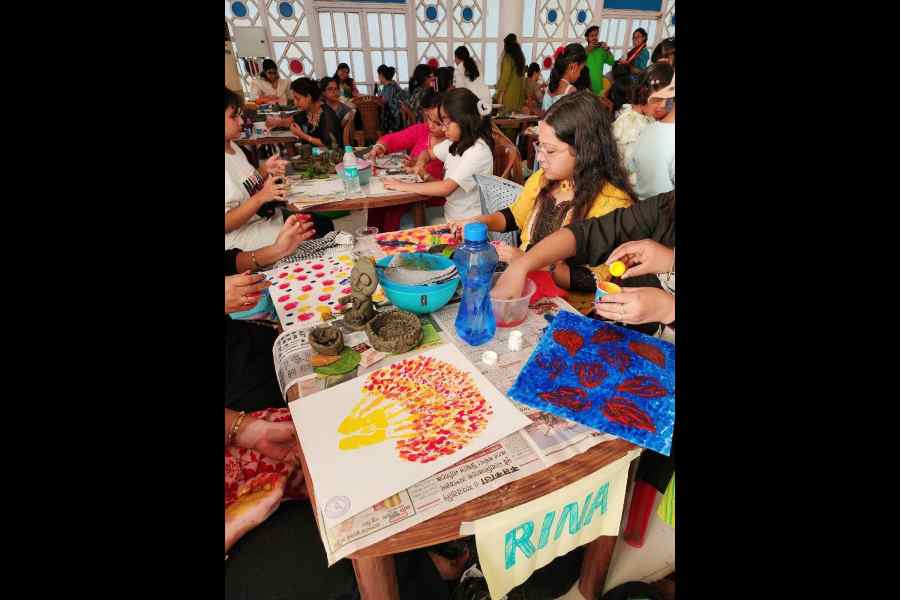
Over 80 participants came down to New Town’s Upasana Griha for a mental health workshop that was as much about pottery and finger painting as it was about motivational speeches.
Participants included artists, educators, homemakers, students, professionals and the curious. The initiative was taken by Mousumi Sarkar, founder of Bong Soulmates, a digital content platform that straddles lifestyle, culture and community narratives. “I had held a small-scale pottery workshop earlier at my Aldo Cafe, near City Centre which was a success. This time, we’re collaborating with Colour Bucket, an art institute with branches in Lake Town, Baguiati and Nagerbazar,” said Sarkar.
Participants were organised in small teams for the introductory pottery session, which started the day. Instructed by Subhadip Pandit, lead trainer at Colour Bucket and also Sarkar’s own art mentor, the session moved at an inclusive pace. Clay was distributed, wheels and tools were made available and guidance shared by the volunteers.
There was no pressure to produce polished artefacts and there was no competition. The message was that the creative process, rather than outcome, was more worthwhile.
In the second half, mental health professional Akshata Das addressed the group on stress, overthinking and anxiety, and offered tools for early recognition and management: grounding exercises, breathwork and routine physical activity.
“Arts such as pottery, finger painting, and drawing can do what talk therapy sometimes struggles with; the emergence of feeling without the burden of articulation,” she said. “The physical act of moulding clay or smearing colour, she said, engages different parts of the brain, offering an alternate route to emotional processing.”
There was also a finger painting session where participants were invited to use their fingers to express whatever arose. The absence of tools, brushes, stencils, seemed to democratise the space further. Some painted abstract forms, others faces, plants or symbols.
“The workshop made space for honest conversations, simple creative joy and for an entry point into complex topic,” said one of the participants, Priyanka Majumdar, who is a teacher at DPS New Town. “I enjoyed it and it was a respite for me from the chores of daily life. It removed some of the abstraction and intimidation associated with mental health discourse too.”
For Sarkar, the outcome felt aligned with her broader intention. “I started Bong Soulmates to create spaces, both online and offline, where people could share. It was just about making room for stories, silence, colour. That’s what today was about.”
For Pandit, the art instructor, the measure of success was grounded. “If someone walked in today thinking: ‘I can’t do this,’ and walked out thinking: ‘Maybe I can,’ that’s enough,” he smiled. “Art doesn’t solve problems per se but it shifts how we carry them.”
Play time
Anarta Newtown Theatre Group presented a wholesome show at the Upasana Griha recently.
The evening opened with Jayati Bandyopadhyay’s introduction, followed by Sanjib Bhattacharya’s inaugural song. The first audio drama was Tritiyo Nayan, written by Nirmalya Mallick, who is also president of the group, and directed by Jayati Bandyopadhyay. The subject played with myth and irony, about the third eye of goddess Durga going missing, that became a prism through which divine anxiety mirrored human absurdity.
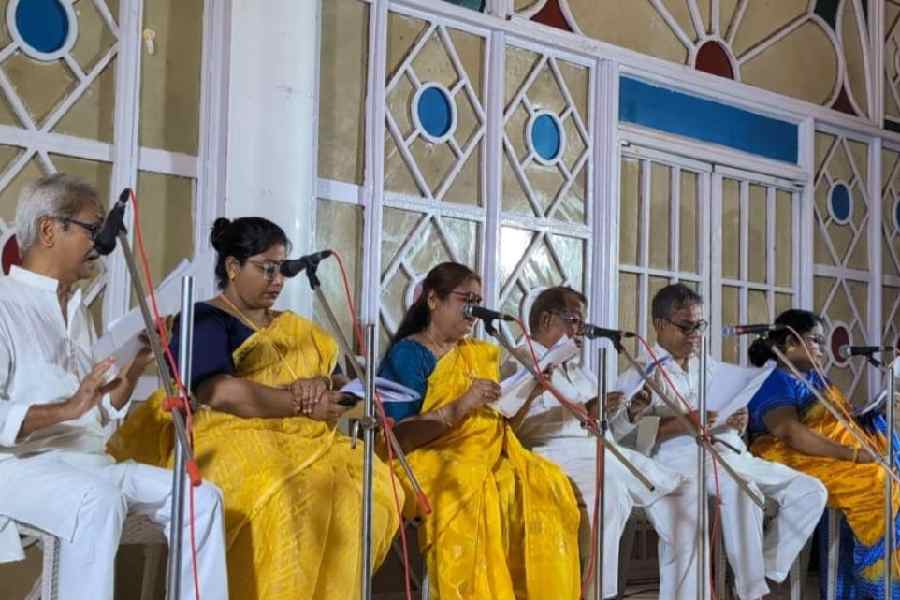
A moment from the show by Anarta theatre group at Upasana Griha
A more reflective tone surfaced in Bastuhara, penned by Soumitra Basu. The play evoked a world eroded by deforestation and urban encroachment. The third piece, Liquorer Khoje by Banani Mukhopadhyay, introduced linguistic play into the sequence. Its comedy derived from slips of the tongue, exposing how language misfires within everyday domestic hierarchies.
Minakshi Singha performed solo to Priyotomeshu Madhu. At 85, she portrayed Rebecca, wife of Michael Madhusudan Dutt. Her voice was frail but clear, and her silences articulate.
The evening concluded with Alokottoron, a collage of poetry and dance structured by Nabanita Konar and Debatree Mukherjee, choreographed by Parama Das, and directed by Bandyopadhyay. The work explored illumination as a slow emergence, using movement and verse as interdependent gestures.
Shanti Ranjan Sarkar’s sound design, consistent throughout the evening, lent the performance a sense of cohesion that bound the separate acts into one continuous listening experience.
Established in 2021, Anarta grew out of a desire among residents to create an artistic forum within their own neighbourhood. Among those early voices were Mallick and Pradip Dutta, of CC Block.
“Many of us carried fragments of earlier engagements with theatre, radio or recitation from our youth. Retirement or relocation had scattered these instincts. Anarta became a way to tether this energy and bring together individuals who wanted to act, write, perform, direct or simply watch theatre again,” Mallick explained.
“Theatre here is not pursued as an ambition,” added Dutta. “It is a form of continuity. Each performance is a small assertion of relevance vis-a-vis time.”