The Election Commission has appointed four senior IAS officers to the Bengal CEO’s office as “special roll observers” ahead of the hearings of voters whose filled-in enumeration forms show “logical discrepancies”.
These hearings, of about 40 lakh voters in the first leg, are expected to begin from January 14.
The appointments appear to reflect a poll panel effort to tighten the special intensive revision’s (SIR) processes at a time the Trinamool Congress has questioned the entire idea of summoning voters for “logical discrepancies” despite them featuring on the draft list.
The special roll observers, three of whom are from Delhi and one from Tripura, are not expected to be present at the hearings. They will check the enumeration forms and the documents furnished by voters at the hearings — after these have been uploaded.
“It’s clear that the poll panel will leave no stone unturned to ensure that no ineligible voter makes it to the (final) rolls even though Bengal’s ruling party is opposing the SIR heavily,” a senior poll panel official said.
“It (the commission) has also made it clear that it will not hesitate to initiate unusual steps to draw up error-free electoral rolls.”
Sailesh, deputy secretary with the National Health Authority; Sandeep Rewaji Rathod, director of the sports department in the youth affairs and sports ministry; Vikash Singh, director of empowerment of persons with disabilities with the social justice and empowerment ministry; and Ratan Biswas, director of census operations, Tripura; are the four special roll observers.
Though none in the poll panel officially clarified why all four IAS officers were from the Tripura cadre, a senior official said that the similarities the neighbouring states share perhaps prompted the poll panel to send the officials to Bengal.
“First, both states have similarities in food habits, culture and language. Second, both states face a similar kind of problem of infiltration from Bangladesh,” said the bureaucrat. The official also said another important point was that the officers were IAS cadres from a BJP-ruled state.
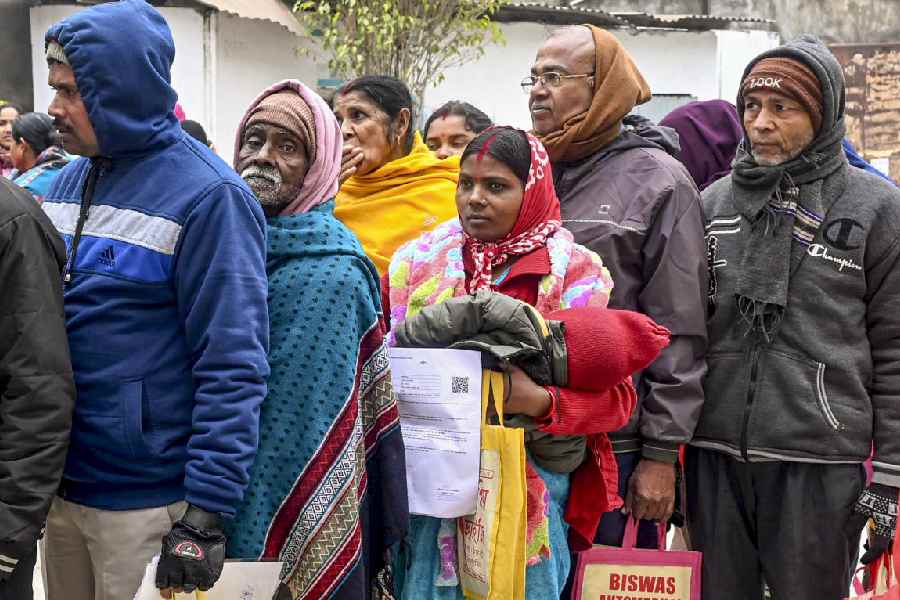
People queue up at an SIR hearing centre in Malda district on Friday. PTI picture
A poll panel official said: “They will assist the CEO (chief electoral officer of the state) with post-hearing issues. If required, the CEO can send them to the districts to take note of the ground realities (such as complaints about the conduct of hearings at specific centres).”
Earlier, another “special roll observer” had been appointed to CEO Manoj Kumar Agarwal’s office in Calcutta to generally oversee the SIR process. Unlike the current four, who are serving officers, Subrata Gupta is a retired IAS officer from the Bengal cadre.
The commission has already appointed 12 IAS officers from the Bengal cadre as “electoral roll observers” to monitor the SIR exercise in the districts. “Roll observers” too have been appointed, one for each of the five divisions (clusters of districts).
Apart from this, central government employees have been deployed in each of the 3,234 hearing centres as micro-observers.
“It has been decided that nearly 40 lakh voters with severe discrepancies — mainly errors in progeny mapping — will be called for hearing from January 14,” a bureaucrat said.
“As the ruling party was protesting against the summoning of voters with ‘logical discrepancies’, the appointment of these officials (special roll observers) just before the start of the hearings for these voters is interesting.”
Currently, the poll panel is conducting hearings for 32 lakh unmapped voters — those unable to link themselves or their parents or grandparents with the previous post-SIR rolls (prepared in 2002 in Bengal).
“So far, more than 25 lakh voters have been heard. The hearings of the rest of the unmapped voters are expected to be over in the next couple of days,” a source said.