Police on Wednesday registered a fresh case against nine persons on charges of assault, criminal intimidation, mischief, criminal trespass and criminal force against women in connection with the eye donation incident at Krishnanagar in Nadia, where a schoolteacher was arrested on Monday on charges of stealing the corneas of his deceased mother.
According to police sources, the new case against neighbours of arrested teacher Amir Chand Sekh was initiated on the basis of a complaint lodged by Abdur Razzak Mondal, his father-in-law and a key witness.
Sekh, known locally as a rationalist and social worker, was taken into custody on Monday after some of his neighbours allegedly assaulted him and his family members, accusing them of stealing the corneas and kidneys of his mother, Rabeya Bibi Sekh, shortly after her death on Sunday night.
The arrests of Amir and five more of his family members — centred around the extraction of Rabeya’s eyes in accordance with her prior organ donation pledge — triggered outrage among social workers and members of the organ donation movement across Bengal. Many questioned the cops and alleged that Amir’s arrest was made based on a “false complaint” instead of upholding the legality of organ donation.
On Wednesday, apparently responding to the mounting criticism, the police initiated a counter case taking cognisance of a complaint against the neighbours accused of creating trouble over the eye donation.
Amir’s father-in-law’s complaint stated: “After the eyes were extracted according to the pledge of the deceased woman, a group of persons gathered and attacked the family members of my son-in-law. They also beat me and outraged the modesty of the women present.”
Although his complaint was lodged on Monday, the police took cognisance of it only on Wednesday.
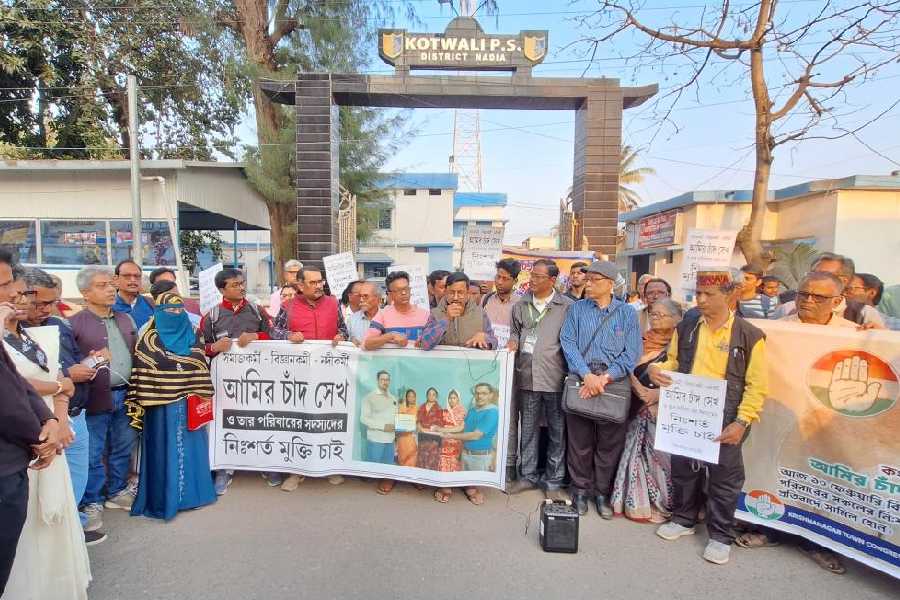
At least 20 organisation staged demonstration on Tuesday in front of Krishnanagar police station against the “mishandling” of the situation, to which cops had said they were “compelled” to arrest Amir and five of his family members primarily to “protect” them from a possible “lynching” attempt. Protesters did not buy this, saying protective custody did not justify formal arrest without evidence of wrongdoing.
On Wednesday, a senior officer of Krishnanagar police district told The Telegraph: “A case has been started against the main offenders involved in the organ donation controversy. No arrest has been made so far.”
Pratap Das, secretary of the West Bengal Nastik Mancha, who had participated in a march in Calcutta on Wednesday protesting Amir’s arrest, said: “It is good to learn that good sense has come back to the police. I hope that those named in the FIR are arrested soon.”
On Wednesday, police also revealed that the post-mortem report from JNM Hospital and College of Medicine, Kalyani, clearly stated that both kidneys of the deceased woman were found intact, contradicting allegations of the neighbours.
Senior police officers, speaking on condition of anonymity, acknowledged the “poor handling” of the situation and “unusual haste” in initiating a case without verifying the veracity of the complaint.
Social activist Sanjit Dutta said that by the time the police acted, the eyes had already been donated to the Murshidabad Medical College Hospital, which formally acknowledged it. “The police could have instantly verified the facts, but they tried to appease the offenders, which has damaged the spirit of the organ donation movement.”
Local sources claimed that the controversy had deeper roots. According to residents, some influential persons had wanted to construct a road through Amir’s yard, but he had refused to part with the land. Amir’s niece Rehena Khatun Bibi said that their entire family had consented to donate their eyes. Her family was targeted because “influential people did not get our land for the road”.
Amir and five others would be produced in court on Thursday.