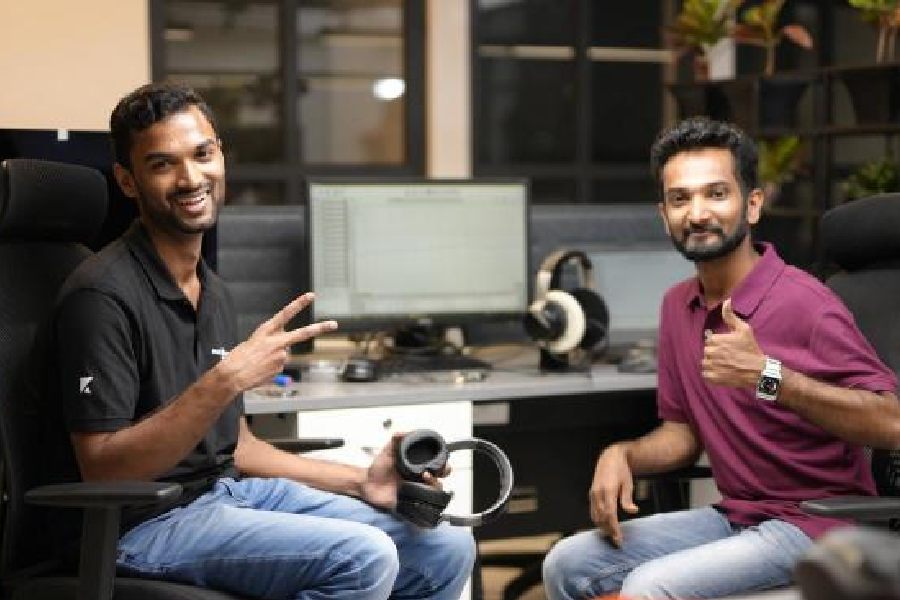
Rapture Innovation Labs has put Indian hardware innovation firmly on the global map. The company’s Sonic Lamb Gen 2 headphones won the CES Innovation Awards 2026 in the headphones and personal audio category, recognised for rethinking how sound is experienced. Co-founded by Navajith Karkera and Jagath Biddappa, the company is focused on building proprietary intellectual property.
Instead of relying solely on traditional audio delivery, Sonic Lamb combines acoustic output with physical sensation, turning bass into something users can feel. The win, presented by the Consumer Technology Association, marks a milestone not just for the company but for India’s deep-tech ambitions.
Karkera, CEO and co-founder, Rapture Innovation Labs, reflects on building a category-defining product from the ground up.
What did being recognised on a global stage — particularly at CES — mean for you and your team? Did it change how you saw yourselves?
Our core differentiation has always been the experience of sound — not just what you hear, but what you feel. Sonic Lamb was built on that idea, reimagining headphones as immersive sensory devices rather than just audio products.
Recognition at CES was a strong validation of that idea. It also meant something larger. Sonic Lamb became the first Indian audio-tech company to receive this recognition, which is significant because India is not traditionally known for building world-class audio hardware.
For our team, the moment was meaningful not because we “won”, but because it affirmed that globally competitive hardware innovation can come from India.
We now hold ourselves to the same standards as the world’s best — across innovation, quality, reliability, and customer experience.
Sonic Lamb wasn’t born out of Bengaluru or Silicon Valley, but Mangalore. How did building a hardware company outside a typical start-up hub influence your approach to innovation?
Building outside a typical start-up hub had clear disadvantages — we will not romanticise that. There was no convenience layer. No easy access to specialists, start-up-friendly vendors, or an ecosystem that makes mistakes cheaper. Everything took more effort: hiring, prototyping, sourcing, and learning through failure.
But we were not chasing trends or fitting into an investor thesis. We built because we believed in what we were making, and found a team that believed in it too. Outside the hub, we stayed anchored to the work.
That gave us an unexpected advantage: focus. In larger ecosystems, it is easy to get pulled into comparisons — who raised, who launched, who is hiring. That pressure can push you towards optics. We did not have that. We had clarity: build, test, improve, repeat.
Hardware rewards that mindset. You cannot pitch your way past reality — the product either works or it does not.
We also chose early to keep everything in-house — R&D, design, engineering, manufacturing, quality, CRM. From a Tier-2 city, that was not obvious, but it gave us control. Being close to manufacturing tightened feedback loops across materials, tolerances, reliability, and repeatability.
What personal frustration or curiosity sparked the original idea behind Sonic Lamb?
It started as a very personal gap in the listening experience. One of my earliest memories is listening to music on a high-end home theatre system my father had set up, the kind of sound that feels rich, full, alive. Not just heard, but felt. That stayed with me longer than I realised.
Years later, while studying engineering in Mangalore, Jagath and I looked for headphones that could replicate that experience across music, movies, and gaming. We could not find one. We also realised no Indian company was attempting to build at that level.
What shifted things was our curiosity as engineers. Through our research including work on hearing implants and helmet communication systems we kept coming back to an idea most headphones ignore: sound doesn’t just reach us through air and ears. It resonates through the body: skin, bone. That’s part of what makes a live concert or a great home theatre feel physical.
In 2019, almost as a weekend experiment, we tried to reproduce sound through all three pathways, air, skin, and bone, integrated into regular headphones. We weren’t trying to start a company. We were just chasing a sensation.
When it worked, it wasn’t a spec that told us but the experience itself. It triggered the same nostalgia from childhood, but now in something you could wear. We hadn’t set out to build a product, it was accidental, an experiment that surprised even us. But when people around us tried it, they loved it. And then they asked to order one. That moment, not a business plan, not a pitch, is what started Sonic Lamb.
How many prototypes did you go through before the product truly felt ‘right’? Was there a specific breakthrough?
Over 50 prototypes... each one humbling. A few factors made it difficult. First, we built our own impulse driver transducer from scratch, as off-the-shelf solutions could not deliver the experience.
Second, we repeatedly redesigned the internal architecture to make it manufacturable in India without compromise.
Third, firmware, materials, tolerances, assembly — every layer went through its own cycle.
The real breakthrough wasn’t making it vibrate, anyone can do that. It was getting the physical bass to feel controlled, musical, and in sync with the track. Impact without muddiness. Presence without distortion.
That took the longest. When we finally felt it, we knew we had something worth shipping.
What was the most expensive mistake you made in the early stages?
Outsourcing manufacturing. That was the most expensive lesson in time, money, and trust.
We initially handed production to an external partner. It seemed practical, but the attention to detail required for a premium product was missing. Tolerances were off, quality inconsistent, deadlines slipped. In hardware, delays compound quickly.
We made the harder call to set up our own plant.
It required more investment and responsibility, but gave us full control over quality, consistency, and timelines. In hindsight, it defined the company we became.
What structural changes does India need — in manufacturing, policy, or funding — to truly become a hardware powerhouse?
Three shifts are critical: deeper component supply chains, faster prototyping, testing, and certification infrastructure, and patient capital aligned with hardware timelines.
With stable policy support for manufacturing and R&D, India can move from assembly to original product innovation at scale.
Every founder story has unseen sacrifices. What did building Sonic Lamb cost you personally?
We chose this path, so I don’t look at it as a sacrifice. Building Sonic Lamb demanded time, focus, and a lot of trade-offs: less “balance” and more commitment, especially in the early years. Hardware needs that level of obsession because the product has to work in the real world, every single time. It’s intense, but it’s also a privilege to build something original with a team that backs your vision, and to see people genuinely feel what you created.
For young Indian engineers who want to build original hardware rather than copy existing products, what mindset shift is most important?
Shift from features to first principles and user experience. Do not ask: “What can I add?” Ask, “What is fundamentally missing, and why?”
Then commit to iteration. Original hardware is built through repeated testing, failure, and refinement — not a single breakthrough version.
What is the one thing aspiring hardware founders must be prepared to endure that no one warns them about?
The long, quiet stretches where you’re working hard but it feels like nothing is moving. Hardware progress is slow, expensive, and mostly invisible. You’ll spend months solving problems customers will never notice. The founders who win are the ones who can stay calm, keep iterating, and hold the standard even when there’s no external validation.